

a particular molecule at a specific wavelength of light. Its value is specific
to a particular chromophore in a particular environment and does not
depend on concentration or path length.
The extinction coefficient, however, is closely related to another optical
property that we have discussed—the refractive index. The extinction
coefficient is proportional to k, as
e l
ð Þ =
4πk
lc
(6.10)
where c is the concentration of chromophores. It can also be related to the
oscillator strength of a transition as
f = 4:3 Â 10
−9
ð
e n
ð Þdn
(6.11)
where the integral is over the absorption peak for which the transition is
being calculated. The extinction coefficient can be calculated from the
absorbance if the concentration of the material and the path length is
known, allowing further connecting of molecular and bulk properties.
In addition to solutions, UV/vis spectroscopy can also be used to characterize solid materials. If the path length and e of a sample are known,
then the density of the sample’s contents can be calculated from the
absorbance value. Alternatively, if the content density is known, then
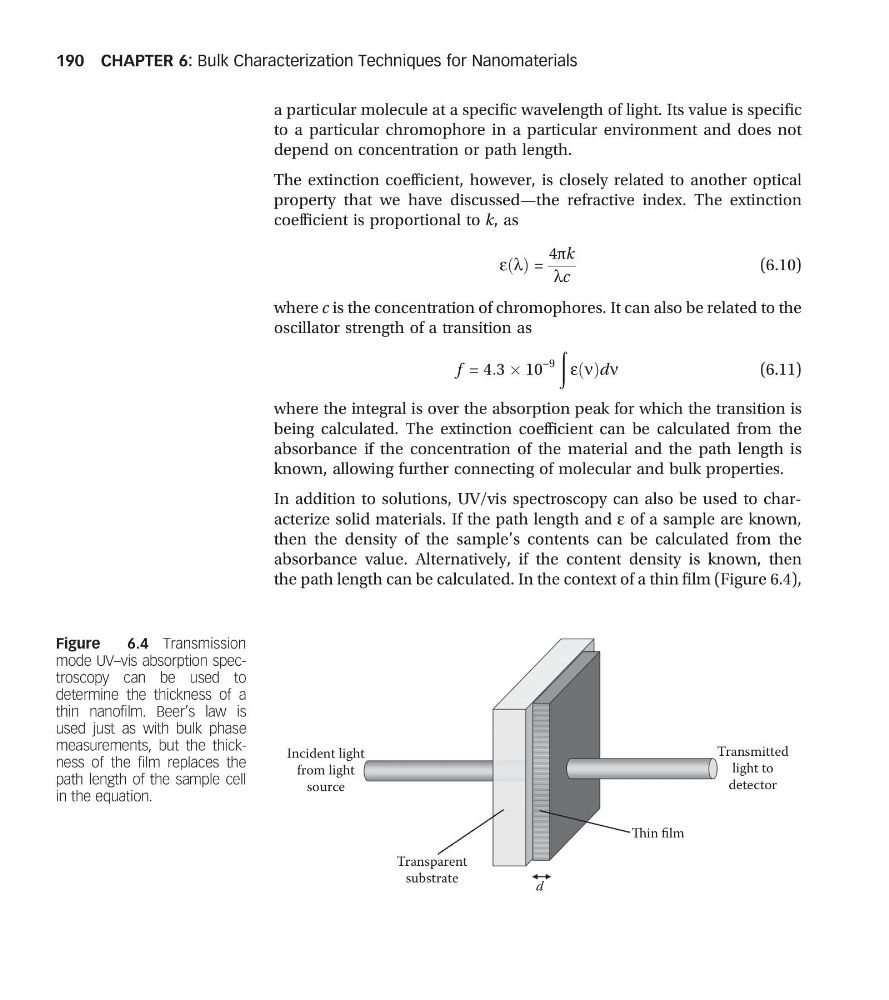
the path length can be calculated. In the context of a thin film (Figure 6.4),
Thin film
Transparent
substrate
d
Transmitted
light to
detector
Incident light
from light
source
Figure
6.4 Transmission
mode UV–vis absorption spectroscopy can be used to
determine the thickness of a
thin nanofilm. Beer’s law is
used just as with bulk phase
measurements, but the thickness of the film replaces the
path length of the sample cell
in the equation.
CHAPTER 6: Bulk Characterization Techniques for Nanomaterials
190
to a particular chromophore in a particular environment and does not
depend on concentration or path length.
The extinction coefficient, however, is closely related to another optical
property that we have discussed—the refractive index. The extinction
coefficient is proportional to k, as
e l
ð Þ =
4πk
lc
(6.10)
where c is the concentration of chromophores. It can also be related to the
oscillator strength of a transition as
f = 4:3 Â 10
−9
ð
e n
ð Þdn
(6.11)
where the integral is over the absorption peak for which the transition is
being calculated. The extinction coefficient can be calculated from the
absorbance if the concentration of the material and the path length is
known, allowing further connecting of molecular and bulk properties.
In addition to solutions, UV/vis spectroscopy can also be used to characterize solid materials. If the path length and e of a sample are known,
then the density of the sample’s contents can be calculated from the
absorbance value. Alternatively, if the content density is known, then
the path length can be calculated. In the context of a thin film (Figure 6.4),
Thin film
Transparent
substrate
d
Transmitted
light to
detector
Incident light
from light
source
Figure
6.4 Transmission
mode UV–vis absorption spectroscopy can be used to
determine the thickness of a
thin nanofilm. Beer’s law is
used just as with bulk phase
measurements, but the thickness of the film replaces the
path length of the sample cell
in the equation.
CHAPTER 6: Bulk Characterization Techniques for Nanomaterials
190