

photon in the ultraviolet and visible wavelength range (~190 nm to
800 nm) typically induces an electronic transition within the absorbing
molecule, promoting it from a low-energy ground state electron configuration to an excited state. The region of a molecule that absorbs the light
and contains the electrons that undergo the electronic transition is called
the chromophore. For example, the amine group –NH 2 absorbs light at a
wavelength of about 190 nm. The absorption causes an electron from the
lone pair on nitrogen to be excited into an antibonding molecular orbital.
This transition is denoted as n ! s*. For our purposes, we consider only
the amount of light absorbed and the corresponding absorption wavelength (l max ). The exact electronic nature of the transitions is less
important. It should be noted that the absorption by chromophores in a
given molecule depends on the exact electronic environment of the
chromophore within the molecule and its surrounding environment (e.g.,
solvent or surface). As a matter of convention, we also note that electronic
transitions are typically reported in terms of the wavelengths of light
(generally nm) that excite the transition.
All light that encounters a material either passes through it (transmission), is reflected off the surface of the material, or is absorbed by the
material. Therefore, if light is absorbed by a sample, the amount of light
transmitted through the sample as measured by the intensity or radiant
power of the beam decreases. The transmittance T of the sample is
defined as the ratio of the intensity of the beam after passing through the
sample (I) to the original intensity of the beam (I o ). The absorbance A of
the sample is defined as the negative logarithm of transmittance, as
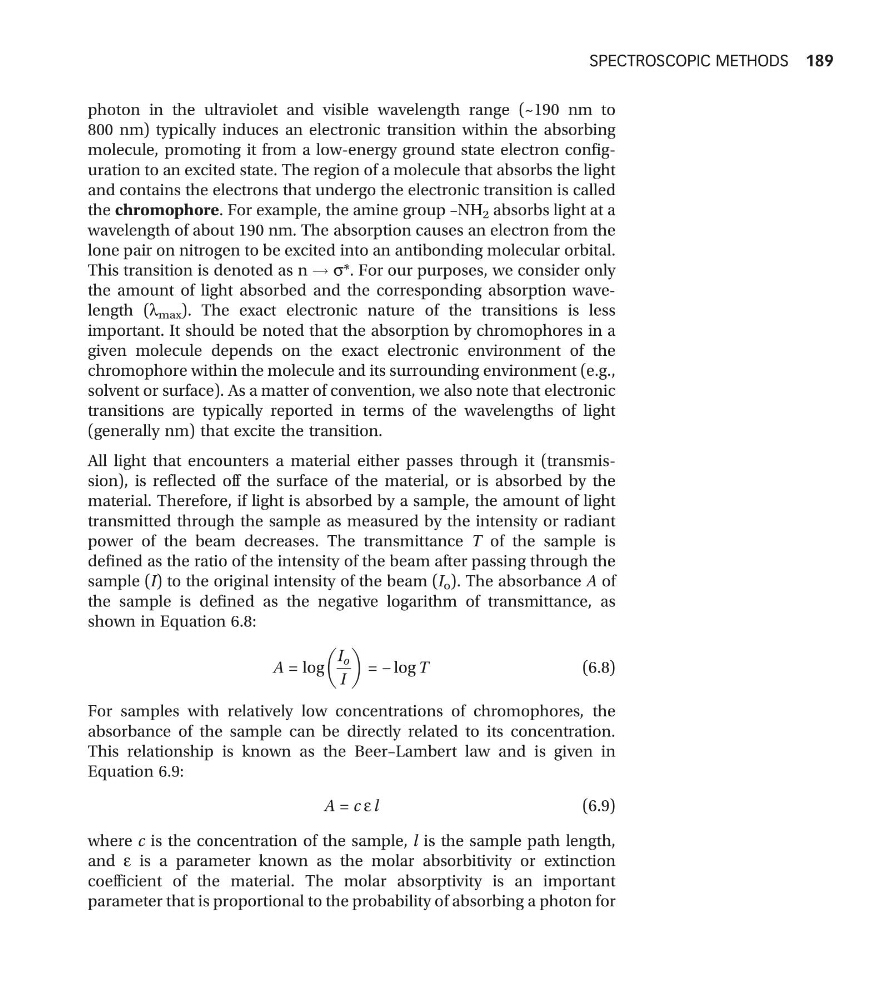
shown in Equation 6.8:
A = log
I o
I
= − log T
(6.8)
For samples with relatively low concentrations of chromophores, the
absorbance of the sample can be directly related to its concentration.
This relationship is known as the Beer–Lambert law and is given in
Equation 6.9:
A = c e l
(6.9)
where c is the concentration of the sample, l is the sample path length,
and e is a parameter known as the molar absorbitivity or extinction
coefficient of the material. The molar absorptivity is an important
parameter that is proportional to the probability of absorbing a photon for
SPECTROSCOPIC METHODS 189
800 nm) typically induces an electronic transition within the absorbing
molecule, promoting it from a low-energy ground state electron configuration to an excited state. The region of a molecule that absorbs the light
and contains the electrons that undergo the electronic transition is called
the chromophore. For example, the amine group –NH 2 absorbs light at a
wavelength of about 190 nm. The absorption causes an electron from the
lone pair on nitrogen to be excited into an antibonding molecular orbital.
This transition is denoted as n ! s*. For our purposes, we consider only
the amount of light absorbed and the corresponding absorption wavelength (l max ). The exact electronic nature of the transitions is less
important. It should be noted that the absorption by chromophores in a
given molecule depends on the exact electronic environment of the
chromophore within the molecule and its surrounding environment (e.g.,
solvent or surface). As a matter of convention, we also note that electronic
transitions are typically reported in terms of the wavelengths of light
(generally nm) that excite the transition.
All light that encounters a material either passes through it (transmission), is reflected off the surface of the material, or is absorbed by the
material. Therefore, if light is absorbed by a sample, the amount of light
transmitted through the sample as measured by the intensity or radiant
power of the beam decreases. The transmittance T of the sample is
defined as the ratio of the intensity of the beam after passing through the
sample (I) to the original intensity of the beam (I o ). The absorbance A of
the sample is defined as the negative logarithm of transmittance, as
shown in Equation 6.8:
A = log
I o
I
= − log T
(6.8)
For samples with relatively low concentrations of chromophores, the
absorbance of the sample can be directly related to its concentration.
This relationship is known as the Beer–Lambert law and is given in
Equation 6.9:
A = c e l
(6.9)
where c is the concentration of the sample, l is the sample path length,
and e is a parameter known as the molar absorbitivity or extinction
coefficient of the material. The molar absorptivity is an important
parameter that is proportional to the probability of absorbing a photon for
SPECTROSCOPIC METHODS 189