

“clouds” and quantum mechanical effects for which the derivation is
beyond the scope of this text.
What, then, is the size of an atom or a molecule? This is not a trivial
question. From the results of quantum mechanics, we realize that the
electron “clouds” of atoms and molecules do not have definite boundaries. Determining where an atom “ends” is therefore somewhat tricky. As
a result, radii of atoms are often experimentally defined, and depending
on the type of measurement made (and consequently the property
measured), a different result might be obtained. For example, one way to
measure the radii of atoms would be to assume that in solids they act as
tiny, hard spheres that have packed closely together (see Figure 5.8).
Using x-ray or neutron diffraction methods, one could then observe how
closely the atoms pack together in a crystal and thereby deduce the
atomic radius. The results of this method yield a type of atomic radius
called the hard sphere radius or van der Waals packing radius. Other
methods also exist, such as measuring the distance between two atoms in
a covalent bond (rather than the distance in a crystal). This method yields
the covalent bond radius. The atomic radius calculated depends on the
method used. In certain cases the results obtained from these different
methods might vary by as much as 30%. The type of measurement one
chooses to use generally depends on the type of system being studied.
After using the most suitable method to determine an atomic radius, one
can then calculate the overlap repulsion between two atoms. A variety of
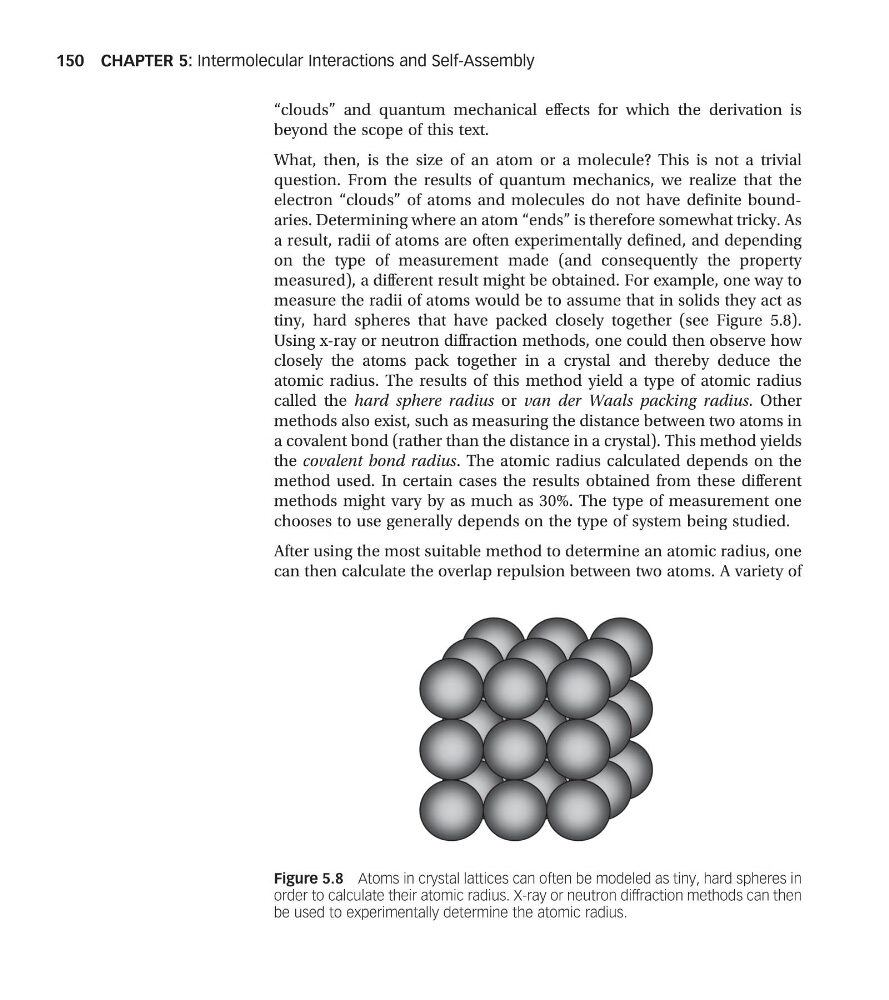
Figure 5.8 Atoms in crystal lattices can often be modeled as tiny, hard spheres in
order to calculate their atomic radius. X-ray or neutron diffraction methods can then
be used to experimentally determine the atomic radius.
CHAPTER 5: Intermolecular Interactions and Self-Assembly
150
beyond the scope of this text.
What, then, is the size of an atom or a molecule? This is not a trivial
question. From the results of quantum mechanics, we realize that the
electron “clouds” of atoms and molecules do not have definite boundaries. Determining where an atom “ends” is therefore somewhat tricky. As
a result, radii of atoms are often experimentally defined, and depending
on the type of measurement made (and consequently the property
measured), a different result might be obtained. For example, one way to
measure the radii of atoms would be to assume that in solids they act as
tiny, hard spheres that have packed closely together (see Figure 5.8).
Using x-ray or neutron diffraction methods, one could then observe how
closely the atoms pack together in a crystal and thereby deduce the
atomic radius. The results of this method yield a type of atomic radius
called the hard sphere radius or van der Waals packing radius. Other
methods also exist, such as measuring the distance between two atoms in
a covalent bond (rather than the distance in a crystal). This method yields
the covalent bond radius. The atomic radius calculated depends on the
method used. In certain cases the results obtained from these different
methods might vary by as much as 30%. The type of measurement one
chooses to use generally depends on the type of system being studied.
After using the most suitable method to determine an atomic radius, one
can then calculate the overlap repulsion between two atoms. A variety of
Figure 5.8 Atoms in crystal lattices can often be modeled as tiny, hard spheres in
order to calculate their atomic radius. X-ray or neutron diffraction methods can then
be used to experimentally determine the atomic radius.
CHAPTER 5: Intermolecular Interactions and Self-Assembly
150