

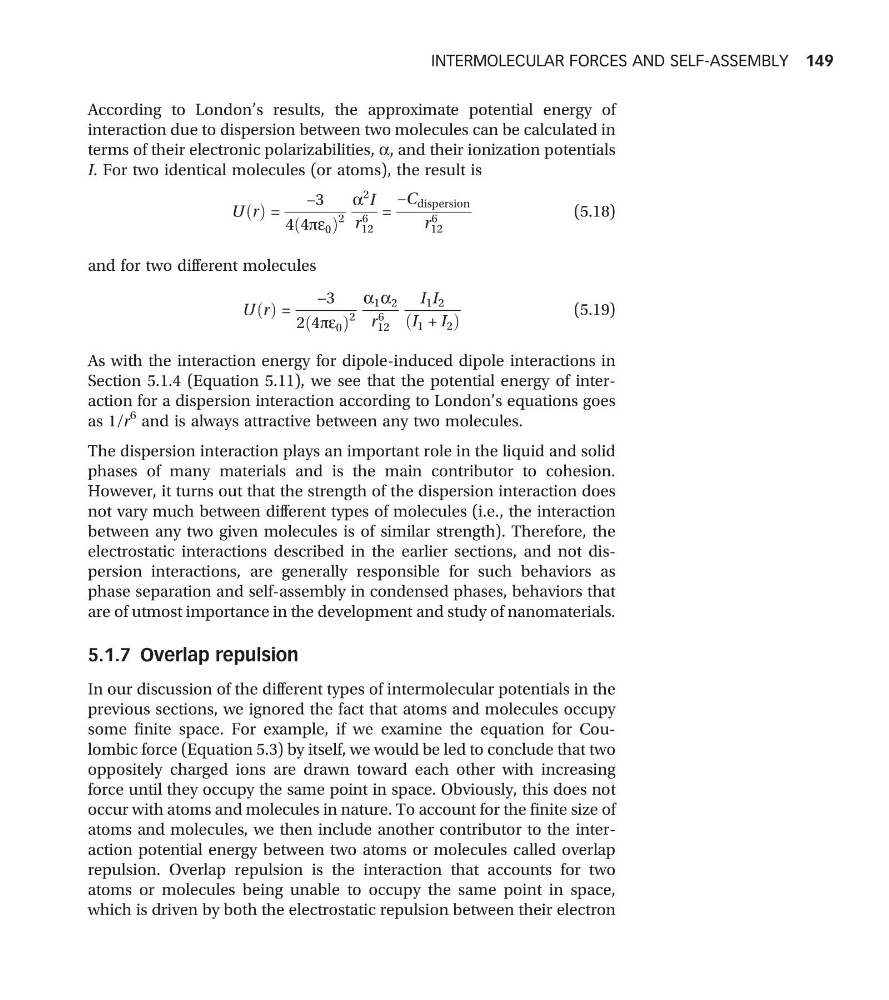
According to London’s results, the approximate potential energy of
interaction due to dispersion between two molecules can be calculated in
terms of their electronic polarizabilities, a, and their ionization potentials
I. For two identical molecules (or atoms), the result is
U r
ð Þ =
−3
4 4πe 0
ð
Þ
2
a
2 I
r
6
12
=
−C dispersion
r
6
12
(5.18)
and for two different molecules
U r
ð Þ =
−3
2 4πe 0
ð
Þ
2
a 1 a 2
r
6
12
I 1 I 2
I 1 + I 2
ð
Þ
(5.19)
As with the interaction energy for dipole-induced dipole interactions in
Section 5.1.4 (Equation 5.11), we see that the potential energy of interaction for a dispersion interaction according to London’s equations goes
as 1/r
6 and is always attractive between any two molecules.
The dispersion interaction plays an important role in the liquid and solid
phases of many materials and is the main contributor to cohesion.
However, it turns out that the strength of the dispersion interaction does
not vary much between different types of molecules (i.e., the interaction
between any two given molecules is of similar strength). Therefore, the
electrostatic interactions described in the earlier sections, and not dispersion interactions, are generally responsible for such behaviors as
phase separation and self-assembly in condensed phases, behaviors that
are of utmost importance in the development and study of nanomaterials.
5.1.7 Overlap repulsion
In our discussion of the different types of intermolecular potentials in the
previous sections, we ignored the fact that atoms and molecules occupy
some finite space. For example, if we examine the equation for Coulombic force (Equation 5.3) by itself, we would be led to conclude that two
oppositely charged ions are drawn toward each other with increasing
force until they occupy the same point in space. Obviously, this does not
occur with atoms and molecules in nature. To account for the finite size of
atoms and molecules, we then include another contributor to the interaction potential energy between two atoms or molecules called overlap
repulsion. Overlap repulsion is the interaction that accounts for two
atoms or molecules being unable to occupy the same point in space,
which is driven by both the electrostatic repulsion between their electron
INTERMOLECULAR FORCES AND SELF-ASSEMBLY 149
interaction due to dispersion between two molecules can be calculated in
terms of their electronic polarizabilities, a, and their ionization potentials
I. For two identical molecules (or atoms), the result is
U r
ð Þ =
−3
4 4πe 0
ð
Þ
2
a
2 I
r
6
12
=
−C dispersion
r
6
12
(5.18)
and for two different molecules
U r
ð Þ =
−3
2 4πe 0
ð
Þ
2
a 1 a 2
r
6
12
I 1 I 2
I 1 + I 2
ð
Þ
(5.19)
As with the interaction energy for dipole-induced dipole interactions in
Section 5.1.4 (Equation 5.11), we see that the potential energy of interaction for a dispersion interaction according to London’s equations goes
as 1/r
6 and is always attractive between any two molecules.
The dispersion interaction plays an important role in the liquid and solid
phases of many materials and is the main contributor to cohesion.
However, it turns out that the strength of the dispersion interaction does
not vary much between different types of molecules (i.e., the interaction
between any two given molecules is of similar strength). Therefore, the
electrostatic interactions described in the earlier sections, and not dispersion interactions, are generally responsible for such behaviors as
phase separation and self-assembly in condensed phases, behaviors that
are of utmost importance in the development and study of nanomaterials.
5.1.7 Overlap repulsion
In our discussion of the different types of intermolecular potentials in the
previous sections, we ignored the fact that atoms and molecules occupy
some finite space. For example, if we examine the equation for Coulombic force (Equation 5.3) by itself, we would be led to conclude that two
oppositely charged ions are drawn toward each other with increasing
force until they occupy the same point in space. Obviously, this does not
occur with atoms and molecules in nature. To account for the finite size of
atoms and molecules, we then include another contributor to the interaction potential energy between two atoms or molecules called overlap
repulsion. Overlap repulsion is the interaction that accounts for two
atoms or molecules being unable to occupy the same point in space,
which is driven by both the electrostatic repulsion between their electron
INTERMOLECULAR FORCES AND SELF-ASSEMBLY 149