

of atoms, molecules, or electrons, for which a rigorous examination is
beyond the scope of this text.
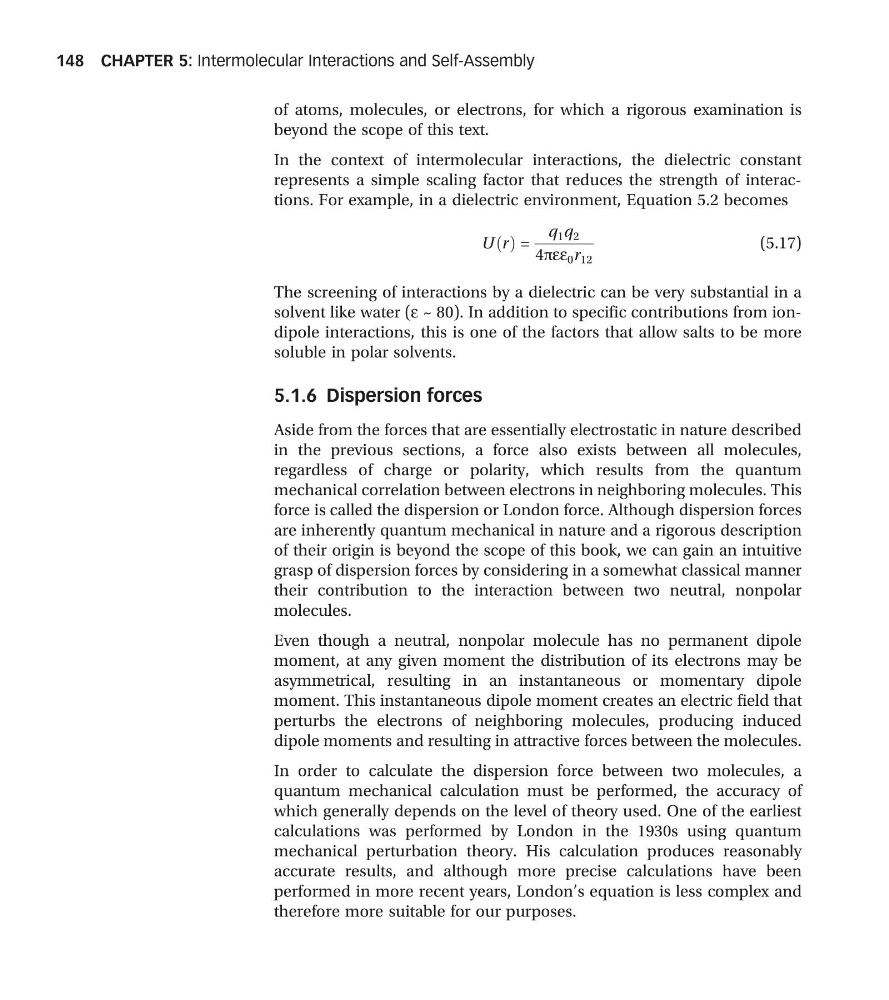
In the context of intermolecular interactions, the dielectric constant
represents a simple scaling factor that reduces the strength of interactions. For example, in a dielectric environment, Equation 5.2 becomes
U r
ð Þ =
q 1 q 2
4πee 0 r 12
(5.17)
The screening of interactions by a dielectric can be very substantial in a
solvent like water (e ~ 80). In addition to specific contributions from iondipole interactions, this is one of the factors that allow salts to be more
soluble in polar solvents.
5.1.6 Dispersion forces
Aside from the forces that are essentially electrostatic in nature described
in the previous sections, a force also exists between all molecules,
regardless of charge or polarity, which results from the quantum
mechanical correlation between electrons in neighboring molecules. This
force is called the dispersion or London force. Although dispersion forces
are inherently quantum mechanical in nature and a rigorous description
of their origin is beyond the scope of this book, we can gain an intuitive
grasp of dispersion forces by considering in a somewhat classical manner
their contribution to the interaction between two neutral, nonpolar
molecules.
Even though a neutral, nonpolar molecule has no permanent dipole
moment, at any given moment the distribution of its electrons may be
asymmetrical, resulting in an instantaneous or momentary dipole
moment. This instantaneous dipole moment creates an electric field that
perturbs the electrons of neighboring molecules, producing induced
dipole moments and resulting in attractive forces between the molecules.
In order to calculate the dispersion force between two molecules, a
quantum mechanical calculation must be performed, the accuracy of
which generally depends on the level of theory used. One of the earliest
calculations was performed by London in the 1930s using quantum
mechanical perturbation theory. His calculation produces reasonably
accurate results, and although more precise calculations have been
performed in more recent years, London’s equation is less complex and
therefore more suitable for our purposes.
CHAPTER 5: Intermolecular Interactions and Self-Assembly
148
beyond the scope of this text.
In the context of intermolecular interactions, the dielectric constant
represents a simple scaling factor that reduces the strength of interactions. For example, in a dielectric environment, Equation 5.2 becomes
U r
ð Þ =
q 1 q 2
4πee 0 r 12
(5.17)
The screening of interactions by a dielectric can be very substantial in a
solvent like water (e ~ 80). In addition to specific contributions from iondipole interactions, this is one of the factors that allow salts to be more
soluble in polar solvents.
5.1.6 Dispersion forces
Aside from the forces that are essentially electrostatic in nature described
in the previous sections, a force also exists between all molecules,
regardless of charge or polarity, which results from the quantum
mechanical correlation between electrons in neighboring molecules. This
force is called the dispersion or London force. Although dispersion forces
are inherently quantum mechanical in nature and a rigorous description
of their origin is beyond the scope of this book, we can gain an intuitive
grasp of dispersion forces by considering in a somewhat classical manner
their contribution to the interaction between two neutral, nonpolar
molecules.
Even though a neutral, nonpolar molecule has no permanent dipole
moment, at any given moment the distribution of its electrons may be
asymmetrical, resulting in an instantaneous or momentary dipole
moment. This instantaneous dipole moment creates an electric field that
perturbs the electrons of neighboring molecules, producing induced
dipole moments and resulting in attractive forces between the molecules.
In order to calculate the dispersion force between two molecules, a
quantum mechanical calculation must be performed, the accuracy of
which generally depends on the level of theory used. One of the earliest
calculations was performed by London in the 1930s using quantum
mechanical perturbation theory. His calculation produces reasonably
accurate results, and although more precise calculations have been
performed in more recent years, London’s equation is less complex and
therefore more suitable for our purposes.
CHAPTER 5: Intermolecular Interactions and Self-Assembly
148