

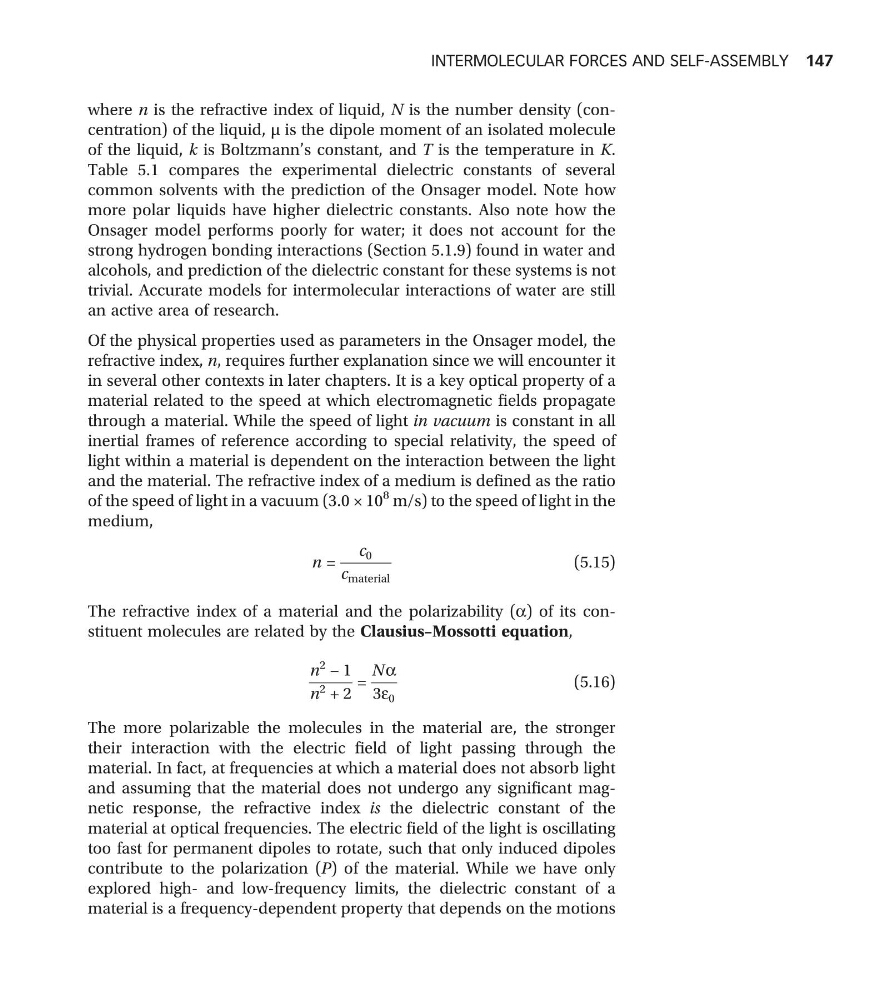
where n is the refractive index of liquid, N is the number density (concentration) of the liquid, μ is the dipole moment of an isolated molecule
of the liquid, k is Boltzmann’s constant, and T is the temperature in K.
Table 5.1 compares the experimental dielectric constants of several
common solvents with the prediction of the Onsager model. Note how
more polar liquids have higher dielectric constants. Also note how the
Onsager model performs poorly for water; it does not account for the
strong hydrogen bonding interactions (Section 5.1.9) found in water and
alcohols, and prediction of the dielectric constant for these systems is not
trivial. Accurate models for intermolecular interactions of water are still
an active area of research.
Of the physical properties used as parameters in the Onsager model, the
refractive index, n, requires further explanation since we will encounter it
in several other contexts in later chapters. It is a key optical property of a
material related to the speed at which electromagnetic fields propagate
through a material. While the speed of light in vacuum is constant in all
inertial frames of reference according to special relativity, the speed of
light within a material is dependent on the interaction between the light
and the material. The refractive index of a medium is defined as the ratio
of the speed of light in a vacuum (3.0 × 10
8 m/s) to the speed of light in the
medium,
n =
c 0
c material
(5.15)
The refractive index of a material and the polarizability (a) of its constituent molecules are related by the Clausius–Mossotti equation,
n
2
− 1
n
2 + 2
=
Na
3e 0
(5.16)
The more polarizable the molecules in the material are, the stronger
their interaction with the electric field of light passing through the
material. In fact, at frequencies at which a material does not absorb light
and assuming that the material does not undergo any significant magnetic response, the refractive index is the dielectric constant of the
material at optical frequencies. The electric field of the light is oscillating
too fast for permanent dipoles to rotate, such that only induced dipoles
contribute to the polarization (P) of the material. While we have only
explored high- and low-frequency limits, the dielectric constant of a
material is a frequency-dependent property that depends on the motions
INTERMOLECULAR FORCES AND SELF-ASSEMBLY 147
of the liquid, k is Boltzmann’s constant, and T is the temperature in K.
Table 5.1 compares the experimental dielectric constants of several
common solvents with the prediction of the Onsager model. Note how
more polar liquids have higher dielectric constants. Also note how the
Onsager model performs poorly for water; it does not account for the
strong hydrogen bonding interactions (Section 5.1.9) found in water and
alcohols, and prediction of the dielectric constant for these systems is not
trivial. Accurate models for intermolecular interactions of water are still
an active area of research.
Of the physical properties used as parameters in the Onsager model, the
refractive index, n, requires further explanation since we will encounter it
in several other contexts in later chapters. It is a key optical property of a
material related to the speed at which electromagnetic fields propagate
through a material. While the speed of light in vacuum is constant in all
inertial frames of reference according to special relativity, the speed of
light within a material is dependent on the interaction between the light
and the material. The refractive index of a medium is defined as the ratio
of the speed of light in a vacuum (3.0 × 10
8 m/s) to the speed of light in the
medium,
n =
c 0
c material
(5.15)
The refractive index of a material and the polarizability (a) of its constituent molecules are related by the Clausius–Mossotti equation,
n
2
− 1
n
2 + 2
=
Na
3e 0
(5.16)
The more polarizable the molecules in the material are, the stronger
their interaction with the electric field of light passing through the
material. In fact, at frequencies at which a material does not absorb light
and assuming that the material does not undergo any significant magnetic response, the refractive index is the dielectric constant of the
material at optical frequencies. The electric field of the light is oscillating
too fast for permanent dipoles to rotate, such that only induced dipoles
contribute to the polarization (P) of the material. While we have only
explored high- and low-frequency limits, the dielectric constant of a
material is a frequency-dependent property that depends on the motions
INTERMOLECULAR FORCES AND SELF-ASSEMBLY 147