

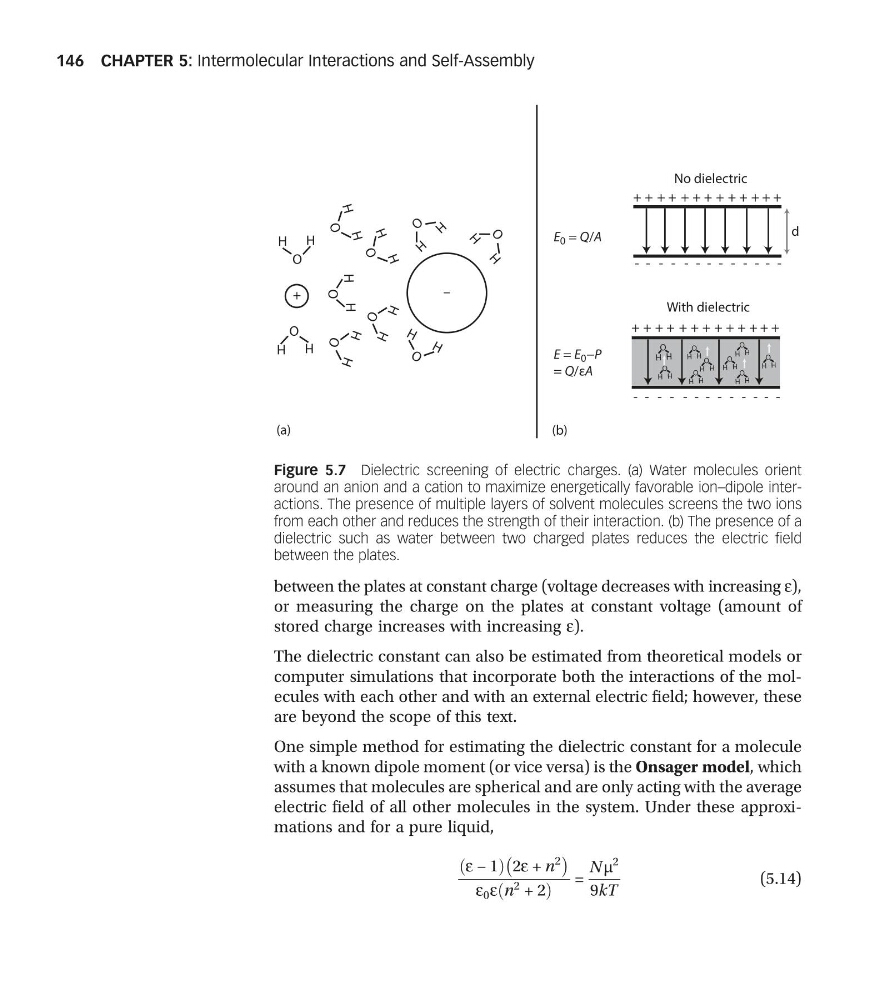
between the plates at constant charge (voltage decreases with increasing e),
or measuring the charge on the plates at constant voltage (amount of
stored charge increases with increasing e).
The dielectric constant can also be estimated from theoretical models or
computer simulations that incorporate both the interactions of the molecules with each other and with an external electric field; however, these
are beyond the scope of this text.
One simple method for estimating the dielectric constant for a molecule
with a known dipole moment (or vice versa) is the Onsager model, which
assumes that molecules are spherical and are only acting with the average
electric field of all other molecules in the system. Under these approximations and for a pure liquid,
e − 1
ð
Þ 2e + n
2
À
Á
e 0 e n
2 + 2
ð
Þ
=
Nμ
2
9kT
(5.14)
E 0 = Q/A
E = E 0 −P
= Q/εA
+ + + + + + + + + + + + +
- - - - - - - - - - - - -
+ + + + + + + + + + + + +
- - - - - - - - - - - - -
d
No dielectric
With dielectric
O
H H
O
H H
O
H H
O
H H
O
H
H
O
H
H
O
H
H
O
H
H
+
–
O
H
H
O H
H
O
H
H
O
H
H
O
H
H
O
H
H
O
H
H
O
H
H
O
H
H
O
H
H
O
H
H
(a)
(b)
Figure 5.7 Dielectric screening of electric charges. (a) Water molecules orient
around an anion and a cation to maximize energetically favorable ion–dipole interactions. The presence of multiple layers of solvent molecules screens the two ions
from each other and reduces the strength of their interaction. (b) The presence of a
dielectric such as water between two charged plates reduces the electric field
between the plates.
CHAPTER 5: Intermolecular Interactions and Self-Assembly
146
or measuring the charge on the plates at constant voltage (amount of
stored charge increases with increasing e).
The dielectric constant can also be estimated from theoretical models or
computer simulations that incorporate both the interactions of the molecules with each other and with an external electric field; however, these
are beyond the scope of this text.
One simple method for estimating the dielectric constant for a molecule
with a known dipole moment (or vice versa) is the Onsager model, which
assumes that molecules are spherical and are only acting with the average
electric field of all other molecules in the system. Under these approximations and for a pure liquid,
e − 1
ð
Þ 2e + n
2
À
Á
e 0 e n
2 + 2
ð
Þ
=
Nμ
2
9kT
(5.14)
E 0 = Q/A
E = E 0 −P
= Q/εA
+ + + + + + + + + + + + +
- - - - - - - - - - - - -
+ + + + + + + + + + + + +
- - - - - - - - - - - - -
d
No dielectric
With dielectric
O
H H
O
H H
O
H H
O
H H
O
H
H
O
H
H
O
H
H
O
H
H
+
–
O
H
H
O H
H
O
H
H
O
H
H
O
H
H
O
H
H
O
H
H
O
H
H
O
H
H
O
H
H
O
H
H
(a)
(b)
Figure 5.7 Dielectric screening of electric charges. (a) Water molecules orient
around an anion and a cation to maximize energetically favorable ion–dipole interactions. The presence of multiple layers of solvent molecules screens the two ions
from each other and reduces the strength of their interaction. (b) The presence of a
dielectric such as water between two charged plates reduces the electric field
between the plates.
CHAPTER 5: Intermolecular Interactions and Self-Assembly
146