

models with increasing sophistication and complexity are used to calculate the repulsive potential energy between two atoms due to overlap.
Perhaps the simplest model is to characterize the atom as a “hard sphere”
with a definite boundary (i.e., the repulsive force between two atoms
would be infinite at any distance smaller than the atomic radius). This
hard sphere model between two atoms at a distance r from each other can
be represented mathematically as
U r
ð Þ =
s
r
∞
(5.20)
where s is the atomic or molecular diameter (i.e., two times the atomic
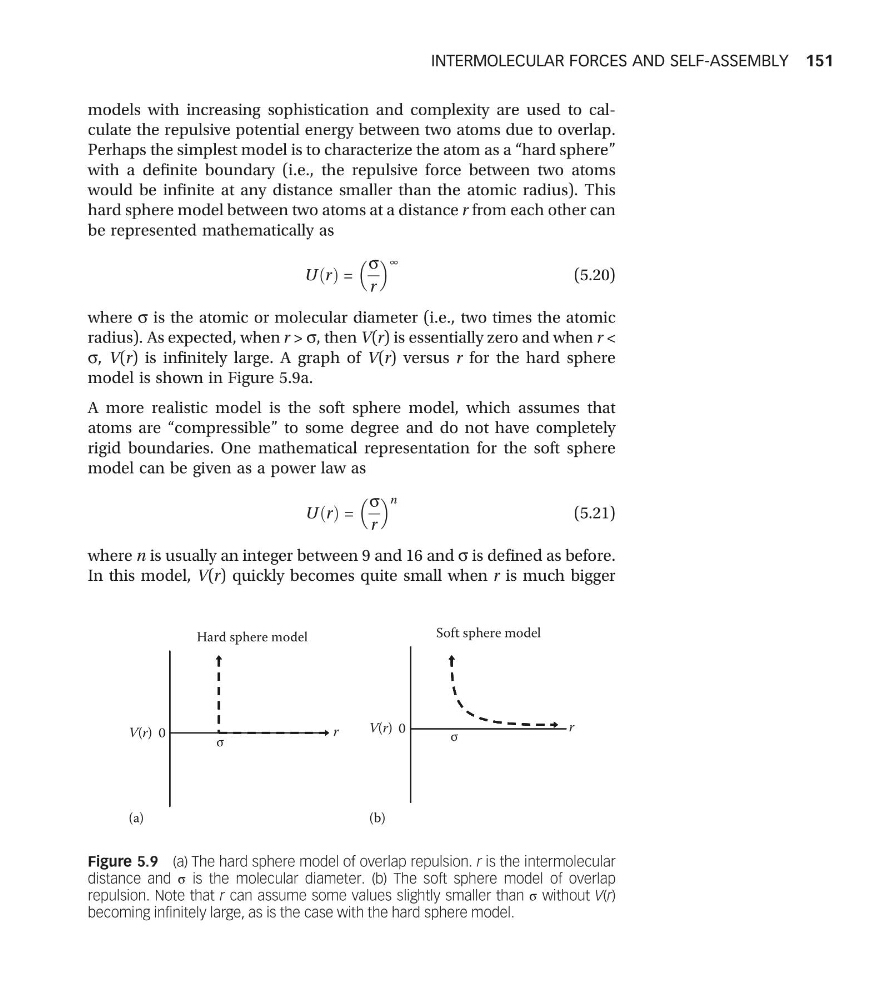
radius). As expected, when r > s, then V(r) is essentially zero and when r <
s, V(r) is infinitely large. A graph of V(r) versus r for the hard sphere
model is shown in Figure 5.9a.
A more realistic model is the soft sphere model, which assumes that
atoms are “compressible” to some degree and do not have completely
rigid boundaries. One mathematical representation for the soft sphere
model can be given as a power law as
U r
ð Þ =
s
r
n
(5.21)
where n is usually an integer between 9 and 16 and s is defined as before.
In this model, V(r) quickly becomes quite small when r is much bigger
(a)
Hard sphere model
V(r)
σ
r
0
(b)
Soft sphere model
V(r)
σ
r
0
Figure 5.9 (a) The hard sphere model of overlap repulsion. r is the intermolecular
distance and σ is the molecular diameter. (b) The soft sphere model of overlap
repulsion. Note that r can assume some values slightly smaller than σ without V(r)
becoming infinitely large, as is the case with the hard sphere model.
INTERMOLECULAR FORCES AND SELF-ASSEMBLY 151
Perhaps the simplest model is to characterize the atom as a “hard sphere”
with a definite boundary (i.e., the repulsive force between two atoms
would be infinite at any distance smaller than the atomic radius). This
hard sphere model between two atoms at a distance r from each other can
be represented mathematically as
U r
ð Þ =
s
r
∞
(5.20)
where s is the atomic or molecular diameter (i.e., two times the atomic
radius). As expected, when r > s, then V(r) is essentially zero and when r <
s, V(r) is infinitely large. A graph of V(r) versus r for the hard sphere
model is shown in Figure 5.9a.
A more realistic model is the soft sphere model, which assumes that
atoms are “compressible” to some degree and do not have completely
rigid boundaries. One mathematical representation for the soft sphere
model can be given as a power law as
U r
ð Þ =
s
r
n
(5.21)
where n is usually an integer between 9 and 16 and s is defined as before.
In this model, V(r) quickly becomes quite small when r is much bigger
(a)
Hard sphere model
V(r)
σ
r
0
(b)
Soft sphere model
V(r)
σ
r
0
Figure 5.9 (a) The hard sphere model of overlap repulsion. r is the intermolecular
distance and σ is the molecular diameter. (b) The soft sphere model of overlap
repulsion. Note that r can assume some values slightly smaller than σ without V(r)
becoming infinitely large, as is the case with the hard sphere model.
INTERMOLECULAR FORCES AND SELF-ASSEMBLY 151