

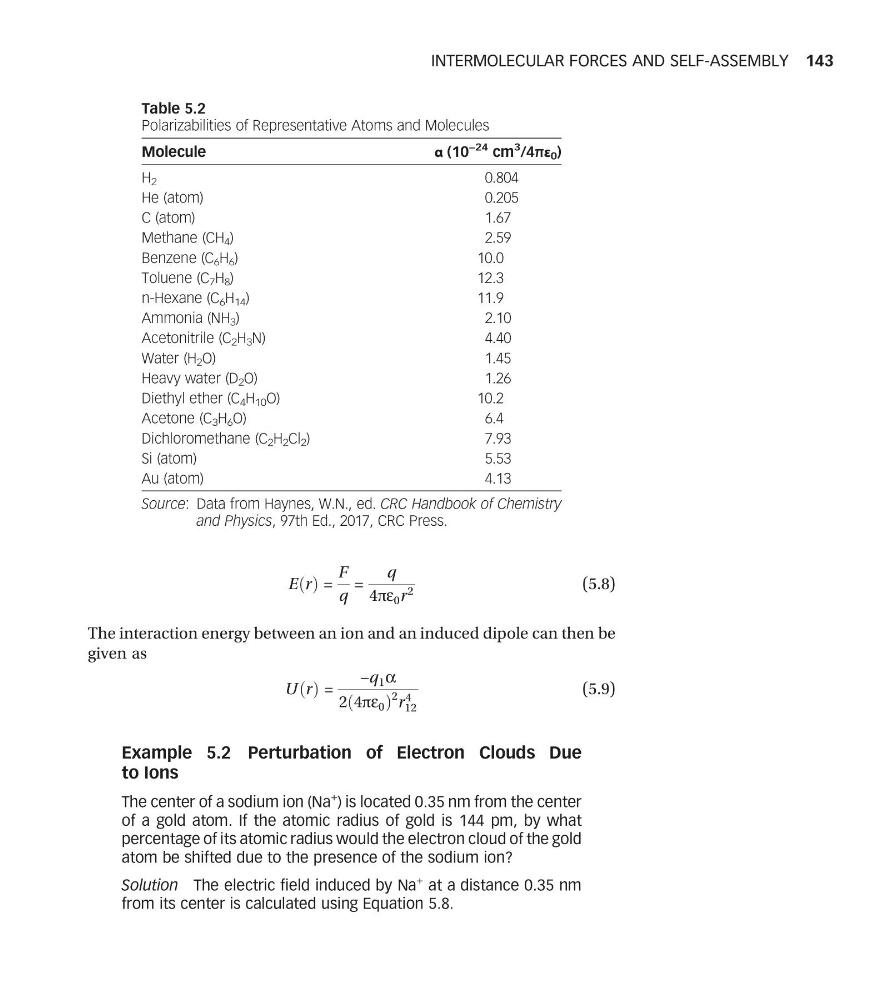
E r
ð Þ =
F
q
=
q
4πe 0 r
2
(5.8)
The interaction energy between an ion and an induced dipole can then be
given as
U r
ð Þ =
−q 1 a
2 4πe 0
ð
Þ
2 r
4
12
(5.9)
Example 5.2 Perturbation of Electron Clouds Due
to Ions
The center of a sodium ion (Na
+
) is located 0.35 nm from the center
of a gold atom. If the atomic radius of gold is 144 pm, by what
percentage of its atomic radius would the electron cloud of the gold
atom be shifted due to the presence of the sodium ion?
Solution The electric field induced by Na
+ at a distance 0.35 nm
from its center is calculated using Equation 5.8.
Table 5.2
Polarizabilities of Representative Atoms and Molecules
Molecule
α (10
−24 cm
3 /4πε 0 )
H 2
0.804
He (atom)
0.205
C (atom)
1.67
Methane (CH 4 )
2.59
Benzene (C 6 H 6 )
10.0
Toluene (C 7 H 8 )
12.3
n-Hexane (C 6 H 14 )
11.9
Ammonia (NH 3 )
2.10
Acetonitrile (C 2 H 3 N)
4.40
Water (H 2 O)
1.45
Heavy water (D 2 O)
1.26
Diethyl ether (C 4 H 10 O)
10.2
Acetone (C 3 H 6 O)
6.4
Dichloromethane (C 2 H 2 Cl 2 )
7.93
Si (atom)
5.53
Au (atom)
4.13
Source: Data from Haynes, W.N., ed. CRC Handbook of Chemistry
and Physics, 97th Ed., 2017, CRC Press.
INTERMOLECULAR FORCES AND SELF-ASSEMBLY 143
ð Þ =
F
q
=
q
4πe 0 r
2
(5.8)
The interaction energy between an ion and an induced dipole can then be
given as
U r
ð Þ =
−q 1 a
2 4πe 0
ð
Þ
2 r
4
12
(5.9)
Example 5.2 Perturbation of Electron Clouds Due
to Ions
The center of a sodium ion (Na
+
) is located 0.35 nm from the center
of a gold atom. If the atomic radius of gold is 144 pm, by what
percentage of its atomic radius would the electron cloud of the gold
atom be shifted due to the presence of the sodium ion?
Solution The electric field induced by Na
+ at a distance 0.35 nm
from its center is calculated using Equation 5.8.
Table 5.2
Polarizabilities of Representative Atoms and Molecules
Molecule
α (10
−24 cm
3 /4πε 0 )
H 2
0.804
He (atom)
0.205
C (atom)
1.67
Methane (CH 4 )
2.59
Benzene (C 6 H 6 )
10.0
Toluene (C 7 H 8 )
12.3
n-Hexane (C 6 H 14 )
11.9
Ammonia (NH 3 )
2.10
Acetonitrile (C 2 H 3 N)
4.40
Water (H 2 O)
1.45
Heavy water (D 2 O)
1.26
Diethyl ether (C 4 H 10 O)
10.2
Acetone (C 3 H 6 O)
6.4
Dichloromethane (C 2 H 2 Cl 2 )
7.93
Si (atom)
5.53
Au (atom)
4.13
Source: Data from Haynes, W.N., ed. CRC Handbook of Chemistry
and Physics, 97th Ed., 2017, CRC Press.
INTERMOLECULAR FORCES AND SELF-ASSEMBLY 143