

5.1.4 Interactions involving induced dipoles
When an ion approaches a nonpolar molecule, the electrons of the
nonpolar molecule experience the effect of the electric field produced by
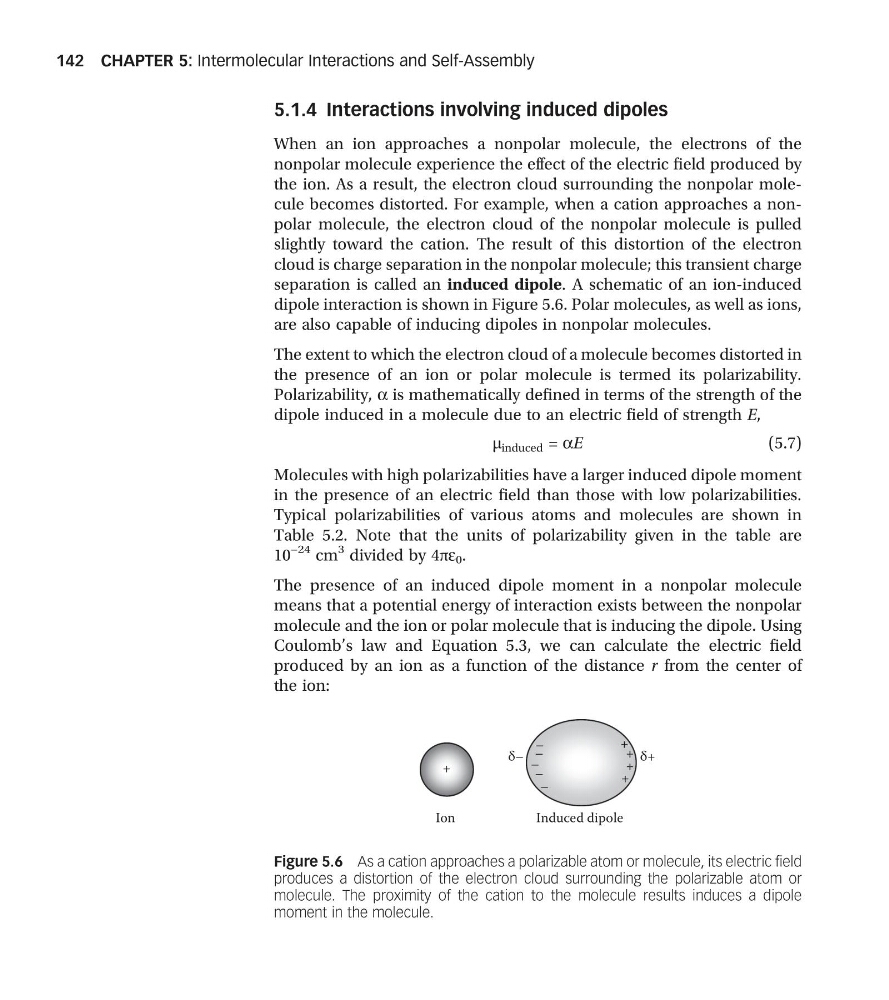
the ion. As a result, the electron cloud surrounding the nonpolar molecule becomes distorted. For example, when a cation approaches a nonpolar molecule, the electron cloud of the nonpolar molecule is pulled
slightly toward the cation. The result of this distortion of the electron
cloud is charge separation in the nonpolar molecule; this transient charge
separation is called an induced dipole. A schematic of an ion-induced
dipole interaction is shown in Figure 5.6. Polar molecules, as well as ions,
are also capable of inducing dipoles in nonpolar molecules.
The extent to which the electron cloud of a molecule becomes distorted in
the presence of an ion or polar molecule is termed its polarizability.
Polarizability, a is mathematically defined in terms of the strength of the
dipole induced in a molecule due to an electric field of strength E,
μ induced = aE
(5.7)
Molecules with high polarizabilities have a larger induced dipole moment
in the presence of an electric field than those with low polarizabilities.
Typical polarizabilities of various atoms and molecules are shown in
Table 5.2. Note that the units of polarizability given in the table are
10
−24 cm
3 divided by 4πe 0 .
The presence of an induced dipole moment in a nonpolar molecule
means that a potential energy of interaction exists between the nonpolar
molecule and the ion or polar molecule that is inducing the dipole. Using
Coulomb’s law and Equation 5.3, we can calculate the electric field
produced by an ion as a function of the distance r from the center of
the ion:
+
–
–
–
–
–
+
+
+
+
δ–
δ+
Ion
Induced dipole
Figure 5.6 As a cation approaches a polarizable atom or molecule, its electric field
produces a distortion of the electron cloud surrounding the polarizable atom or
molecule. The proximity of the cation to the molecule results induces a dipole
moment in the molecule.
CHAPTER 5: Intermolecular Interactions and Self-Assembly
142
When an ion approaches a nonpolar molecule, the electrons of the
nonpolar molecule experience the effect of the electric field produced by
the ion. As a result, the electron cloud surrounding the nonpolar molecule becomes distorted. For example, when a cation approaches a nonpolar molecule, the electron cloud of the nonpolar molecule is pulled
slightly toward the cation. The result of this distortion of the electron
cloud is charge separation in the nonpolar molecule; this transient charge
separation is called an induced dipole. A schematic of an ion-induced
dipole interaction is shown in Figure 5.6. Polar molecules, as well as ions,
are also capable of inducing dipoles in nonpolar molecules.
The extent to which the electron cloud of a molecule becomes distorted in
the presence of an ion or polar molecule is termed its polarizability.
Polarizability, a is mathematically defined in terms of the strength of the
dipole induced in a molecule due to an electric field of strength E,
μ induced = aE
(5.7)
Molecules with high polarizabilities have a larger induced dipole moment
in the presence of an electric field than those with low polarizabilities.
Typical polarizabilities of various atoms and molecules are shown in
Table 5.2. Note that the units of polarizability given in the table are
10
−24 cm
3 divided by 4πe 0 .
The presence of an induced dipole moment in a nonpolar molecule
means that a potential energy of interaction exists between the nonpolar
molecule and the ion or polar molecule that is inducing the dipole. Using
Coulomb’s law and Equation 5.3, we can calculate the electric field
produced by an ion as a function of the distance r from the center of
the ion:
+
–
–
–
–
–
+
+
+
+
δ–
δ+
Ion
Induced dipole
Figure 5.6 As a cation approaches a polarizable atom or molecule, its electric field
produces a distortion of the electron cloud surrounding the polarizable atom or
molecule. The proximity of the cation to the molecule results induces a dipole
moment in the molecule.
CHAPTER 5: Intermolecular Interactions and Self-Assembly
142