

E r
ð Þ =
q Na +
4πε 0 r
2
=
1:602 Â 10
−19
C
À
Á
4π 8:854 Â 10
−12
m −3 kg −1 s 4 A
2
À
Á
0:35 Â 10
−9
m
À
Á 2
= 1:18 Â 10
10 J
Cm
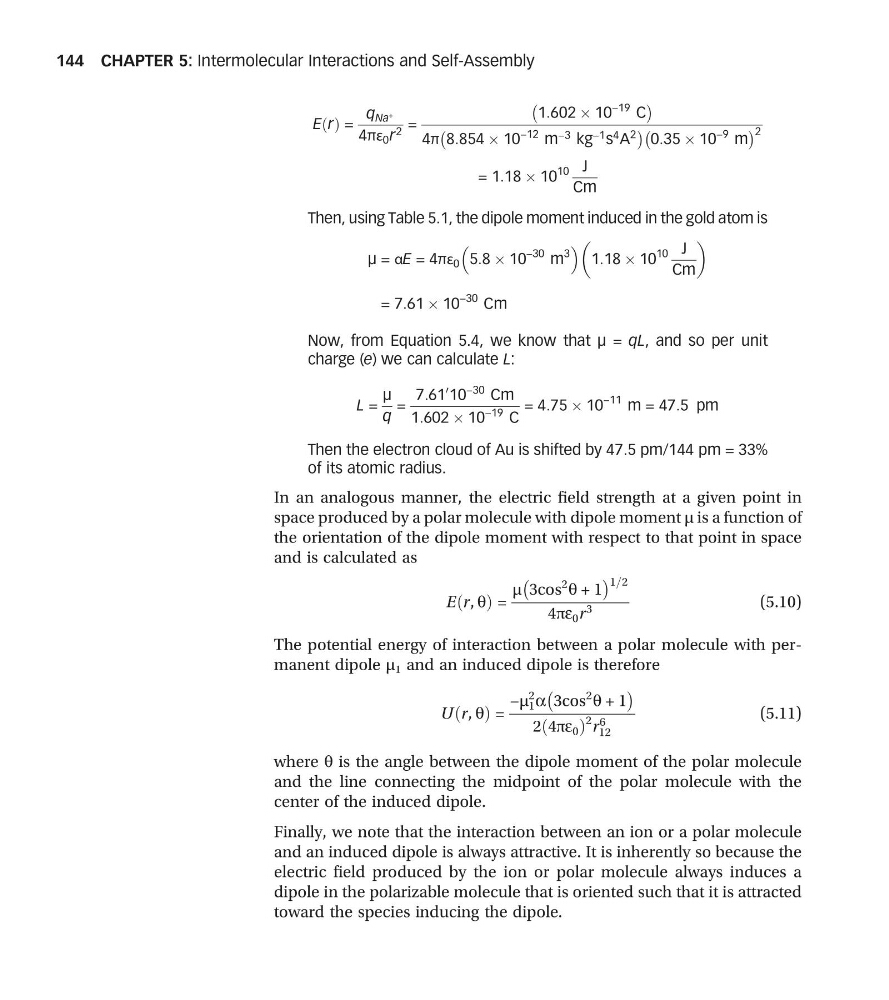
Then, using Table 5.1, the dipole moment induced in the gold atom is
μ = αE = 4πε 0 5:8 Â 10
−30
m
3
1:18 Â 10
10 J
Cm
= 7:61 Â 10
−30
Cm
Now, from Equation 5.4, we know that μ = qL, and so per unit
charge (e) we can calculate L:
L =
μ
q
=
7:61
0 10
−30
Cm
1:602 Â 10
−19
C
= 4:75 Â 10
−11 m = 47:5 pm
Then the electron cloud of Au is shifted by 47.5 pm/144 pm = 33%
of its atomic radius.
In an analogous manner, the electric field strength at a given point in
space produced by a polar molecule with dipole moment µ is a function of
the orientation of the dipole moment with respect to that point in space
and is calculated as
E r, q
ð Þ =
μ 3cos
2 q + 1
À
Á 1=2
4πe 0 r
3
(5.10)
The potential energy of interaction between a polar molecule with permanent dipole µ 1 and an induced dipole is therefore
U r, q
ð Þ =
−μ
2
1 a 3cos
2 q + 1
À
Á
2 4πe 0
ð
Þ
2 r
6
12
(5.11)
where q is the angle between the dipole moment of the polar molecule
and the line connecting the midpoint of the polar molecule with the
center of the induced dipole.
Finally, we note that the interaction between an ion or a polar molecule
and an induced dipole is always attractive. It is inherently so because the
electric field produced by the ion or polar molecule always induces a
dipole in the polarizable molecule that is oriented such that it is attracted
toward the species inducing the dipole.
CHAPTER 5: Intermolecular Interactions and Self-Assembly
144
ð Þ =
q Na +
4πε 0 r
2
=
1:602 Â 10
−19
C
À
Á
4π 8:854 Â 10
−12
m −3 kg −1 s 4 A
2
À
Á
0:35 Â 10
−9
m
À
Á 2
= 1:18 Â 10
10 J
Cm
Then, using Table 5.1, the dipole moment induced in the gold atom is
μ = αE = 4πε 0 5:8 Â 10
−30
m
3
1:18 Â 10
10 J
Cm
= 7:61 Â 10
−30
Cm
Now, from Equation 5.4, we know that μ = qL, and so per unit
charge (e) we can calculate L:
L =
μ
q
=
7:61
0 10
−30
Cm
1:602 Â 10
−19
C
= 4:75 Â 10
−11 m = 47:5 pm
Then the electron cloud of Au is shifted by 47.5 pm/144 pm = 33%
of its atomic radius.
In an analogous manner, the electric field strength at a given point in
space produced by a polar molecule with dipole moment µ is a function of
the orientation of the dipole moment with respect to that point in space
and is calculated as
E r, q
ð Þ =
μ 3cos
2 q + 1
À
Á 1=2
4πe 0 r
3
(5.10)
The potential energy of interaction between a polar molecule with permanent dipole µ 1 and an induced dipole is therefore
U r, q
ð Þ =
−μ
2
1 a 3cos
2 q + 1
À
Á
2 4πe 0
ð
Þ
2 r
6
12
(5.11)
where q is the angle between the dipole moment of the polar molecule
and the line connecting the midpoint of the polar molecule with the
center of the induced dipole.
Finally, we note that the interaction between an ion or a polar molecule
and an induced dipole is always attractive. It is inherently so because the
electric field produced by the ion or polar molecule always induces a
dipole in the polarizable molecule that is oriented such that it is attracted
toward the species inducing the dipole.
CHAPTER 5: Intermolecular Interactions and Self-Assembly
144