

the physicist’s convention), and one where the dipole is defined as
pointing toward the partial negative charge (sometimes called the
chemist’s convention). We will use the convention of the dipole pointing
toward the partial positive charge.
Polar molecules such as H 2 O are often characterized by their dipole
moment µ, which is defined for a single bonds as
μ = qL
(5.4)
where L is the distance separating the partial positive and partial negative
charges of magnitude q, as shown in Figure 5.3. The total dipole moment
of a molecule is the vector sum of the dipole moments of all of the bonds
within the molecule. Dipole moments of some common molecules are
shown in Table 5.1. As shown in the table, dipole moments are often given
in units of Debye (D), where 1 D = 3.336 × 10
−30 C m.
When an ion draws near to a molecule with a dipole, there is an electrostatic interaction between the dipole and the ionic species. The
potential energy of this interaction is given as
δ−
O
H
H
δ+
δ+
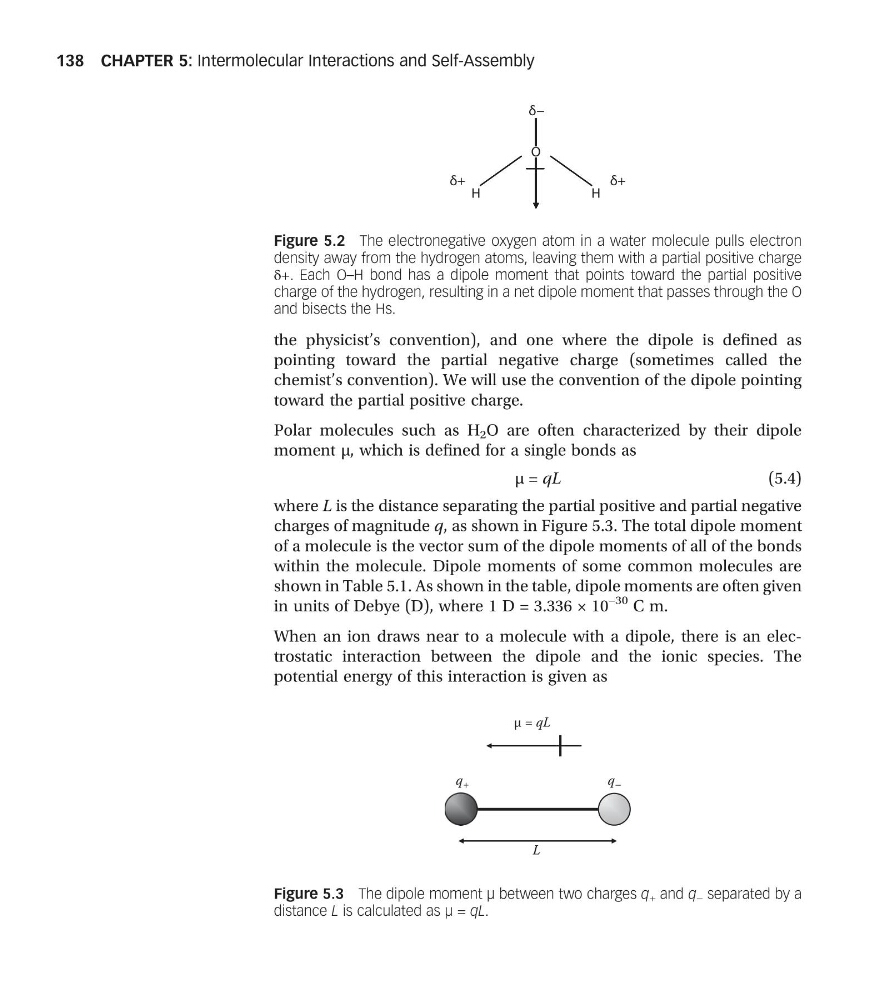
Figure 5.2 The electronegative oxygen atom in a water molecule pulls electron
density away from the hydrogen atoms, leaving them with a partial positive charge
δ+. Each O–H bond has a dipole moment that points toward the partial positive
charge of the hydrogen, resulting in a net dipole moment that passes through the O
and bisects the Hs.
q –
q +
L
μ = qL
Figure 5.3 The dipole moment µ between two charges q + and q − separated by a
distance L is calculated as µ = qL.
CHAPTER 5: Intermolecular Interactions and Self-Assembly
138
pointing toward the partial negative charge (sometimes called the
chemist’s convention). We will use the convention of the dipole pointing
toward the partial positive charge.
Polar molecules such as H 2 O are often characterized by their dipole
moment µ, which is defined for a single bonds as
μ = qL
(5.4)
where L is the distance separating the partial positive and partial negative
charges of magnitude q, as shown in Figure 5.3. The total dipole moment
of a molecule is the vector sum of the dipole moments of all of the bonds
within the molecule. Dipole moments of some common molecules are
shown in Table 5.1. As shown in the table, dipole moments are often given
in units of Debye (D), where 1 D = 3.336 × 10
−30 C m.
When an ion draws near to a molecule with a dipole, there is an electrostatic interaction between the dipole and the ionic species. The
potential energy of this interaction is given as
δ−
O
H
H
δ+
δ+
Figure 5.2 The electronegative oxygen atom in a water molecule pulls electron
density away from the hydrogen atoms, leaving them with a partial positive charge
δ+. Each O–H bond has a dipole moment that points toward the partial positive
charge of the hydrogen, resulting in a net dipole moment that passes through the O
and bisects the Hs.
q –
q +
L
μ = qL
Figure 5.3 The dipole moment µ between two charges q + and q − separated by a
distance L is calculated as µ = qL.
CHAPTER 5: Intermolecular Interactions and Self-Assembly
138