

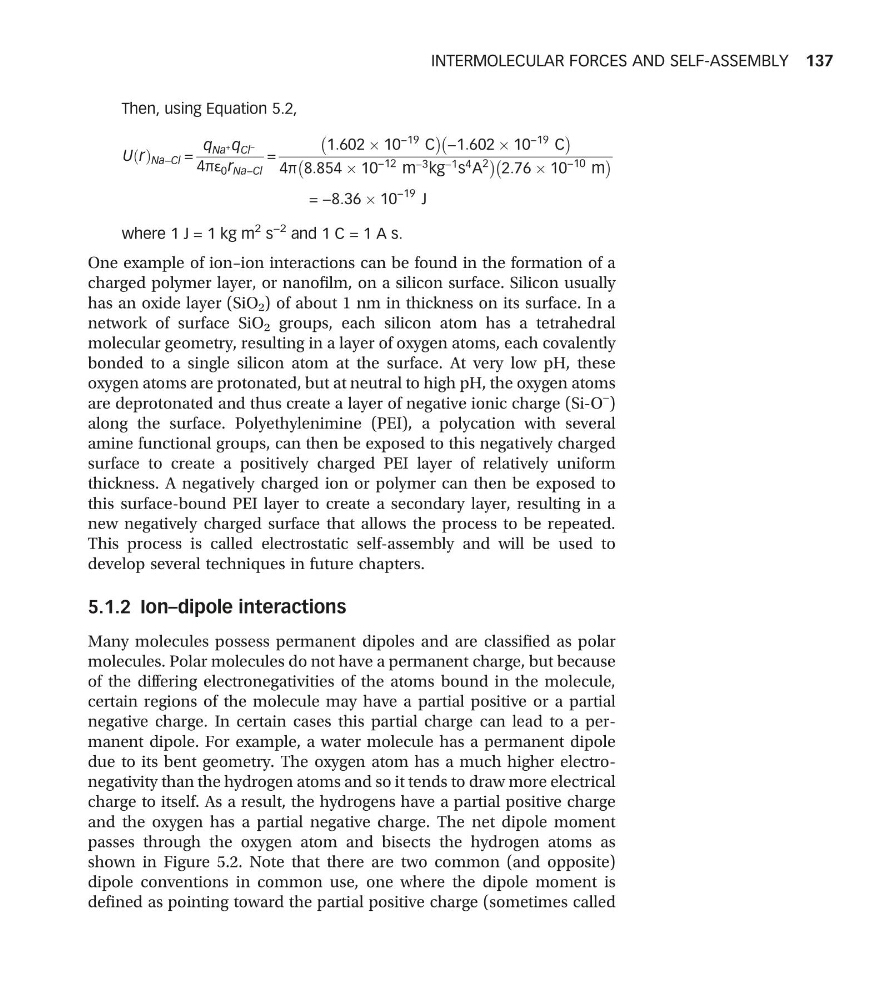
Then, using Equation 5.2,
U r
ð Þ Na−Cl =
q Na + q Cl −
4πε 0 r Na−Cl
=
1:602 Â 10
−19
C
À
Á −1:602 Â 10
−19
C
À
Á
4π 8:854 Â 10
−12
m
−3 kg
−1 s
4 A
2
À
Á
2:76 Â 10
−10
m
À
Á
= −8:36 Â 10
−19
J
where 1 J = 1 kg m
2 s
−2 and 1 C = 1 A s.
One example of ion–ion interactions can be found in the formation of a
charged polymer layer, or nanofilm, on a silicon surface. Silicon usually
has an oxide layer (SiO 2 ) of about 1 nm in thickness on its surface. In a
network of surface SiO 2 groups, each silicon atom has a tetrahedral
molecular geometry, resulting in a layer of oxygen atoms, each covalently
bonded to a single silicon atom at the surface. At very low pH, these
oxygen atoms are protonated, but at neutral to high pH, the oxygen atoms
are deprotonated and thus create a layer of negative ionic charge (Si-O
− )
along the surface. Polyethylenimine (PEI), a polycation with several
amine functional groups, can then be exposed to this negatively charged
surface to create a positively charged PEI layer of relatively uniform
thickness. A negatively charged ion or polymer can then be exposed to
this surface-bound PEI layer to create a secondary layer, resulting in a
new negatively charged surface that allows the process to be repeated.
This process is called electrostatic self-assembly and will be used to
develop several techniques in future chapters.
5.1.2 Ion–dipole interactions
Many molecules possess permanent dipoles and are classified as polar
molecules. Polar molecules do not have a permanent charge, but because
of the differing electronegativities of the atoms bound in the molecule,
certain regions of the molecule may have a partial positive or a partial
negative charge. In certain cases this partial charge can lead to a permanent dipole. For example, a water molecule has a permanent dipole
due to its bent geometry. The oxygen atom has a much higher electronegativity than the hydrogen atoms and so it tends to draw more electrical
charge to itself. As a result, the hydrogens have a partial positive charge
and the oxygen has a partial negative charge. The net dipole moment
passes through the oxygen atom and bisects the hydrogen atoms as
shown in Figure 5.2. Note that there are two common (and opposite)
dipole conventions in common use, one where the dipole moment is
defined as pointing toward the partial positive charge (sometimes called
INTERMOLECULAR FORCES AND SELF-ASSEMBLY 137
U r
ð Þ Na−Cl =
q Na + q Cl −
4πε 0 r Na−Cl
=
1:602 Â 10
−19
C
À
Á −1:602 Â 10
−19
C
À
Á
4π 8:854 Â 10
−12
m
−3 kg
−1 s
4 A
2
À
Á
2:76 Â 10
−10
m
À
Á
= −8:36 Â 10
−19
J
where 1 J = 1 kg m
2 s
−2 and 1 C = 1 A s.
One example of ion–ion interactions can be found in the formation of a
charged polymer layer, or nanofilm, on a silicon surface. Silicon usually
has an oxide layer (SiO 2 ) of about 1 nm in thickness on its surface. In a
network of surface SiO 2 groups, each silicon atom has a tetrahedral
molecular geometry, resulting in a layer of oxygen atoms, each covalently
bonded to a single silicon atom at the surface. At very low pH, these
oxygen atoms are protonated, but at neutral to high pH, the oxygen atoms
are deprotonated and thus create a layer of negative ionic charge (Si-O
− )
along the surface. Polyethylenimine (PEI), a polycation with several
amine functional groups, can then be exposed to this negatively charged
surface to create a positively charged PEI layer of relatively uniform
thickness. A negatively charged ion or polymer can then be exposed to
this surface-bound PEI layer to create a secondary layer, resulting in a
new negatively charged surface that allows the process to be repeated.
This process is called electrostatic self-assembly and will be used to
develop several techniques in future chapters.
5.1.2 Ion–dipole interactions
Many molecules possess permanent dipoles and are classified as polar
molecules. Polar molecules do not have a permanent charge, but because
of the differing electronegativities of the atoms bound in the molecule,
certain regions of the molecule may have a partial positive or a partial
negative charge. In certain cases this partial charge can lead to a permanent dipole. For example, a water molecule has a permanent dipole
due to its bent geometry. The oxygen atom has a much higher electronegativity than the hydrogen atoms and so it tends to draw more electrical
charge to itself. As a result, the hydrogens have a partial positive charge
and the oxygen has a partial negative charge. The net dipole moment
passes through the oxygen atom and bisects the hydrogen atoms as
shown in Figure 5.2. Note that there are two common (and opposite)
dipole conventions in common use, one where the dipole moment is
defined as pointing toward the partial positive charge (sometimes called
INTERMOLECULAR FORCES AND SELF-ASSEMBLY 137