

where e 0 is the permittivity of free space (8.854 × 10
−12 m
−3 kg
−1 s
4 A
2 ) and
r 12 is the distance between the two ionic species. For atomic or molecular
ions, q is often calculated as q = ze where z is the formal charge on the ion
and e is the charge on an electron, 1.60217 × 10
−19 C.
We can express the Coulombic force using the relationship between
potential energy and force (Equation 5.1) as
F r
ð Þ = −
dU r
ð Þ
dr
=
q 1 q 2
4πe 0 r
2
12
(5.3)
Equation 5.3 is obtained by differentiating Equation 5.2 and realizing that
d/dr(1/r) is −1/r
2
. From Equation 5.3, we see that the Coulombic force
between two ions changes as 1/r
2 . We also see that the force is negative
when the two ions are attracted to each other (when q 1 and q 2 have
opposite signs) and positive when they repel each other.
Example 5.1 The Coulombic Energy between Ions
The ionic radius of Na
+ is determined to be 95 pm and the ionic
radius of Cl
− is 181 pm. Calculate the Coulombic energy between
two isolated ions of Na
+ and Cl
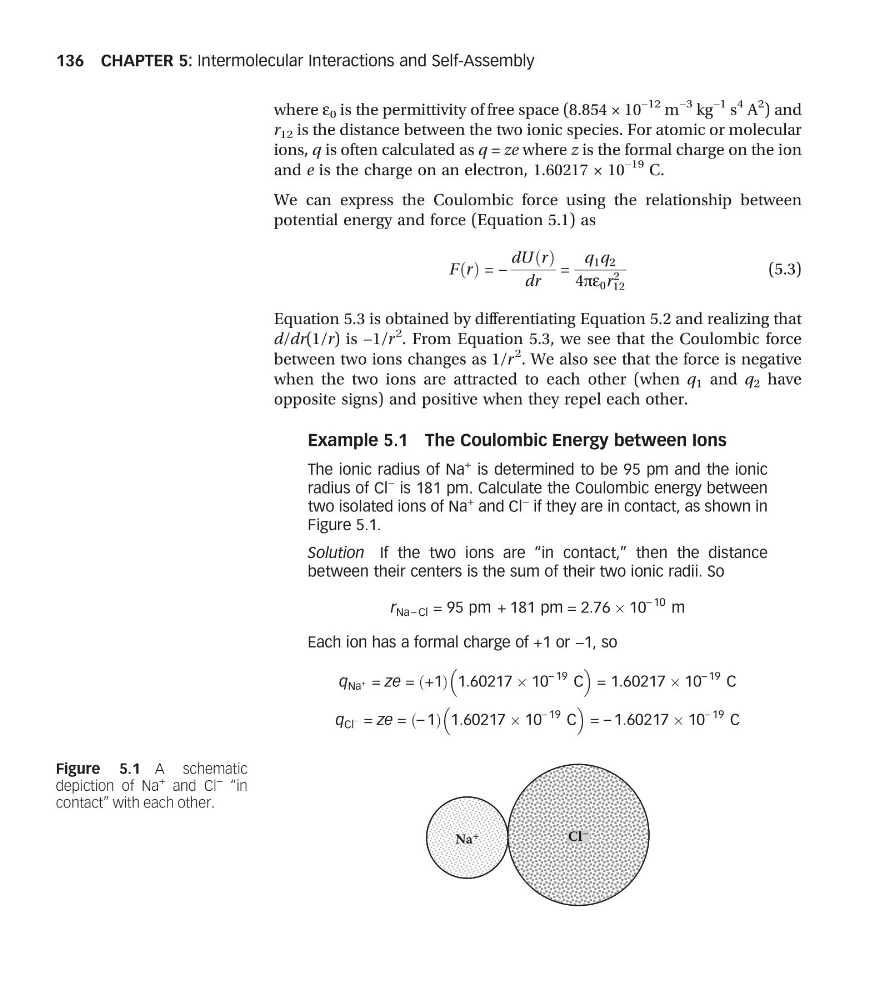
− if they are in contact, as shown in
Figure 5.1.
Solution If the two ions are “in contact,” then the distance
between their centers is the sum of their two ionic radii. So
r Na – Cl = 95 pm + 181 pm = 2:76 Â 10
– 10
m
Each ion has a formal charge of +1 or −1, so
q Na
+ = ze = +1
ð Þ 1:60217 Â 10
– 19
C
= 1:60217 Â 10
– 19
C
q Cl
– = ze = – 1
ð Þ 1:60217 Â 10
– 19 C
= – 1:60217 Â 10
– 19 C
Na +
Cl –
Figure 5.1 A schematic
depiction of Na
+ and Cl
− “in
contact” with each other.
CHAPTER 5: Intermolecular Interactions and Self-Assembly
136
−12 m
−3 kg
−1 s
4 A
2 ) and
r 12 is the distance between the two ionic species. For atomic or molecular
ions, q is often calculated as q = ze where z is the formal charge on the ion
and e is the charge on an electron, 1.60217 × 10
−19 C.
We can express the Coulombic force using the relationship between
potential energy and force (Equation 5.1) as
F r
ð Þ = −
dU r
ð Þ
dr
=
q 1 q 2
4πe 0 r
2
12
(5.3)
Equation 5.3 is obtained by differentiating Equation 5.2 and realizing that
d/dr(1/r) is −1/r
2
. From Equation 5.3, we see that the Coulombic force
between two ions changes as 1/r
2 . We also see that the force is negative
when the two ions are attracted to each other (when q 1 and q 2 have
opposite signs) and positive when they repel each other.
Example 5.1 The Coulombic Energy between Ions
The ionic radius of Na
+ is determined to be 95 pm and the ionic
radius of Cl
− is 181 pm. Calculate the Coulombic energy between
two isolated ions of Na
+ and Cl
− if they are in contact, as shown in
Figure 5.1.
Solution If the two ions are “in contact,” then the distance
between their centers is the sum of their two ionic radii. So
r Na – Cl = 95 pm + 181 pm = 2:76 Â 10
– 10
m
Each ion has a formal charge of +1 or −1, so
q Na
+ = ze = +1
ð Þ 1:60217 Â 10
– 19
C
= 1:60217 Â 10
– 19
C
q Cl
– = ze = – 1
ð Þ 1:60217 Â 10
– 19 C
= – 1:60217 Â 10
– 19 C
Na +
Cl –
Figure 5.1 A schematic
depiction of Na
+ and Cl
− “in
contact” with each other.
CHAPTER 5: Intermolecular Interactions and Self-Assembly
136