

energy of the interacting molecules increases with increasing r, the force
will tend to move it toward smaller r to decrease the potential energy.
The van der Waals interaction is the collective term used to describe
attractive or repulsive forces, or noncovalent interactions, between molecules. Named after Dutch scientist Johannes Diderick van der Waals, this
type of intermolecular interaction generally refers to molecules involving
ion–ion, ion–dipole, dipole–dipole forces, and interactions involving
induced dipoles (including London dispersion forces). van der Waals
forces play a key role in biology, polymer science, surface science,
nanotechnology, and material science. They govern self-assembly processes, protein–protein interactions, and crystallization processes. These
interactions are also found in nature. For example, the ability of geckos to
climb smooth surfaces (such as glass) is attributed to van der Waals
interactions and likely involves a nanofilm of water trapped between the
glass surface and the foot. In fact, research is currently being done in
many nanoscience laboratories to mimic this behavior and allow people
to scale walls or to create “gecko tape” that exploits this ability.
Geckos possess the ability to cling to nearly any surface, sometimes even
by a single toe, because they have millions of branching hairs called setae
on their toepads that present enough surface area for van der Waals
interactions to have an influence at the macroscopic scale. Recent
advances in nanotechnology have yielded reusable “adhesives” that are
four times more “adhesive” than a gecko’s foot. These adhesives are
comprised of flexible polymers connected by silicon bases to carbon
nanotubes, which are cylindrical graphene columns held together by van
der Waals interactions. Structure, properties, and uses of carbon
nanotubes will be further discussed in Chapter 9.
5.1.1 Ion–ion interactions
Ion–ion forces are perhaps the most well-known intermolecular forces
and are among the strongest intermolecular forces of those we’ll be discussing. Ion–ion forces arise between two ionic (charged) species, such as
the force between Na
+ and Cl
− that holds together crystals of common
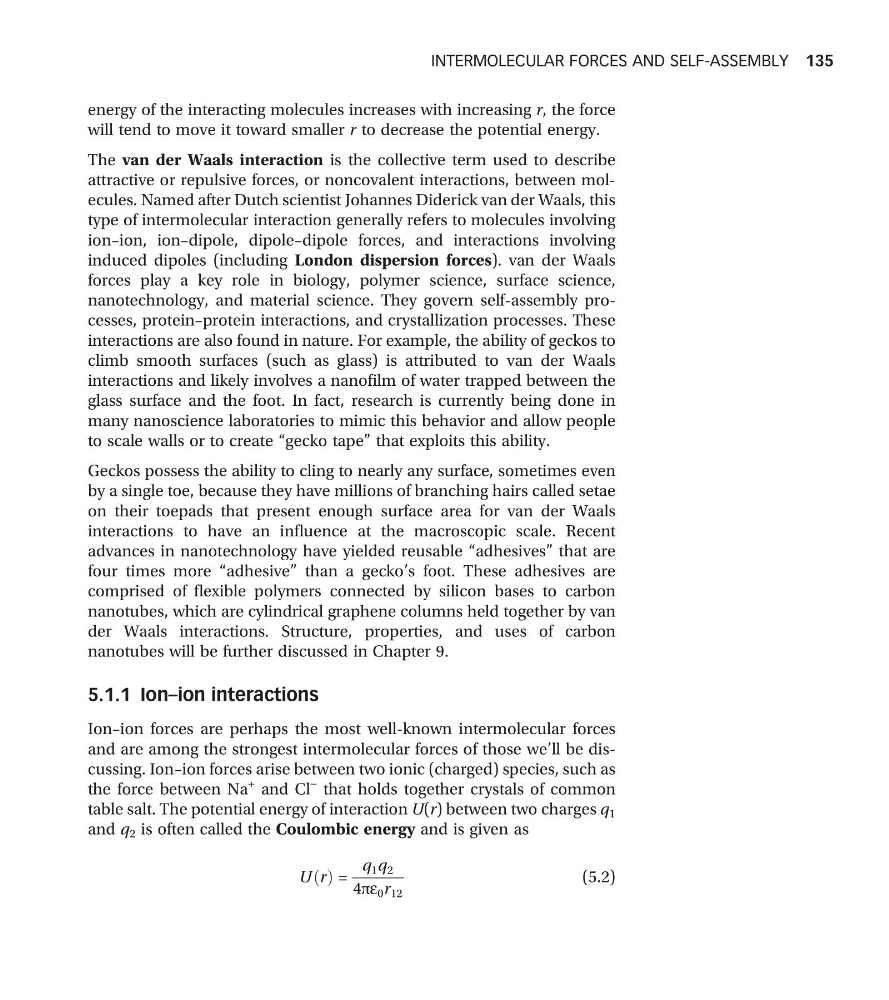
table salt. The potential energy of interaction U(r) between two charges q 1
and q 2 is often called the Coulombic energy and is given as
U r
ð Þ =
q 1 q 2
4πe 0 r 12
(5.2)
INTERMOLECULAR FORCES AND SELF-ASSEMBLY 135
will tend to move it toward smaller r to decrease the potential energy.
The van der Waals interaction is the collective term used to describe
attractive or repulsive forces, or noncovalent interactions, between molecules. Named after Dutch scientist Johannes Diderick van der Waals, this
type of intermolecular interaction generally refers to molecules involving
ion–ion, ion–dipole, dipole–dipole forces, and interactions involving
induced dipoles (including London dispersion forces). van der Waals
forces play a key role in biology, polymer science, surface science,
nanotechnology, and material science. They govern self-assembly processes, protein–protein interactions, and crystallization processes. These
interactions are also found in nature. For example, the ability of geckos to
climb smooth surfaces (such as glass) is attributed to van der Waals
interactions and likely involves a nanofilm of water trapped between the
glass surface and the foot. In fact, research is currently being done in
many nanoscience laboratories to mimic this behavior and allow people
to scale walls or to create “gecko tape” that exploits this ability.
Geckos possess the ability to cling to nearly any surface, sometimes even
by a single toe, because they have millions of branching hairs called setae
on their toepads that present enough surface area for van der Waals
interactions to have an influence at the macroscopic scale. Recent
advances in nanotechnology have yielded reusable “adhesives” that are
four times more “adhesive” than a gecko’s foot. These adhesives are
comprised of flexible polymers connected by silicon bases to carbon
nanotubes, which are cylindrical graphene columns held together by van
der Waals interactions. Structure, properties, and uses of carbon
nanotubes will be further discussed in Chapter 9.
5.1.1 Ion–ion interactions
Ion–ion forces are perhaps the most well-known intermolecular forces
and are among the strongest intermolecular forces of those we’ll be discussing. Ion–ion forces arise between two ionic (charged) species, such as
the force between Na
+ and Cl
− that holds together crystals of common
table salt. The potential energy of interaction U(r) between two charges q 1
and q 2 is often called the Coulombic energy and is given as
U r
ð Þ =
q 1 q 2
4πe 0 r 12
(5.2)
INTERMOLECULAR FORCES AND SELF-ASSEMBLY 135