

based on measuring a “tunneling” current that is produced when two bodies
approach each other without ever touching. The electron essentially jumps
from one body to the other. If there is a potential difference applied between
the two bodies, then tunneling electrons will produce an electrical current. It
is important to appreciate that this kind of electron tunneling occurs because
two bodies are so close together that their electronic wavefunctions begin to
overlap. Scanning tunneling microscopy (STM) is an example of how
quantum mechanical tunneling can be used to probe the nanostructure of
surfaces. The technique operates by monitoring the “tunneling” current that
is produced when a sharp tip is brought extremely close to a surface that is
able to conduct electricity.
4.6.2 Implications for the quantum mechanical harmonic
oscillator
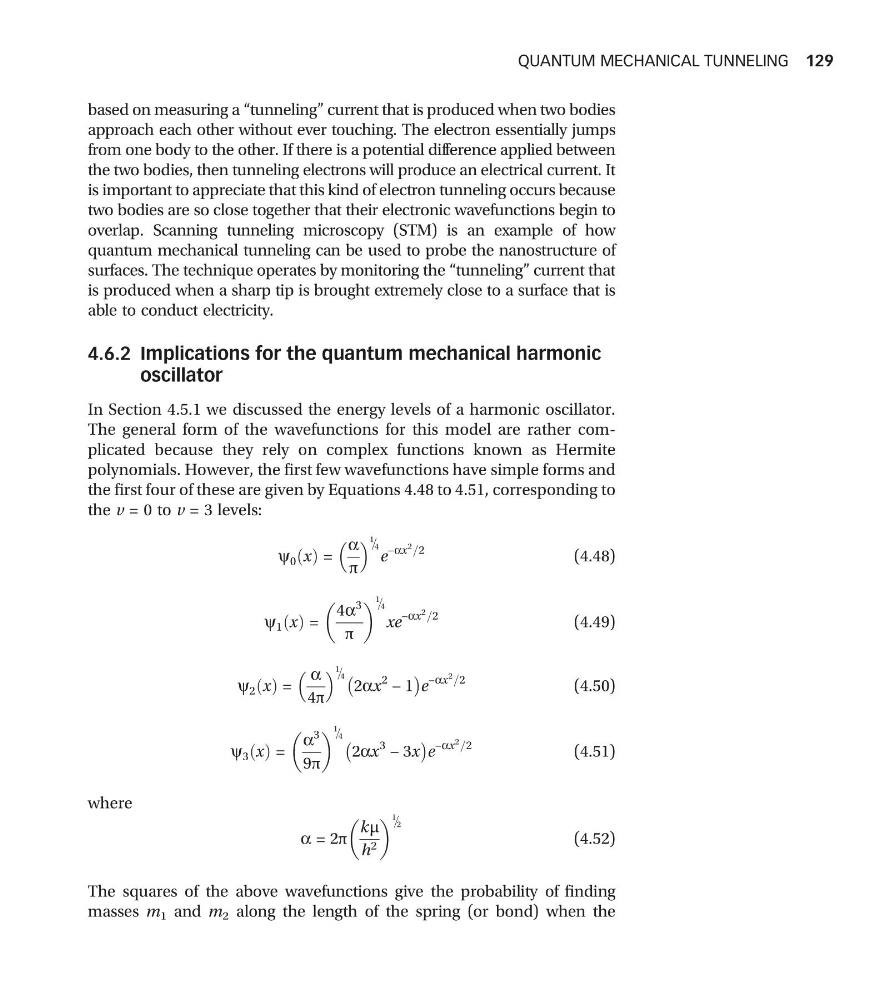
In Section 4.5.1 we discussed the energy levels of a harmonic oscillator.
The general form of the wavefunctions for this model are rather complicated because they rely on complex functions known as Hermite
polynomials. However, the first few wavefunctions have simple forms and
the first four of these are given by Equations 4.48 to 4.51, corresponding to
the v = 0 to v = 3 levels:
y 0 x
ð Þ =
a
π
1
4
=
e
−ax
2 =2
(4.48)
y 1 x
ð Þ =
4a
3
π
1 4
=
xe
−ax
2 =2
(4.49)
y 2 x
ð Þ =
a
4π
1
4
=
2ax
2
− 1
À
Á
e
−ax
2 =2
(4.50)
y 3 x
ð Þ =
a
3
9π
1 4
=
2ax
3
− 3x
À
Á
e
−ax
2 =2
(4.51)
where
a = 2π
kμ
h 2
1
2
=
(4.52)
The squares of the above wavefunctions give the probability of finding
masses m 1 and m 2 along the length of the spring (or bond) when the
QUANTUM MECHANICAL TUNNELING 129
approach each other without ever touching. The electron essentially jumps
from one body to the other. If there is a potential difference applied between
the two bodies, then tunneling electrons will produce an electrical current. It
is important to appreciate that this kind of electron tunneling occurs because
two bodies are so close together that their electronic wavefunctions begin to
overlap. Scanning tunneling microscopy (STM) is an example of how
quantum mechanical tunneling can be used to probe the nanostructure of
surfaces. The technique operates by monitoring the “tunneling” current that
is produced when a sharp tip is brought extremely close to a surface that is
able to conduct electricity.
4.6.2 Implications for the quantum mechanical harmonic
oscillator
In Section 4.5.1 we discussed the energy levels of a harmonic oscillator.
The general form of the wavefunctions for this model are rather complicated because they rely on complex functions known as Hermite
polynomials. However, the first few wavefunctions have simple forms and
the first four of these are given by Equations 4.48 to 4.51, corresponding to
the v = 0 to v = 3 levels:
y 0 x
ð Þ =
a
π
1
4
=
e
−ax
2 =2
(4.48)
y 1 x
ð Þ =
4a
3
π
1 4
=
xe
−ax
2 =2
(4.49)
y 2 x
ð Þ =
a
4π
1
4
=
2ax
2
− 1
À
Á
e
−ax
2 =2
(4.50)
y 3 x
ð Þ =
a
3
9π
1 4
=
2ax
3
− 3x
À
Á
e
−ax
2 =2
(4.51)
where
a = 2π
kμ
h 2
1
2
=
(4.52)
The squares of the above wavefunctions give the probability of finding
masses m 1 and m 2 along the length of the spring (or bond) when the
QUANTUM MECHANICAL TUNNELING 129