

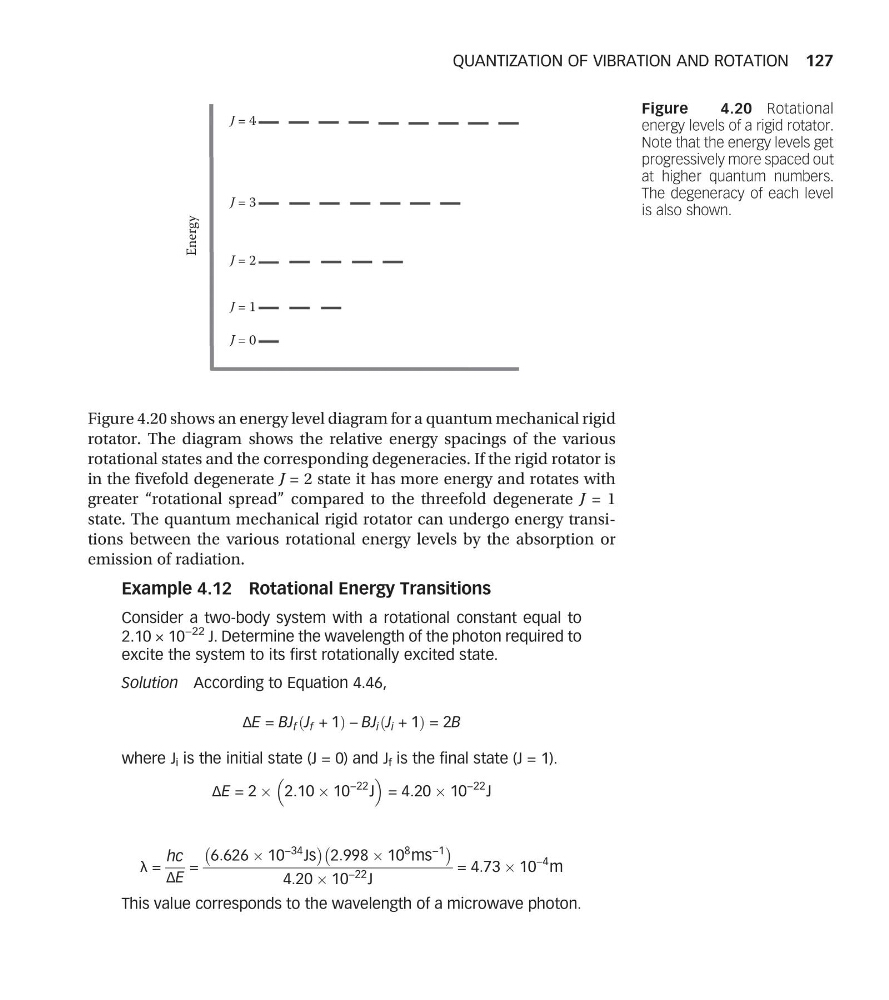
Figure 4.20 shows an energy level diagram for a quantum mechanical rigid
rotator. The diagram shows the relative energy spacings of the various
rotational states and the corresponding degeneracies. If the rigid rotator is
in the fivefold degenerate J = 2 state it has more energy and rotates with
greater “rotational spread” compared to the threefold degenerate J = 1
state. The quantum mechanical rigid rotator can undergo energy transitions between the various rotational energy levels by the absorption or
emission of radiation.
Example 4.12 Rotational Energy Transitions
Consider a two-body system with a rotational constant equal to
2.10 × 10
−22 J. Determine the wavelength of the photon required to
excite the system to its first rotationally excited state.
Solution According to Equation 4.46,
ΔE = BJ f J f + 1
ð
Þ− BJ i J i + 1
ð
Þ= 2B
where J i is the initial state (J = 0) and J f is the final state (J = 1).
ΔE = 2 Â 2:10 Â 10
−22 J
= 4:20 Â 10
−22 J
λ =
hc
ΔE
=
6:626 Â 10
−34 Js
À
Á
2:998 Â 10
8 ms
−1
À
Á
4:20 Â 10
−22 J
= 4:73 Â 10
−4 m
This value corresponds to the wavelength of a microwave photon.
Energy
J = 4
J = 3
J = 2
J = 1
J = 0
Figure
4.20 Rotational
energy levels of a rigid rotator.
Note that the energy levels get
progressively more spaced out
at higher quantum numbers.
The degeneracy of each level
is also shown.
QUANTIZATION OF VIBRATION AND ROTATION 127
rotator. The diagram shows the relative energy spacings of the various
rotational states and the corresponding degeneracies. If the rigid rotator is
in the fivefold degenerate J = 2 state it has more energy and rotates with
greater “rotational spread” compared to the threefold degenerate J = 1
state. The quantum mechanical rigid rotator can undergo energy transitions between the various rotational energy levels by the absorption or
emission of radiation.
Example 4.12 Rotational Energy Transitions
Consider a two-body system with a rotational constant equal to
2.10 × 10
−22 J. Determine the wavelength of the photon required to
excite the system to its first rotationally excited state.
Solution According to Equation 4.46,
ΔE = BJ f J f + 1
ð
Þ− BJ i J i + 1
ð
Þ= 2B
where J i is the initial state (J = 0) and J f is the final state (J = 1).
ΔE = 2 Â 2:10 Â 10
−22 J
= 4:20 Â 10
−22 J
λ =
hc
ΔE
=
6:626 Â 10
−34 Js
À
Á
2:998 Â 10
8 ms
−1
À
Á
4:20 Â 10
−22 J
= 4:73 Â 10
−4 m
This value corresponds to the wavelength of a microwave photon.
Energy
J = 4
J = 3
J = 2
J = 1
J = 0
Figure
4.20 Rotational
energy levels of a rigid rotator.
Note that the energy levels get
progressively more spaced out
at higher quantum numbers.
The degeneracy of each level
is also shown.
QUANTIZATION OF VIBRATION AND ROTATION 127