

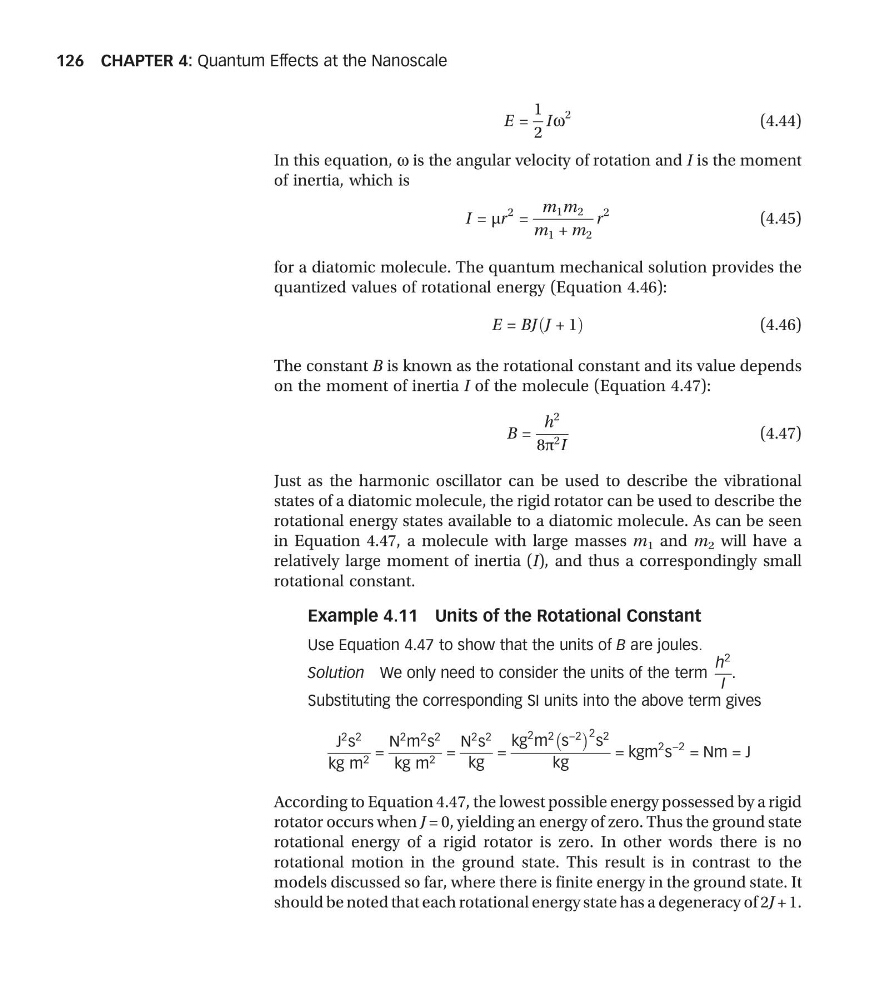
E =
1
2
Iw
2
(4.44)
In this equation, w is the angular velocity of rotation and I is the moment
of inertia, which is
I = μr
2 =
m 1 m 2
m 1 + m 2
r
2
(4.45)
for a diatomic molecule. The quantum mechanical solution provides the
quantized values of rotational energy (Equation 4.46):
E = BJ J + 1
ð
Þ
(4.46)
The constant B is known as the rotational constant and its value depends
on the moment of inertia I of the molecule (Equation 4.47):
B =
h
2
8π
2 I
(4.47)
Just as the harmonic oscillator can be used to describe the vibrational
states of a diatomic molecule, the rigid rotator can be used to describe the
rotational energy states available to a diatomic molecule. As can be seen
in Equation 4.47, a molecule with large masses m 1 and m 2 will have a
relatively large moment of inertia (I), and thus a correspondingly small
rotational constant.
Example 4.11 Units of the Rotational Constant
Use Equation 4.47 to show that the units of B are joules.
Solution We only need to consider the units of the term
h
2
I
.
Substituting the corresponding SI units into the above term gives
J
2 s
2
kg m
2
=
N
2 m
2 s
2
kg m
2
=
N
2 s
2
kg
=
kg
2 m
2 s
−2
À Á 2 s
2
kg
= kgm
2 s
−2 = Nm = J
According to Equation 4.47, the lowest possible energy possessed by a rigid
rotator occurs when J = 0, yielding an energy of zero. Thus the ground state
rotational energy of a rigid rotator is zero. In other words there is no
rotational motion in the ground state. This result is in contrast to the
models discussed so far, where there is finite energy in the ground state. It
should be noted that each rotational energy state has a degeneracy of 2J + 1.
CHAPTER 4: Quantum Effects at the Nanoscale
126
1
2
Iw
2
(4.44)
In this equation, w is the angular velocity of rotation and I is the moment
of inertia, which is
I = μr
2 =
m 1 m 2
m 1 + m 2
r
2
(4.45)
for a diatomic molecule. The quantum mechanical solution provides the
quantized values of rotational energy (Equation 4.46):
E = BJ J + 1
ð
Þ
(4.46)
The constant B is known as the rotational constant and its value depends
on the moment of inertia I of the molecule (Equation 4.47):
B =
h
2
8π
2 I
(4.47)
Just as the harmonic oscillator can be used to describe the vibrational
states of a diatomic molecule, the rigid rotator can be used to describe the
rotational energy states available to a diatomic molecule. As can be seen
in Equation 4.47, a molecule with large masses m 1 and m 2 will have a
relatively large moment of inertia (I), and thus a correspondingly small
rotational constant.
Example 4.11 Units of the Rotational Constant
Use Equation 4.47 to show that the units of B are joules.
Solution We only need to consider the units of the term
h
2
I
.
Substituting the corresponding SI units into the above term gives
J
2 s
2
kg m
2
=
N
2 m
2 s
2
kg m
2
=
N
2 s
2
kg
=
kg
2 m
2 s
−2
À Á 2 s
2
kg
= kgm
2 s
−2 = Nm = J
According to Equation 4.47, the lowest possible energy possessed by a rigid
rotator occurs when J = 0, yielding an energy of zero. Thus the ground state
rotational energy of a rigid rotator is zero. In other words there is no
rotational motion in the ground state. This result is in contrast to the
models discussed so far, where there is finite energy in the ground state. It
should be noted that each rotational energy state has a degeneracy of 2J + 1.
CHAPTER 4: Quantum Effects at the Nanoscale
126