

Example 4.10 Vibrational Energy Transitions
Consider two atoms that vibrate across a bond with a fundamental
frequency of 6.42 × 10
13 s
−1
. Determine the wavelength of the
photon required to excite the system to its first vibrationally excited
state.
Solution According to Equation 4.41,
ΔE = hυ v f +
1
2
=
− hυ v i +
1
2
=
= hυ 1 +
1
2
=
− hυ 0 +
1
2
=
where v i is the initial state (v = 0) and v f is the final state (v = 1).
ΔE = hυ
3
2
=
− hυ
1
2
=
= hυ
3
2
= −
1
2
=
= hυ
Thus, ΔE is (6.42 × 10
13 s
−1
) × (6.626 × 10
−34 Js) = 4.25 × 10
−20 J
λ =
hc
ΔE
=
6:626 Â 10
−34 Js
À
Á
2:998 Â 10
8 ms
−1
À
Á
4:25 Â 10
−20 J
= 4:67 Â 10
−6 m
This value is 4.67 μm and corresponds to the wavelength of an
infrared photon.
4.5.2 Quantization of rotational motion: The rigid rotator
The final quantum mechanical model we will discuss is that of the rigid
rotator. In this model we have a mass m 1 and m 2 connected by a rigid rod
of length r analogous to that shown in Figure 4.17b. Although this system
cannot vibrate, it can undergo rotational motion. When using classical
physics to describe rotational motion, the rotational kinetic energy is
given by
v = 1
v = 0
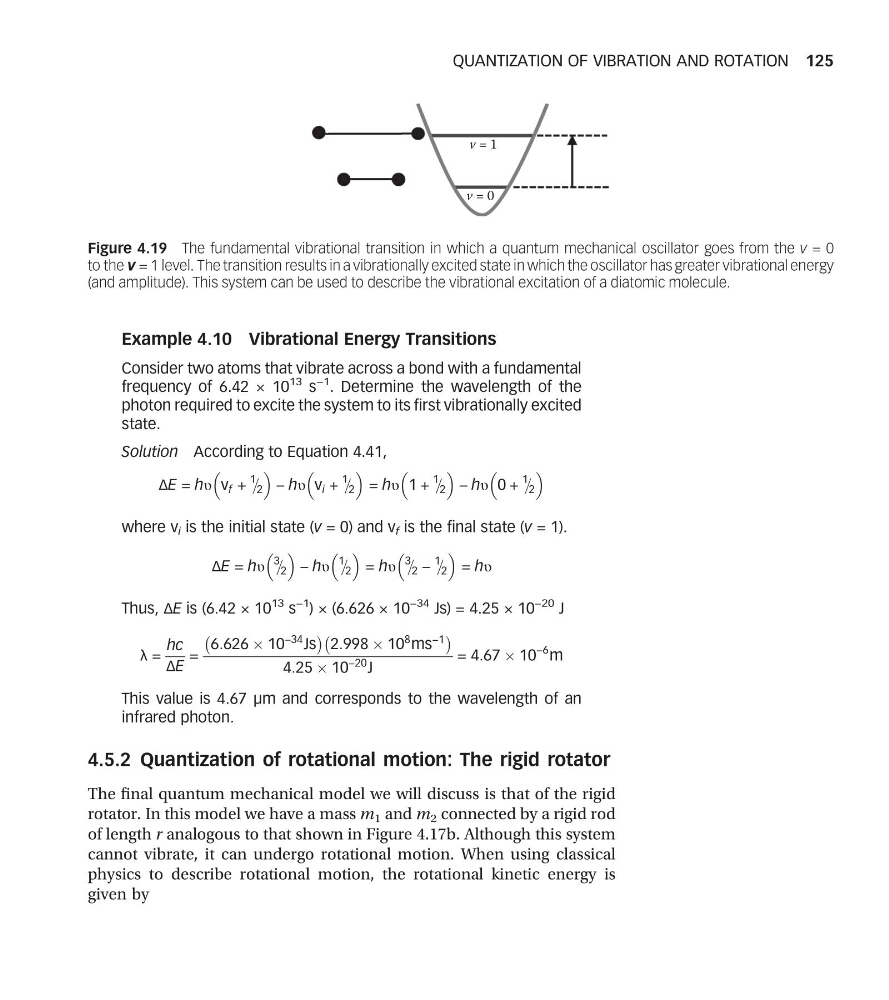
Figure 4.19 The fundamental vibrational transition in which a quantum mechanical oscillator goes from the v = 0
to the v = 1 level. The transition results in a vibrationally excited state in which the oscillator has greater vibrational energy
(and amplitude). This system can be used to describe the vibrational excitation of a diatomic molecule.
QUANTIZATION OF VIBRATION AND ROTATION 125
Consider two atoms that vibrate across a bond with a fundamental
frequency of 6.42 × 10
13 s
−1
. Determine the wavelength of the
photon required to excite the system to its first vibrationally excited
state.
Solution According to Equation 4.41,
ΔE = hυ v f +
1
2
=
− hυ v i +
1
2
=
= hυ 1 +
1
2
=
− hυ 0 +
1
2
=
where v i is the initial state (v = 0) and v f is the final state (v = 1).
ΔE = hυ
3
2
=
− hυ
1
2
=
= hυ
3
2
= −
1
2
=
= hυ
Thus, ΔE is (6.42 × 10
13 s
−1
) × (6.626 × 10
−34 Js) = 4.25 × 10
−20 J
λ =
hc
ΔE
=
6:626 Â 10
−34 Js
À
Á
2:998 Â 10
8 ms
−1
À
Á
4:25 Â 10
−20 J
= 4:67 Â 10
−6 m
This value is 4.67 μm and corresponds to the wavelength of an
infrared photon.
4.5.2 Quantization of rotational motion: The rigid rotator
The final quantum mechanical model we will discuss is that of the rigid
rotator. In this model we have a mass m 1 and m 2 connected by a rigid rod
of length r analogous to that shown in Figure 4.17b. Although this system
cannot vibrate, it can undergo rotational motion. When using classical
physics to describe rotational motion, the rotational kinetic energy is
given by
v = 1
v = 0
Figure 4.19 The fundamental vibrational transition in which a quantum mechanical oscillator goes from the v = 0
to the v = 1 level. The transition results in a vibrationally excited state in which the oscillator has greater vibrational energy
(and amplitude). This system can be used to describe the vibrational excitation of a diatomic molecule.
QUANTIZATION OF VIBRATION AND ROTATION 125