

Example 4.9 Units of the Fundamental Vibration
Frequency
Show that Equation 4.42 has units of reciprocal seconds (s
−1
)
Solution We only need to consider the units of the term
ffiffiffi ffi
k
μ
s
Substituting the corresponding SI units into the above term gives
ffiffiffiffiffiffiffiffiffiffiffi
N=m
kg
s
=
ffiffiffiffiffiffiffiffiffiffiffiffiffiffiffiffiffiffiffiffiffiffiffi
kgms
−2 =m
kg
s
=
ffiffiffiffiffiffiffiffiffiffiffi ffi
ms
−2
m
s
=
ffiffiffiffiffi
1
s
2
r
=
1
s
= s
−1
According to Equation 4.41, the lowest possible energy possessed by a
harmonic oscillator occurs when v = 0. However, the energy of the ground
state is not zero; it has a value of E = 1/2hn. This nonzero ground state
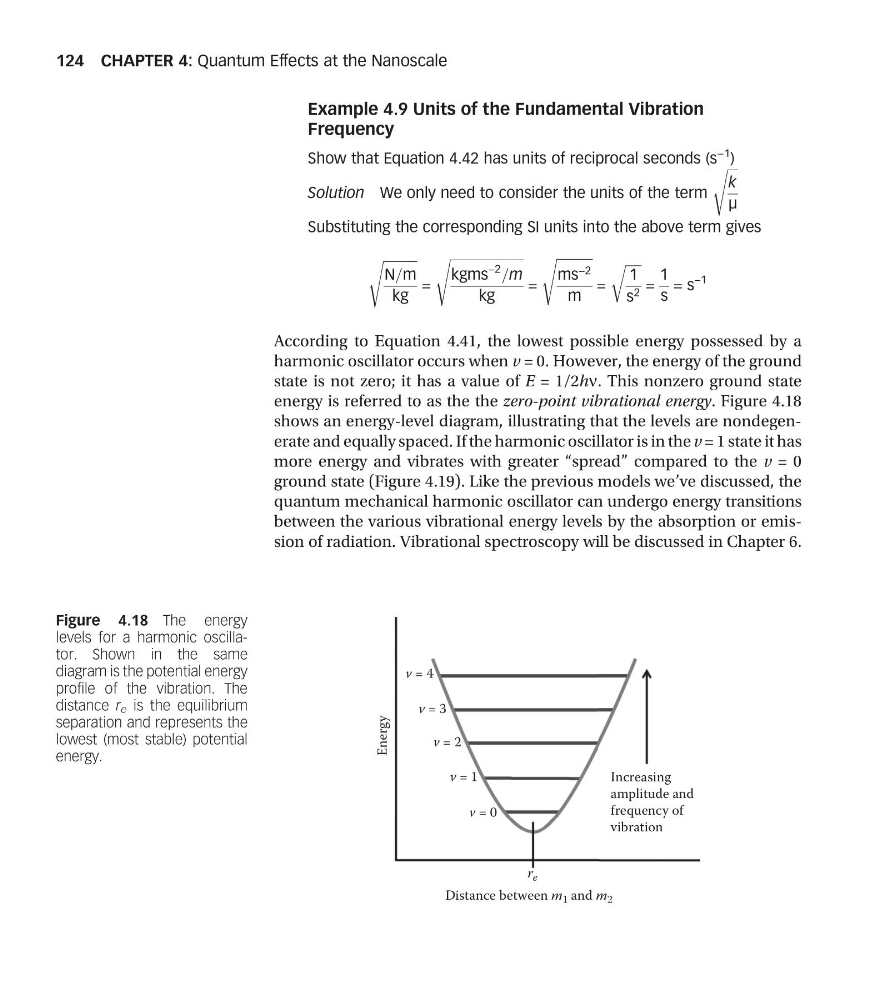
energy is referred to as the the zero-point vibrational energy. Figure 4.18
shows an energy-level diagram, illustrating that the levels are nondegenerate and equally spaced. If the harmonic oscillator is in the v = 1 state it has
more energy and vibrates with greater “spread” compared to the v = 0
ground state (Figure 4.19). Like the previous models we’ve discussed, the
quantum mechanical harmonic oscillator can undergo energy transitions
between the various vibrational energy levels by the absorption or emission of radiation. Vibrational spectroscopy will be discussed in Chapter 6.
Increasing
amplitude and
frequency of
vibration
Energy
v = 4
v = 3
v = 2
v = 1
v = 0
Distance between m 1 and m 2
r e
Figure 4.18 The energy
levels for a harmonic oscillator. Shown in the same
diagram is the potential energy
profile of the vibration. The
distance r e is the equilibrium
separation and represents the
lowest (most stable) potential
energy.
CHAPTER 4: Quantum Effects at the Nanoscale
124
Frequency
Show that Equation 4.42 has units of reciprocal seconds (s
−1
)
Solution We only need to consider the units of the term
ffiffiffi ffi
k
μ
s
Substituting the corresponding SI units into the above term gives
ffiffiffiffiffiffiffiffiffiffiffi
N=m
kg
s
=
ffiffiffiffiffiffiffiffiffiffiffiffiffiffiffiffiffiffiffiffiffiffiffi
kgms
−2 =m
kg
s
=
ffiffiffiffiffiffiffiffiffiffiffi ffi
ms
−2
m
s
=
ffiffiffiffiffi
1
s
2
r
=
1
s
= s
−1
According to Equation 4.41, the lowest possible energy possessed by a
harmonic oscillator occurs when v = 0. However, the energy of the ground
state is not zero; it has a value of E = 1/2hn. This nonzero ground state
energy is referred to as the the zero-point vibrational energy. Figure 4.18
shows an energy-level diagram, illustrating that the levels are nondegenerate and equally spaced. If the harmonic oscillator is in the v = 1 state it has
more energy and vibrates with greater “spread” compared to the v = 0
ground state (Figure 4.19). Like the previous models we’ve discussed, the
quantum mechanical harmonic oscillator can undergo energy transitions
between the various vibrational energy levels by the absorption or emission of radiation. Vibrational spectroscopy will be discussed in Chapter 6.
Increasing
amplitude and
frequency of
vibration
Energy
v = 4
v = 3
v = 2
v = 1
v = 0
Distance between m 1 and m 2
r e
Figure 4.18 The energy
levels for a harmonic oscillator. Shown in the same
diagram is the potential energy
profile of the vibration. The
distance r e is the equilibrium
separation and represents the
lowest (most stable) potential
energy.
CHAPTER 4: Quantum Effects at the Nanoscale
124