

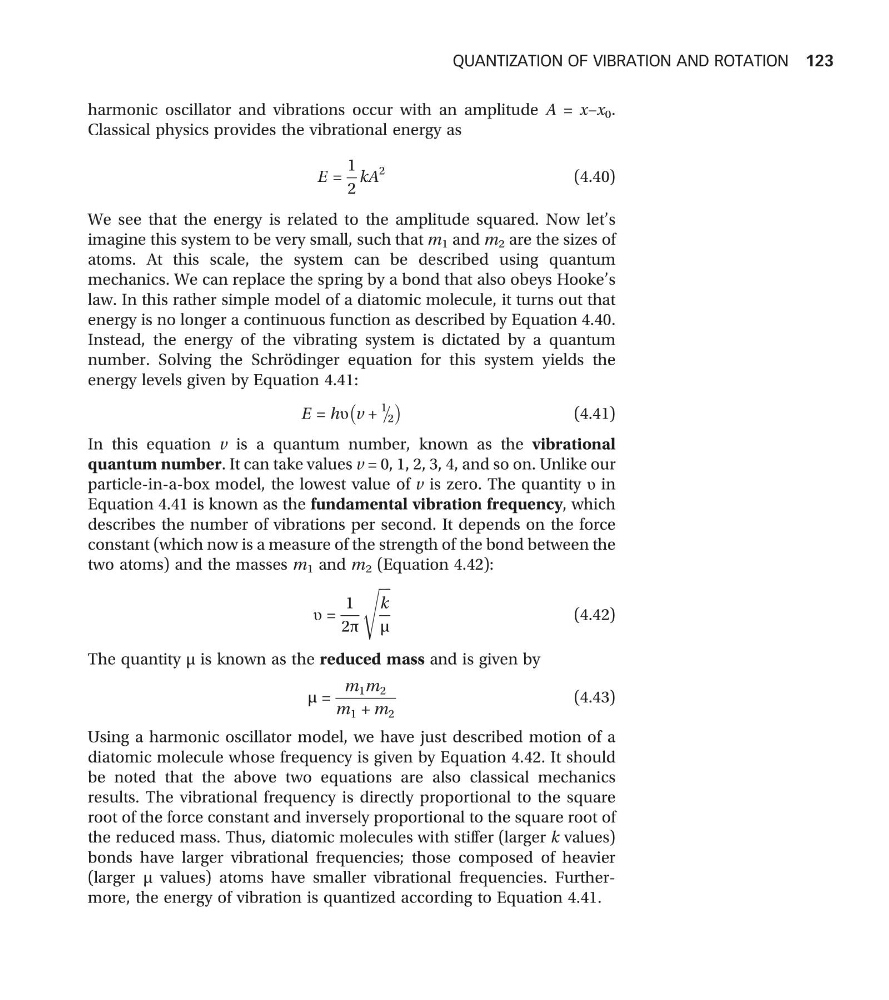
harmonic oscillator and vibrations occur with an amplitude A = x−x 0 .
Classical physics provides the vibrational energy as
E =
1
2
kA
2
(4.40)
We see that the energy is related to the amplitude squared. Now let’s
imagine this system to be very small, such that m 1 and m 2 are the sizes of
atoms. At this scale, the system can be described using quantum
mechanics. We can replace the spring by a bond that also obeys Hooke’s
law. In this rather simple model of a diatomic molecule, it turns out that
energy is no longer a continuous function as described by Equation 4.40.
Instead, the energy of the vibrating system is dictated by a quantum
number. Solving the Schrödinger equation for this system yields the
energy levels given by Equation 4.41:
E = hυ v +
1
2
=
À
Á
(4.41)
In this equation v is a quantum number, known as the vibrational
quantum number. It can take values v = 0, 1, 2, 3, 4, and so on. Unlike our
particle-in-a-box model, the lowest value of v is zero. The quantity υ in
Equation 4.41 is known as the fundamental vibration frequency, which
describes the number of vibrations per second. It depends on the force
constant (which now is a measure of the strength of the bond between the
two atoms) and the masses m 1 and m 2 (Equation 4.42):
υ =
1
2π
ffiffiffi ffi
k
μ
s
(4.42)
The quantity μ is known as the reduced mass and is given by
μ =
m 1 m 2
m 1 + m 2
(4.43)
Using a harmonic oscillator model, we have just described motion of a
diatomic molecule whose frequency is given by Equation 4.42. It should
be noted that the above two equations are also classical mechanics
results. The vibrational frequency is directly proportional to the square
root of the force constant and inversely proportional to the square root of
the reduced mass. Thus, diatomic molecules with stiffer (larger k values)
bonds have larger vibrational frequencies; those composed of heavier
(larger μ values) atoms have smaller vibrational frequencies. Furthermore, the energy of vibration is quantized according to Equation 4.41.
QUANTIZATION OF VIBRATION AND ROTATION 123
Classical physics provides the vibrational energy as
E =
1
2
kA
2
(4.40)
We see that the energy is related to the amplitude squared. Now let’s
imagine this system to be very small, such that m 1 and m 2 are the sizes of
atoms. At this scale, the system can be described using quantum
mechanics. We can replace the spring by a bond that also obeys Hooke’s
law. In this rather simple model of a diatomic molecule, it turns out that
energy is no longer a continuous function as described by Equation 4.40.
Instead, the energy of the vibrating system is dictated by a quantum
number. Solving the Schrödinger equation for this system yields the
energy levels given by Equation 4.41:
E = hυ v +
1
2
=
À
Á
(4.41)
In this equation v is a quantum number, known as the vibrational
quantum number. It can take values v = 0, 1, 2, 3, 4, and so on. Unlike our
particle-in-a-box model, the lowest value of v is zero. The quantity υ in
Equation 4.41 is known as the fundamental vibration frequency, which
describes the number of vibrations per second. It depends on the force
constant (which now is a measure of the strength of the bond between the
two atoms) and the masses m 1 and m 2 (Equation 4.42):
υ =
1
2π
ffiffiffi ffi
k
μ
s
(4.42)
The quantity μ is known as the reduced mass and is given by
μ =
m 1 m 2
m 1 + m 2
(4.43)
Using a harmonic oscillator model, we have just described motion of a
diatomic molecule whose frequency is given by Equation 4.42. It should
be noted that the above two equations are also classical mechanics
results. The vibrational frequency is directly proportional to the square
root of the force constant and inversely proportional to the square root of
the reduced mass. Thus, diatomic molecules with stiffer (larger k values)
bonds have larger vibrational frequencies; those composed of heavier
(larger μ values) atoms have smaller vibrational frequencies. Furthermore, the energy of vibration is quantized according to Equation 4.41.
QUANTIZATION OF VIBRATION AND ROTATION 123