

E =
h
2
8mr
2
(4.38)
The energy eigenvalue in Equation 4.38 represents the difference in the
energy of the first excited state of a nanoparticle due to quantum confinement from the energy that would be observed in a bulk material,
which allows control of the optical and electronic properties of quantum
dots (semiconductor nanoparticles). We will discuss the semiconducting
properties of quantum dots in Chapter 9.
4.5 QUANTIZATION OF VIBRATION
AND ROTATION
4.5.1 Quantization of vibrational motion:
The harmonic oscillator
We now consider the quantization of two-body systems. Consider two
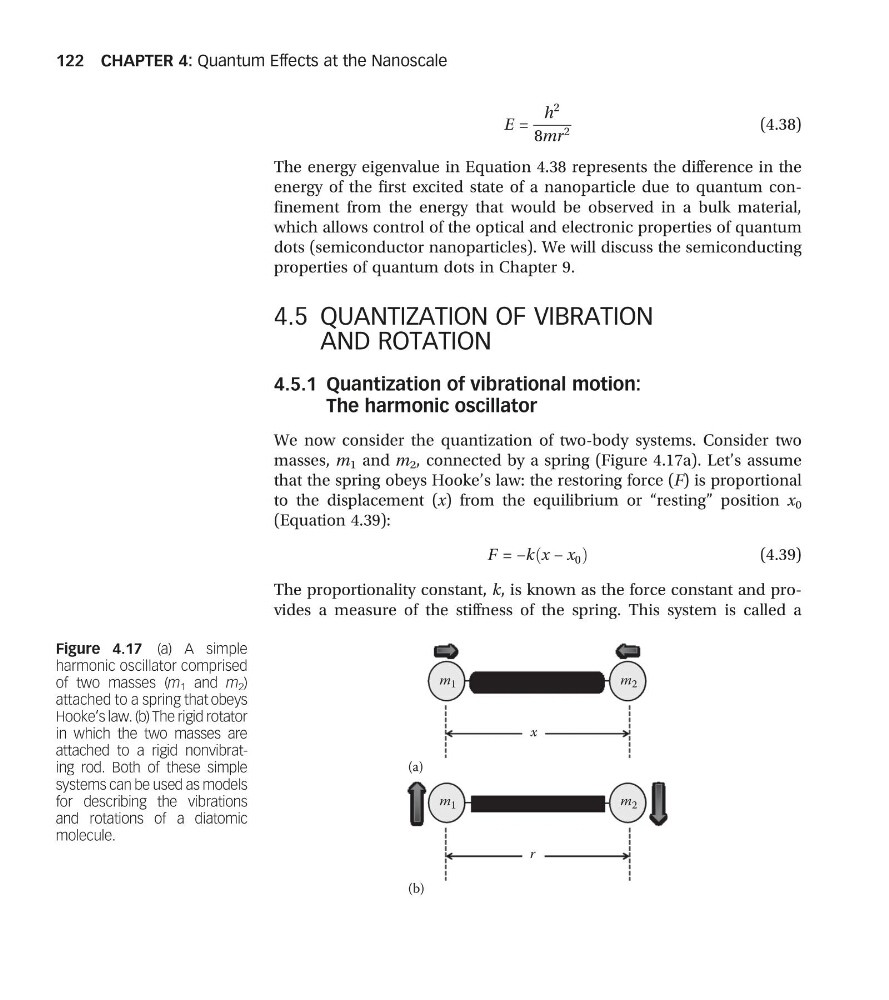
masses, m 1 and m 2 , connected by a spring (Figure 4.17a). Let’s assume
that the spring obeys Hooke’s law: the restoring force (F) is proportional
to the displacement (x) from the equilibrium or “resting” position x 0
(Equation 4.39):
F = −k x − x 0
ð
Þ
(4.39)
The proportionality constant, k, is known as the force constant and provides a measure of the stiffness of the spring. This system is called a
m 1
(a)
(b)
m 2
m 1
x
r
m 2
Figure 4.17 (a) A simple
harmonic oscillator comprised
of two masses (m 1 and m 2 )
attached to a spring that obeys
Hooke’s law. (b) The rigid rotator
in which the two masses are
attached to a rigid nonvibrating rod. Both of these simple
systems can be used as models
for describing the vibrations
and rotations of a diatomic
molecule.
CHAPTER 4: Quantum Effects at the Nanoscale
122
h
2
8mr
2
(4.38)
The energy eigenvalue in Equation 4.38 represents the difference in the
energy of the first excited state of a nanoparticle due to quantum confinement from the energy that would be observed in a bulk material,
which allows control of the optical and electronic properties of quantum
dots (semiconductor nanoparticles). We will discuss the semiconducting
properties of quantum dots in Chapter 9.
4.5 QUANTIZATION OF VIBRATION
AND ROTATION
4.5.1 Quantization of vibrational motion:
The harmonic oscillator
We now consider the quantization of two-body systems. Consider two
masses, m 1 and m 2 , connected by a spring (Figure 4.17a). Let’s assume
that the spring obeys Hooke’s law: the restoring force (F) is proportional
to the displacement (x) from the equilibrium or “resting” position x 0
(Equation 4.39):
F = −k x − x 0
ð
Þ
(4.39)
The proportionality constant, k, is known as the force constant and provides a measure of the stiffness of the spring. This system is called a
m 1
(a)
(b)
m 2
m 1
x
r
m 2
Figure 4.17 (a) A simple
harmonic oscillator comprised
of two masses (m 1 and m 2 )
attached to a spring that obeys
Hooke’s law. (b) The rigid rotator
in which the two masses are
attached to a rigid nonvibrating rod. Both of these simple
systems can be used as models
for describing the vibrations
and rotations of a diatomic
molecule.
CHAPTER 4: Quantum Effects at the Nanoscale
122