

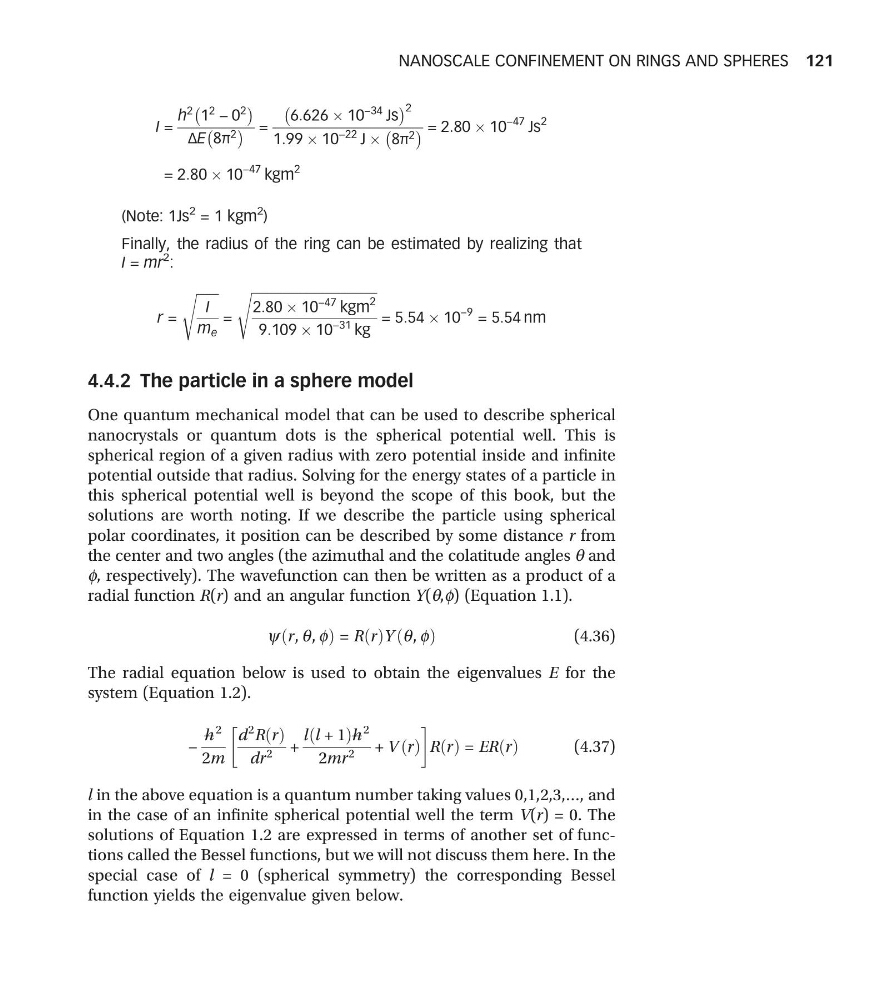
I =
h
2 1
2
− 0
2
À
Á
ΔE 8π
2
À
Á =
6:626 Â 10
−34 Js
À
Á 2
1:99 Â 10
−22 J Â 8π 2
À
Á = 2:80 Â 10
−47 Js
2
= 2:80 Â 10
−47 kgm
2
(Note: 1Js
2 = 1 kgm
2
)
Finally, the radius of the ring can be estimated by realizing that
I = mr
2 :
r =
ffiffiffiffiffiffiffi
I
m e
s
=
ffiffiffiffiffiffiffiffiffiffiffiffiffiffiffiffiffiffiffiffiffiffiffiffiffiffiffiffiffiffiffiffiffiffiffiffiffiffiffi
2:80 Â 10
−47 kgm
2
9:109 Â 10
−31 kg
s
= 5:54 Â 10
−9 = 5:54 nm
4.4.2 The particle in a sphere model
One quantum mechanical model that can be used to describe spherical
nanocrystals or quantum dots is the spherical potential well. This is
spherical region of a given radius with zero potential inside and infinite
potential outside that radius. Solving for the energy states of a particle in
this spherical potential well is beyond the scope of this book, but the
solutions are worth noting. If we describe the particle using spherical
polar coordinates, it position can be described by some distance r from
the center and two angles (the azimuthal and the colatitude angles q and
f, respectively). The wavefunction can then be written as a product of a
radial function R(r) and an angular function Y(q,f) (Equation 1.1).
y r, q, f
ð
Þ= R r
ð ÞY q, f
ð
Þ
(4.36)
The radial equation below is used to obtain the eigenvalues E for the
system (Equation 1.2).
−
h
À
2
2m
d
2 R r
ð Þ
dr
2 +
l l + 1
ð
Þh À
2
2mr
2
+ V r
ð Þ
!
R r
ð Þ = ER r
ð Þ
(4.37)
l in the above equation is a quantum number taking values 0,1,2,3,…, and
in the case of an infinite spherical potential well the term V(r) = 0. The
solutions of Equation 1.2 are expressed in terms of another set of functions called the Bessel functions, but we will not discuss them here. In the
special case of l = 0 (spherical symmetry) the corresponding Bessel
function yields the eigenvalue given below.
NANOSCALE CONFINEMENT ON RINGS AND SPHERES 121
h
2 1
2
− 0
2
À
Á
ΔE 8π
2
À
Á =
6:626 Â 10
−34 Js
À
Á 2
1:99 Â 10
−22 J Â 8π 2
À
Á = 2:80 Â 10
−47 Js
2
= 2:80 Â 10
−47 kgm
2
(Note: 1Js
2 = 1 kgm
2
)
Finally, the radius of the ring can be estimated by realizing that
I = mr
2 :
r =
ffiffiffiffiffiffiffi
I
m e
s
=
ffiffiffiffiffiffiffiffiffiffiffiffiffiffiffiffiffiffiffiffiffiffiffiffiffiffiffiffiffiffiffiffiffiffiffiffiffiffiffi
2:80 Â 10
−47 kgm
2
9:109 Â 10
−31 kg
s
= 5:54 Â 10
−9 = 5:54 nm
4.4.2 The particle in a sphere model
One quantum mechanical model that can be used to describe spherical
nanocrystals or quantum dots is the spherical potential well. This is
spherical region of a given radius with zero potential inside and infinite
potential outside that radius. Solving for the energy states of a particle in
this spherical potential well is beyond the scope of this book, but the
solutions are worth noting. If we describe the particle using spherical
polar coordinates, it position can be described by some distance r from
the center and two angles (the azimuthal and the colatitude angles q and
f, respectively). The wavefunction can then be written as a product of a
radial function R(r) and an angular function Y(q,f) (Equation 1.1).
y r, q, f
ð
Þ= R r
ð ÞY q, f
ð
Þ
(4.36)
The radial equation below is used to obtain the eigenvalues E for the
system (Equation 1.2).
−
h
À
2
2m
d
2 R r
ð Þ
dr
2 +
l l + 1
ð
Þh À
2
2mr
2
+ V r
ð Þ
!
R r
ð Þ = ER r
ð Þ
(4.37)
l in the above equation is a quantum number taking values 0,1,2,3,…, and
in the case of an infinite spherical potential well the term V(r) = 0. The
solutions of Equation 1.2 are expressed in terms of another set of functions called the Bessel functions, but we will not discuss them here. In the
special case of l = 0 (spherical symmetry) the corresponding Bessel
function yields the eigenvalue given below.
NANOSCALE CONFINEMENT ON RINGS AND SPHERES 121