

Solving the Schrödinger equation for this system yields the energy levels
described by Equation 4.35:
E =
h
2
8π
2 I
n
2
(4.35)
According to the above equation, the ground state energy is zero because
n = 0. The presence of n
2 in Equation 4.35 implies the levels above this are
always twofold degenerate because n = ±1, ±2, ±3, ±4, and so on. An
energy level diagram for this model is shown in Figure 4.15c.
Example 4.8 Estimating the Size of a Ring Nanoantenna
Imagine a single electron confined to a ring “nanoantenna.” This
electron absorbs light of wavelength 1000 μm (1 mm, in the microwave region of the electromagnetic spectrum), which corresponds
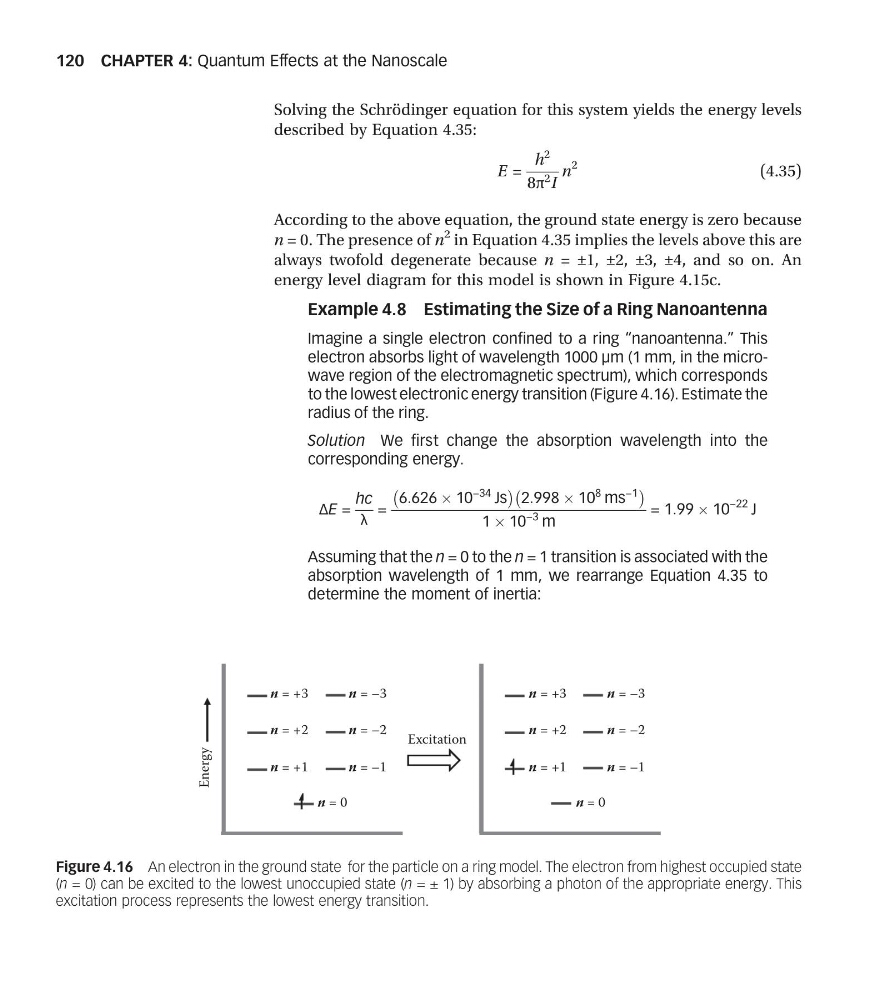
to the lowest electronic energy transition (Figure 4.16). Estimate the
radius of the ring.
Solution We first change the absorption wavelength into the
corresponding energy.
ΔE =
hc
λ
=
6:626 Â 10
−34 Js
À
Á
2:998 Â 10
8 ms
−1
À
Á
1 Â 10
−3 m
= 1:99 Â 10
−22 J
Assuming that the n = 0 to the n = 1 transition is associated with the
absorption wavelength of 1 mm, we rearrange Equation 4.35 to
determine the moment of inertia:
Energy
n = +3
n = +2
n = +1
n = 0
n = –3
n = –2
n = –1
n = +3
n = +2
n = +1
n = 0
n = –3
n = –2
n = –1
Excitation
Figure 4.16 An electron in the ground state for the particle on a ring model. The electron from highest occupied state
(n = 0) can be excited to the lowest unoccupied state (n = ± 1) by absorbing a photon of the appropriate energy. This
excitation process represents the lowest energy transition.
CHAPTER 4: Quantum Effects at the Nanoscale
120
described by Equation 4.35:
E =
h
2
8π
2 I
n
2
(4.35)
According to the above equation, the ground state energy is zero because
n = 0. The presence of n
2 in Equation 4.35 implies the levels above this are
always twofold degenerate because n = ±1, ±2, ±3, ±4, and so on. An
energy level diagram for this model is shown in Figure 4.15c.
Example 4.8 Estimating the Size of a Ring Nanoantenna
Imagine a single electron confined to a ring “nanoantenna.” This
electron absorbs light of wavelength 1000 μm (1 mm, in the microwave region of the electromagnetic spectrum), which corresponds
to the lowest electronic energy transition (Figure 4.16). Estimate the
radius of the ring.
Solution We first change the absorption wavelength into the
corresponding energy.
ΔE =
hc
λ
=
6:626 Â 10
−34 Js
À
Á
2:998 Â 10
8 ms
−1
À
Á
1 Â 10
−3 m
= 1:99 Â 10
−22 J
Assuming that the n = 0 to the n = 1 transition is associated with the
absorption wavelength of 1 mm, we rearrange Equation 4.35 to
determine the moment of inertia:
Energy
n = +3
n = +2
n = +1
n = 0
n = –3
n = –2
n = –1
n = +3
n = +2
n = +1
n = 0
n = –3
n = –2
n = –1
Excitation
Figure 4.16 An electron in the ground state for the particle on a ring model. The electron from highest occupied state
(n = 0) can be excited to the lowest unoccupied state (n = ± 1) by absorbing a photon of the appropriate energy. This
excitation process represents the lowest energy transition.
CHAPTER 4: Quantum Effects at the Nanoscale
120