

4.4.1 The particle on a ring model
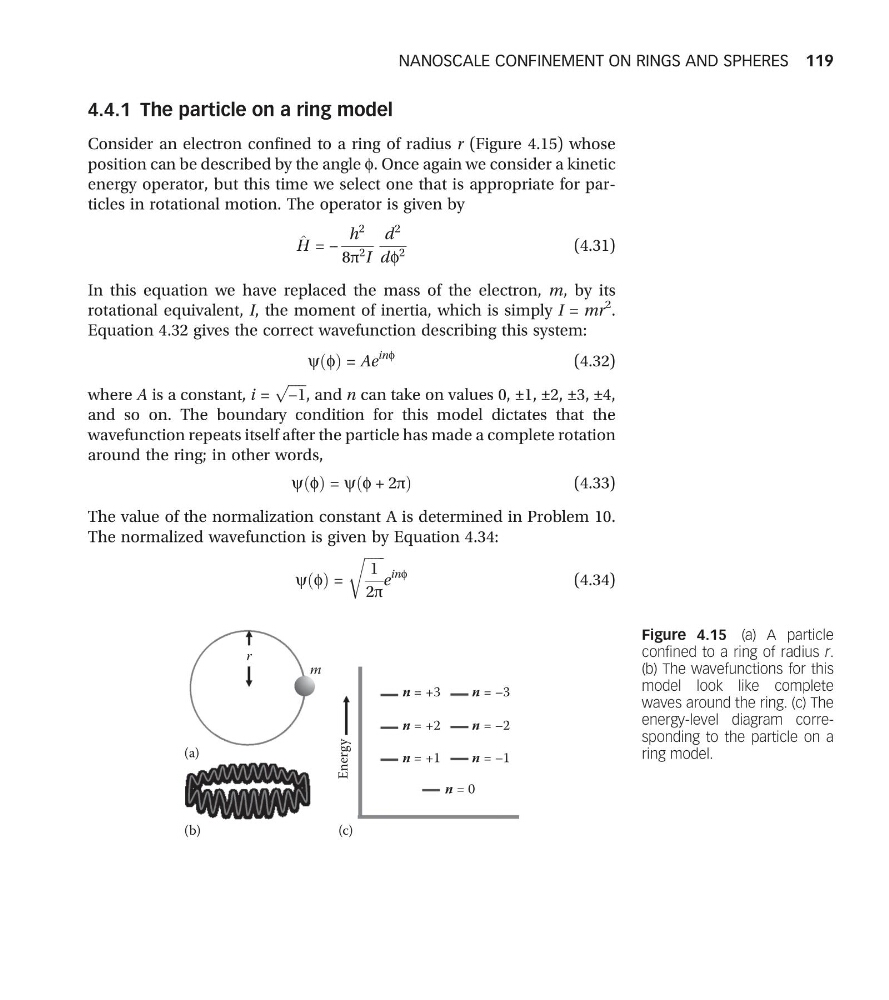
Consider an electron confined to a ring of radius r (Figure 4.15) whose
position can be described by the angle f. Once again we consider a kinetic
energy operator, but this time we select one that is appropriate for particles in rotational motion. The operator is given by
^
H = −
h
2
8π
2 I
d
2
df
2
(4.31)
In this equation we have replaced the mass of the electron, m, by its
rotational equivalent, I, the moment of inertia, which is simply I = mr
2 .
Equation 4.32 gives the correct wavefunction describing this system:
y f
ð Þ = Ae
inf
(4.32)
where A is a constant, i =
ffiffiffiffiffi
−1
p
, and n can take on values 0, ±1, ±2, ±3, ±4,
and so on. The boundary condition for this model dictates that the
wavefunction repeats itself after the particle has made a complete rotation
around the ring; in other words,
y f
ð Þ = y f + 2π
ð
Þ
(4.33)
The value of the normalization constant A is determined in Problem 10.
The normalized wavefunction is given by Equation 4.34:
y f
ð Þ =
ffiffiffiffiffi ffi
1
2π
r
e
inf
(4.34)
(a)
(b)
(c)
Energy
m
n = +3
n = +2
n = +1
n = 0
n = –3
n = –2
n = –1
r
Figure 4.15 (a) A particle
confined to a ring of radius r.
(b) The wavefunctions for this
model look like complete
waves around the ring. (c) The
energy-level diagram corresponding to the particle on a
ring model.
NANOSCALE CONFINEMENT ON RINGS AND SPHERES 119
Consider an electron confined to a ring of radius r (Figure 4.15) whose
position can be described by the angle f. Once again we consider a kinetic
energy operator, but this time we select one that is appropriate for particles in rotational motion. The operator is given by
^
H = −
h
2
8π
2 I
d
2
df
2
(4.31)
In this equation we have replaced the mass of the electron, m, by its
rotational equivalent, I, the moment of inertia, which is simply I = mr
2 .
Equation 4.32 gives the correct wavefunction describing this system:
y f
ð Þ = Ae
inf
(4.32)
where A is a constant, i =
ffiffiffiffiffi
−1
p
, and n can take on values 0, ±1, ±2, ±3, ±4,
and so on. The boundary condition for this model dictates that the
wavefunction repeats itself after the particle has made a complete rotation
around the ring; in other words,
y f
ð Þ = y f + 2π
ð
Þ
(4.33)
The value of the normalization constant A is determined in Problem 10.
The normalized wavefunction is given by Equation 4.34:
y f
ð Þ =
ffiffiffiffiffi ffi
1
2π
r
e
inf
(4.34)
(a)
(b)
(c)
Energy
m
n = +3
n = +2
n = +1
n = 0
n = –3
n = –2
n = –1
r
Figure 4.15 (a) A particle
confined to a ring of radius r.
(b) The wavefunctions for this
model look like complete
waves around the ring. (c) The
energy-level diagram corresponding to the particle on a
ring model.
NANOSCALE CONFINEMENT ON RINGS AND SPHERES 119