

4.4 NANOSCALE CONFINEMENT ON RINGS
AND SPHERES
Our final two simple models for quantum confinement consider electrons
in which the confining region can be defined by a ring or sphere, such
that the Hamiltonian and wavefunction depend on angular coordinates.
Such models are useful for systems such as aromatic molecules and
spherical nanoparticles.
(a)
(b)
(c)
(d)
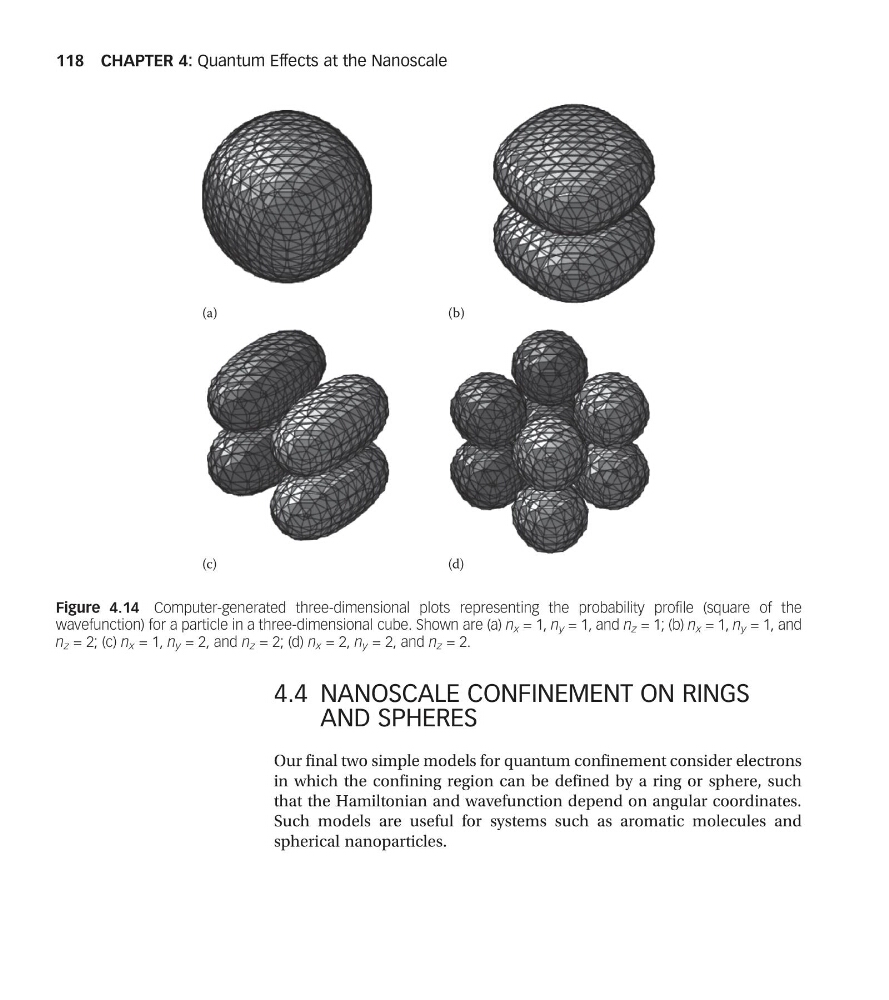
Figure 4.14 Computer-generated three-dimensional plots representing the probability profile (square of the
wavefunction) for a particle in a three-dimensional cube. Shown are (a) n x = 1, n y = 1, and n z = 1; (b) n x = 1, n y = 1, and
n z = 2; (c) n x = 1, n y = 2, and n z = 2; (d) n x = 2, n y = 2, and n z = 2.
CHAPTER 4: Quantum Effects at the Nanoscale
118
AND SPHERES
Our final two simple models for quantum confinement consider electrons
in which the confining region can be defined by a ring or sphere, such
that the Hamiltonian and wavefunction depend on angular coordinates.
Such models are useful for systems such as aromatic molecules and
spherical nanoparticles.
(a)
(b)
(c)
(d)
Figure 4.14 Computer-generated three-dimensional plots representing the probability profile (square of the
wavefunction) for a particle in a three-dimensional cube. Shown are (a) n x = 1, n y = 1, and n z = 1; (b) n x = 1, n y = 1, and
n z = 2; (c) n x = 1, n y = 2, and n z = 2; (d) n x = 2, n y = 2, and n z = 2.
CHAPTER 4: Quantum Effects at the Nanoscale
118