

photon whose energy matches the difference between the energy levels
corresponding to the transition. Since we know the dependence of energy
on the quantum state from Equation 4.18, we can take the difference in
energy between two states to determine the energy of the transition. To
describe this transition, we can label the initial quantum number n i and
the final n f , regardless of whether we have an absorption or an emission
process. The energy of the transition (ΔE) is then given by Equation 4.19
and can be directly related to wavelength (l) of absorption (or emission):
ΔE = E n f − E n i =
n
2
f h
2
8mL
2 −
n
2
i h
2
8mL
2 =
h
2
8mL
2 n
2
f − n
2
i
À
Á
=
hc
l
(4.19)
It is important to note that the value of ΔE in the above expression will be
positive for absorption and negative for emission. It is also important to
note that due to the Pauli exclusion principle, only two electrons (one
spin-up, one spin-down) can occupy each state. The electron on a line
model has some value in predicting the absorption properties of electrons
confined to a line on the order of nanometers.
Example 4.7 Freely Moving Electrons on a Nanowire
Consider six electrons moving along a nanowire of length 2 nm.
Determine the wavelength of light required to excite an electron
from the ground state to its first excited state in this material.
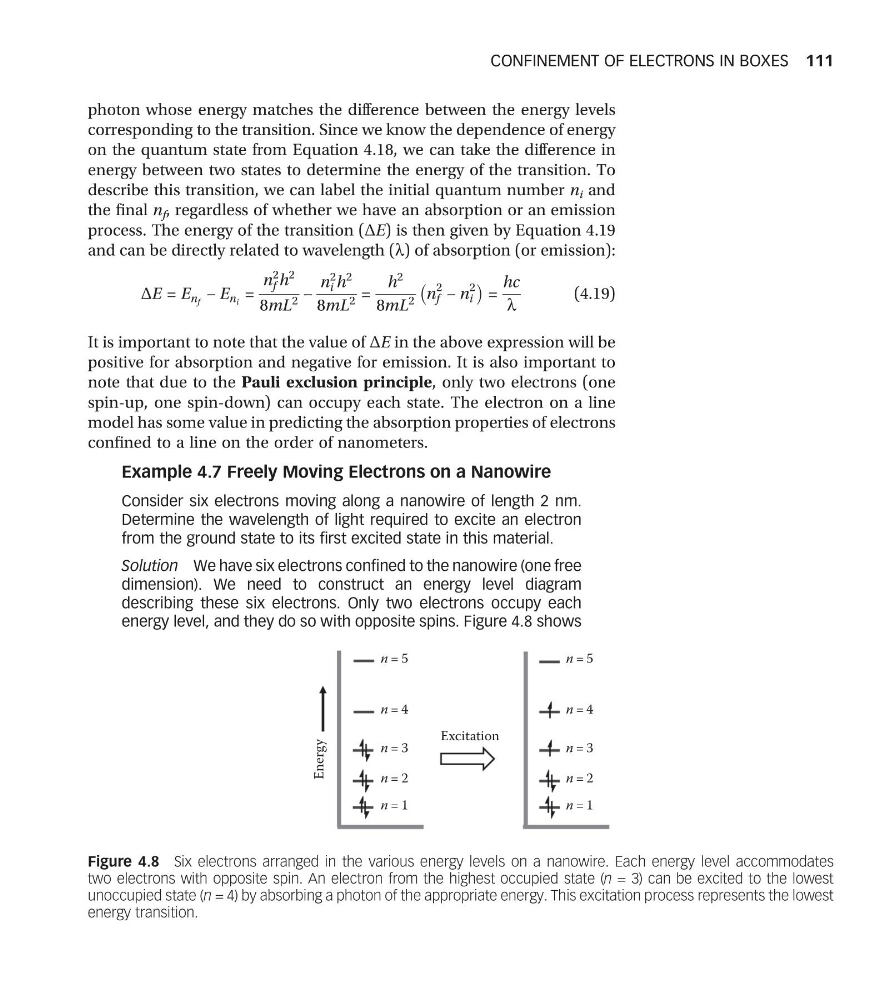
Solution We have six electrons confined to the nanowire (one free
dimension). We need to construct an energy level diagram
describing these six electrons. Only two electrons occupy each
energy level, and they do so with opposite spins. Figure 4.8 shows
Energy
Excitation
n = 5
n = 4
n = 3
n = 2
n = 1
n = 5
n = 4
n = 3
n = 2
n = 1
Figure 4.8 Six electrons arranged in the various energy levels on a nanowire. Each energy level accommodates
two electrons with opposite spin. An electron from the highest occupied state (n = 3) can be excited to the lowest
unoccupied state (n = 4) by absorbing a photon of the appropriate energy. This excitation process represents the lowest
energy transition.
CONFINEMENT OF ELECTRONS IN BOXES 111
corresponding to the transition. Since we know the dependence of energy
on the quantum state from Equation 4.18, we can take the difference in
energy between two states to determine the energy of the transition. To
describe this transition, we can label the initial quantum number n i and
the final n f , regardless of whether we have an absorption or an emission
process. The energy of the transition (ΔE) is then given by Equation 4.19
and can be directly related to wavelength (l) of absorption (or emission):
ΔE = E n f − E n i =
n
2
f h
2
8mL
2 −
n
2
i h
2
8mL
2 =
h
2
8mL
2 n
2
f − n
2
i
À
Á
=
hc
l
(4.19)
It is important to note that the value of ΔE in the above expression will be
positive for absorption and negative for emission. It is also important to
note that due to the Pauli exclusion principle, only two electrons (one
spin-up, one spin-down) can occupy each state. The electron on a line
model has some value in predicting the absorption properties of electrons
confined to a line on the order of nanometers.
Example 4.7 Freely Moving Electrons on a Nanowire
Consider six electrons moving along a nanowire of length 2 nm.
Determine the wavelength of light required to excite an electron
from the ground state to its first excited state in this material.
Solution We have six electrons confined to the nanowire (one free
dimension). We need to construct an energy level diagram
describing these six electrons. Only two electrons occupy each
energy level, and they do so with opposite spins. Figure 4.8 shows
Energy
Excitation
n = 5
n = 4
n = 3
n = 2
n = 1
n = 5
n = 4
n = 3
n = 2
n = 1
Figure 4.8 Six electrons arranged in the various energy levels on a nanowire. Each energy level accommodates
two electrons with opposite spin. An electron from the highest occupied state (n = 3) can be excited to the lowest
unoccupied state (n = 4) by absorbing a photon of the appropriate energy. This excitation process represents the lowest
energy transition.
CONFINEMENT OF ELECTRONS IN BOXES 111