

the transition in which the electron is excited from the n = 3 to the
n = 4 level. This represents the lowest energy transition from the
ground state to the first excited state. According to Equation 4.19,
the energy of the transition is given by
ΔE =
h
2
8 mL
2
n
2
f − n
2
i
=
6:626 Â 10
−34
J · s
À
Á 2
8 9:10939 Â 10
−31
kg
À
Á
2:00 Â 10
−9
m
À
Á 2 16 − 9
ð
Þ
= 1:054 Â 10
−19 J
And since
ΔE =
hc
λ
, λ =
hc
ΔE
=
(6:626 Â 10
−34
J Á s)(2:9979 Â 10
−8
m
s
= )
1:054 Â 10
−19
J
10
9
nm
1 m
= 1982 nm
Now that we have developed an expression for the energy of the electron,
we can explore the effect of size on energy level spacing. To determine a
general expression for the energy spacing, we can define a particular state
by its n value and then describe its neighboring level by n + 1. The energy
spacing is then
ΔE = E n+1 − E n =
h
2 n + 1
ð
Þ
2
8mL
2
−
h
2 n
2
8mL
2 =
h
2
8mL
2 2n + 1
ð
Þ
(4.20)
Equation 4.20 tells us that energy spacing decreases as the length L
increases. In fact, for bulk macroscopic dimensions, L may be so large that
the spacings are so small that the levels converge to a continuum. At the
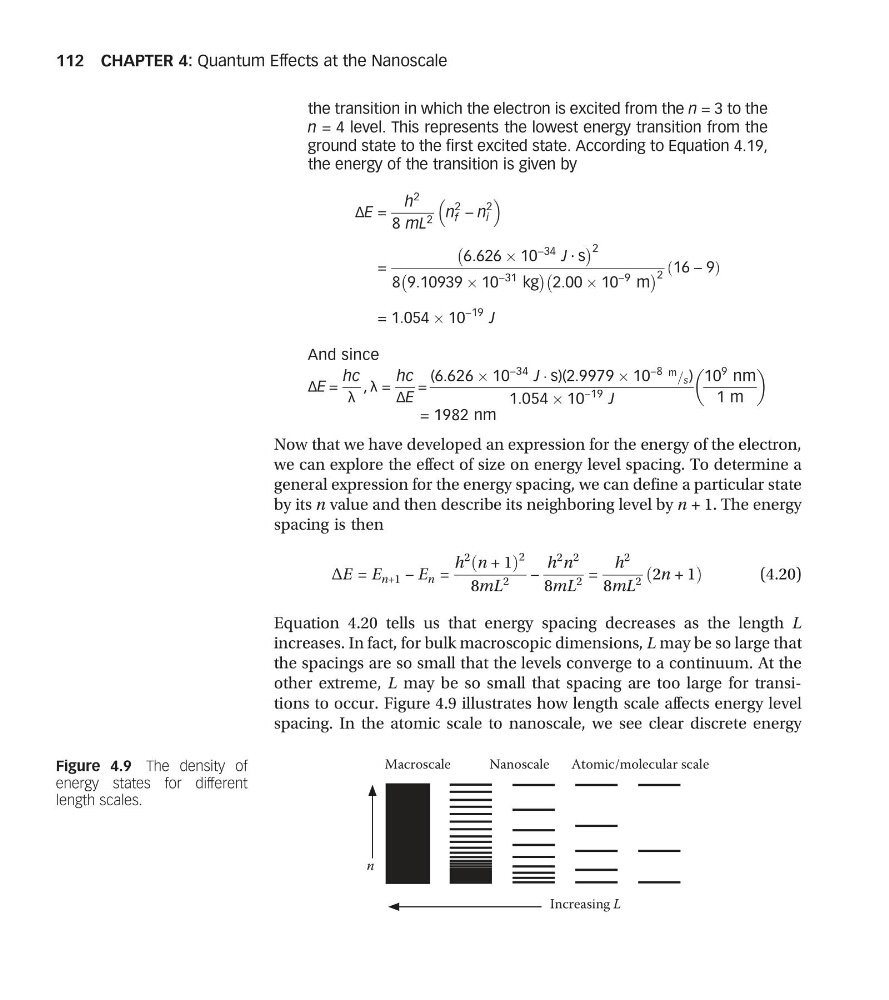
other extreme, L may be so small that spacing are too large for transitions to occur. Figure 4.9 illustrates how length scale affects energy level
spacing. In the atomic scale to nanoscale, we see clear discrete energy
Nanoscale
Atomic/molecular scale
Macroscale
Increasing L
n
Figure 4.9 The density of
energy states for different
length scales.
CHAPTER 4: Quantum Effects at the Nanoscale
112
n = 4 level. This represents the lowest energy transition from the
ground state to the first excited state. According to Equation 4.19,
the energy of the transition is given by
ΔE =
h
2
8 mL
2
n
2
f − n
2
i
=
6:626 Â 10
−34
J · s
À
Á 2
8 9:10939 Â 10
−31
kg
À
Á
2:00 Â 10
−9
m
À
Á 2 16 − 9
ð
Þ
= 1:054 Â 10
−19 J
And since
ΔE =
hc
λ
, λ =
hc
ΔE
=
(6:626 Â 10
−34
J Á s)(2:9979 Â 10
−8
m
s
= )
1:054 Â 10
−19
J
10
9
nm
1 m
= 1982 nm
Now that we have developed an expression for the energy of the electron,
we can explore the effect of size on energy level spacing. To determine a
general expression for the energy spacing, we can define a particular state
by its n value and then describe its neighboring level by n + 1. The energy
spacing is then
ΔE = E n+1 − E n =
h
2 n + 1
ð
Þ
2
8mL
2
−
h
2 n
2
8mL
2 =
h
2
8mL
2 2n + 1
ð
Þ
(4.20)
Equation 4.20 tells us that energy spacing decreases as the length L
increases. In fact, for bulk macroscopic dimensions, L may be so large that
the spacings are so small that the levels converge to a continuum. At the
other extreme, L may be so small that spacing are too large for transitions to occur. Figure 4.9 illustrates how length scale affects energy level
spacing. In the atomic scale to nanoscale, we see clear discrete energy
Nanoscale
Atomic/molecular scale
Macroscale
Increasing L
n
Figure 4.9 The density of
energy states for different
length scales.
CHAPTER 4: Quantum Effects at the Nanoscale
112