

In operator algebra, wavefunctions are a type of eigenfunction
and the energies obtained by operating on the wavefunction with the
Hamiltonian are the eigenvalues of the wavefunction. The example below
shows how eigenvalues are obtained from operators and eigenfunctions.
Example 4.3 An Eigenvalue Problem
Consider the operator ^
H =
d
2
dx
2
and the eigenfunctions ψ(x) = B e
−ax ,
where a and B are both constants. Determine the corresponding
eigenvalue.
Solution According to Equation 4.9,
^
Hψ x
ð Þ =
d
2
dx
2
B e
−ax
Â
Ã
= B
d
2
dx
2
e
−ax = a
2 B e
−ax = a
2 ψ x
ð Þ
The eigenvalue is a
2
.
We now apply the Schrödinger equation to more relevant systems in
nanoscience. In particular, we focus on the consequences of electrons
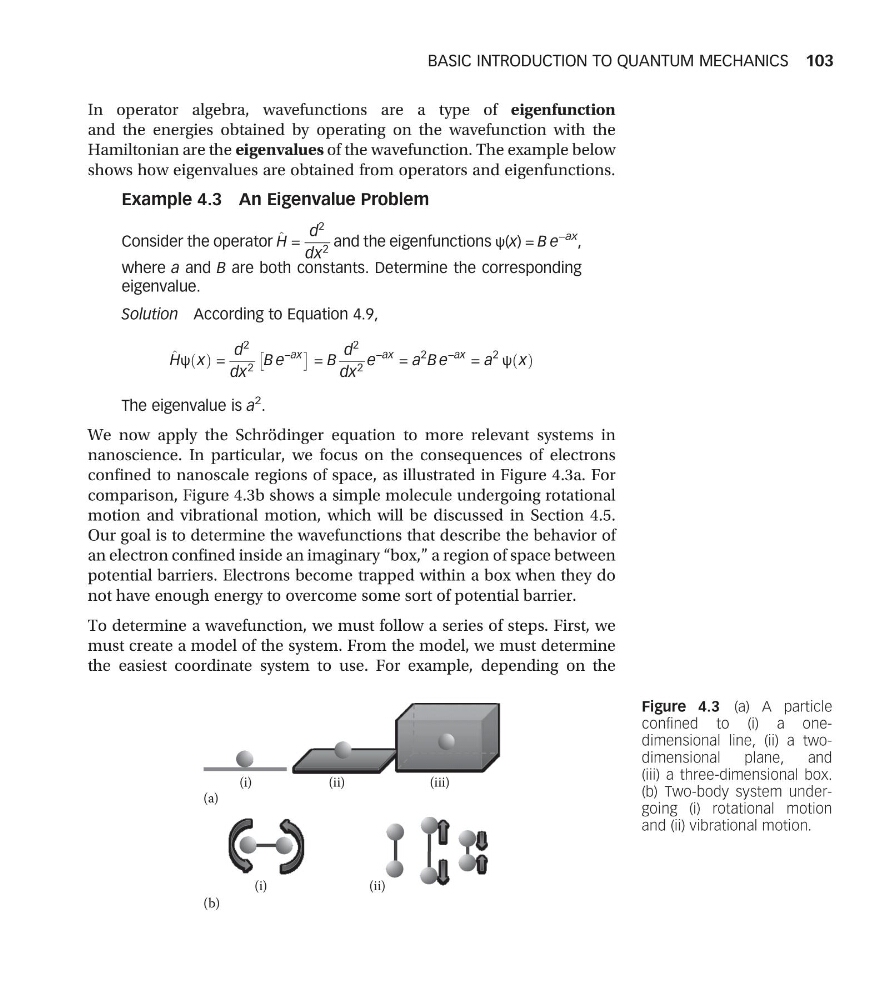
confined to nanoscale regions of space, as illustrated in Figure 4.3a. For
comparison, Figure 4.3b shows a simple molecule undergoing rotational
motion and vibrational motion, which will be discussed in Section 4.5.
Our goal is to determine the wavefunctions that describe the behavior of
an electron confined inside an imaginary “box,” a region of space between
potential barriers. Electrons become trapped within a box when they do
not have enough energy to overcome some sort of potential barrier.
To determine a wavefunction, we must follow a series of steps. First, we
must create a model of the system. From the model, we must determine
the easiest coordinate system to use. For example, depending on the
(i)
(ii)
(iii)
(i)
(ii)
(a)
(b)
Figure 4.3 (a) A particle
confined to (i) a onedimensional line, (ii) a twodimensional
plane,
and
(iii) a three-dimensional box.
(b) Two-body system undergoing (i) rotational motion
and (ii) vibrational motion.
BASIC INTRODUCTION TO QUANTUM MECHANICS 103
and the energies obtained by operating on the wavefunction with the
Hamiltonian are the eigenvalues of the wavefunction. The example below
shows how eigenvalues are obtained from operators and eigenfunctions.
Example 4.3 An Eigenvalue Problem
Consider the operator ^
H =
d
2
dx
2
and the eigenfunctions ψ(x) = B e
−ax ,
where a and B are both constants. Determine the corresponding
eigenvalue.
Solution According to Equation 4.9,
^
Hψ x
ð Þ =
d
2
dx
2
B e
−ax
Â
Ã
= B
d
2
dx
2
e
−ax = a
2 B e
−ax = a
2 ψ x
ð Þ
The eigenvalue is a
2
.
We now apply the Schrödinger equation to more relevant systems in
nanoscience. In particular, we focus on the consequences of electrons
confined to nanoscale regions of space, as illustrated in Figure 4.3a. For
comparison, Figure 4.3b shows a simple molecule undergoing rotational
motion and vibrational motion, which will be discussed in Section 4.5.
Our goal is to determine the wavefunctions that describe the behavior of
an electron confined inside an imaginary “box,” a region of space between
potential barriers. Electrons become trapped within a box when they do
not have enough energy to overcome some sort of potential barrier.
To determine a wavefunction, we must follow a series of steps. First, we
must create a model of the system. From the model, we must determine
the easiest coordinate system to use. For example, depending on the
(i)
(ii)
(iii)
(i)
(ii)
(a)
(b)
Figure 4.3 (a) A particle
confined to (i) a onedimensional line, (ii) a twodimensional
plane,
and
(iii) a three-dimensional box.
(b) Two-body system undergoing (i) rotational motion
and (ii) vibrational motion.
BASIC INTRODUCTION TO QUANTUM MECHANICS 103