

We discuss this model in more detail in Section 4.3, and show how
equations like Equation 4.8 are solved.
4.2.5 The Schrödinger equation
We now present the fundamental equation of quantum mechanics that
allows us to describe the energy of confined particles, such as electrons.
The Schrödinger equation, also known as the Schrödinger wave equation, takes into account the wavelike nature of small particles and is
completely consistent with the uncertainty principle. To use the equation,
we need to know the particle’s mass and define its region of enclosure
(known as boundary conditions). For simplicity, we can define the region
in one dimension (the x-direction). Solving the equation should allow us
to determine the energy of the particle in the defined region. We will do
the mathematical derivations in the next section, but for now we will
simply present the Schrödinger equation as a simple axiom in quantum
theory (Equation 4.9):
^
Hy x
ð Þ = Ey x
ð Þ
(4.9)
The above equation is deceptively simple, so let’s discuss each term
separately. The term ^
H is an operator (also known as the Hamiltonian
operator). Operators describes some kind of mathematical operation,
such as “take the square root,” or “multiply by four,” or “take the second
derivative.” The Hamiltonian operator is an energy operator, meaning
that when it’s used in the Schrödinger equation, it will yield the energy of
the system. The Hamiltonian operator consists of a kinetic energy term
( ^
K ) and a potential energy term ( ^
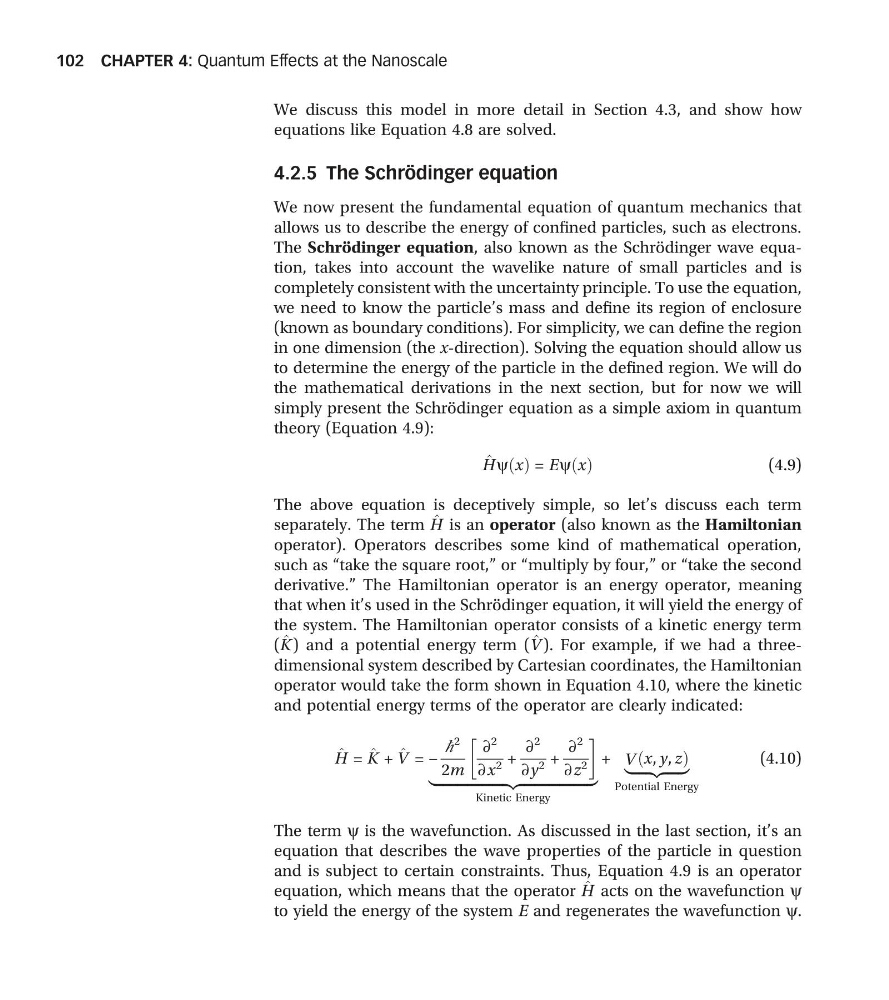
V ). For example, if we had a threedimensional system described by Cartesian coordinates, the Hamiltonian
operator would take the form shown in Equation 4.10, where the kinetic
and potential energy terms of the operator are clearly indicated:
^
H = ^
K + ^
V = −
ℏ
2
2m
∂
2
∂x
2 +
∂
2
∂y
2 +
∂
2
∂z
2
!
|fflfflfflfflfflfflfflfflfflfflfflfflfflfflfflfflfflfflfflffl{zfflfflfflfflfflfflfflfflfflfflfflfflfflfflfflfflfflfflfflffl}
Kinetic Energy
+ V x, y, z
ð
Þ
|fflfflfflfflffl{zfflfflfflfflffl}
Potential Energy
(4.10)
The term y is the wavefunction. As discussed in the last section, it’s an
equation that describes the wave properties of the particle in question
and is subject to certain constraints. Thus, Equation 4.9 is an operator
equation, which means that the operator ^
H acts on the wavefunction y
to yield the energy of the system E and regenerates the wavefunction y.
CHAPTER 4: Quantum Effects at the Nanoscale
102
equations like Equation 4.8 are solved.
4.2.5 The Schrödinger equation
We now present the fundamental equation of quantum mechanics that
allows us to describe the energy of confined particles, such as electrons.
The Schrödinger equation, also known as the Schrödinger wave equation, takes into account the wavelike nature of small particles and is
completely consistent with the uncertainty principle. To use the equation,
we need to know the particle’s mass and define its region of enclosure
(known as boundary conditions). For simplicity, we can define the region
in one dimension (the x-direction). Solving the equation should allow us
to determine the energy of the particle in the defined region. We will do
the mathematical derivations in the next section, but for now we will
simply present the Schrödinger equation as a simple axiom in quantum
theory (Equation 4.9):
^
Hy x
ð Þ = Ey x
ð Þ
(4.9)
The above equation is deceptively simple, so let’s discuss each term
separately. The term ^
H is an operator (also known as the Hamiltonian
operator). Operators describes some kind of mathematical operation,
such as “take the square root,” or “multiply by four,” or “take the second
derivative.” The Hamiltonian operator is an energy operator, meaning
that when it’s used in the Schrödinger equation, it will yield the energy of
the system. The Hamiltonian operator consists of a kinetic energy term
( ^
K ) and a potential energy term ( ^
V ). For example, if we had a threedimensional system described by Cartesian coordinates, the Hamiltonian
operator would take the form shown in Equation 4.10, where the kinetic
and potential energy terms of the operator are clearly indicated:
^
H = ^
K + ^
V = −
ℏ
2
2m
∂
2
∂x
2 +
∂
2
∂y
2 +
∂
2
∂z
2
!
|fflfflfflfflfflfflfflfflfflfflfflfflfflfflfflfflfflfflfflffl{zfflfflfflfflfflfflfflfflfflfflfflfflfflfflfflfflfflfflfflffl}
Kinetic Energy
+ V x, y, z
ð
Þ
|fflfflfflfflffl{zfflfflfflfflffl}
Potential Energy
(4.10)
The term y is the wavefunction. As discussed in the last section, it’s an
equation that describes the wave properties of the particle in question
and is subject to certain constraints. Thus, Equation 4.9 is an operator
equation, which means that the operator ^
H acts on the wavefunction y
to yield the energy of the system E and regenerates the wavefunction y.
CHAPTER 4: Quantum Effects at the Nanoscale
102