

At this point it is worth saying something about spatial quantization. This
is the allowed three-dimensional region given to a bound particle. An
example is the 1s orbital in hydrogen. We know this to be a spherically
symmetrical orbital that accommodates the ground state electron in
hydrogen. A 2p orbital consists of dumbbell-shaped region occupied by
the electron. It should be noted that spatial quantization provides only a
probability density of finding a particle within the space defined by
certain boundary conditions.
4.2.4 The wavefunction
In Sections 4.2.1 and 4.2.2, we established that light and matter can
be represented as waves. Quantum confinement is observed when a
dimension of a material is of the same magnitude as the de Broglie wavelength of the particles (typically electrons) moving within the material.
Confined particles can be represented by an important mathematical
function called the wavefunction. The wavefunction, usually given the
symbol y, is a function that describes the wave properties of the bound
particle. While a particle’s wavefunction cannot be directly observed, the
square of the wavefunction has an observable, probabilistic interpretation. For example let’s consider an electron confined to a line of length a.
This is a simple one-dimensional model where our line can be described
along an x-axis, where the length goes from x = 0 to x = a. Since our model
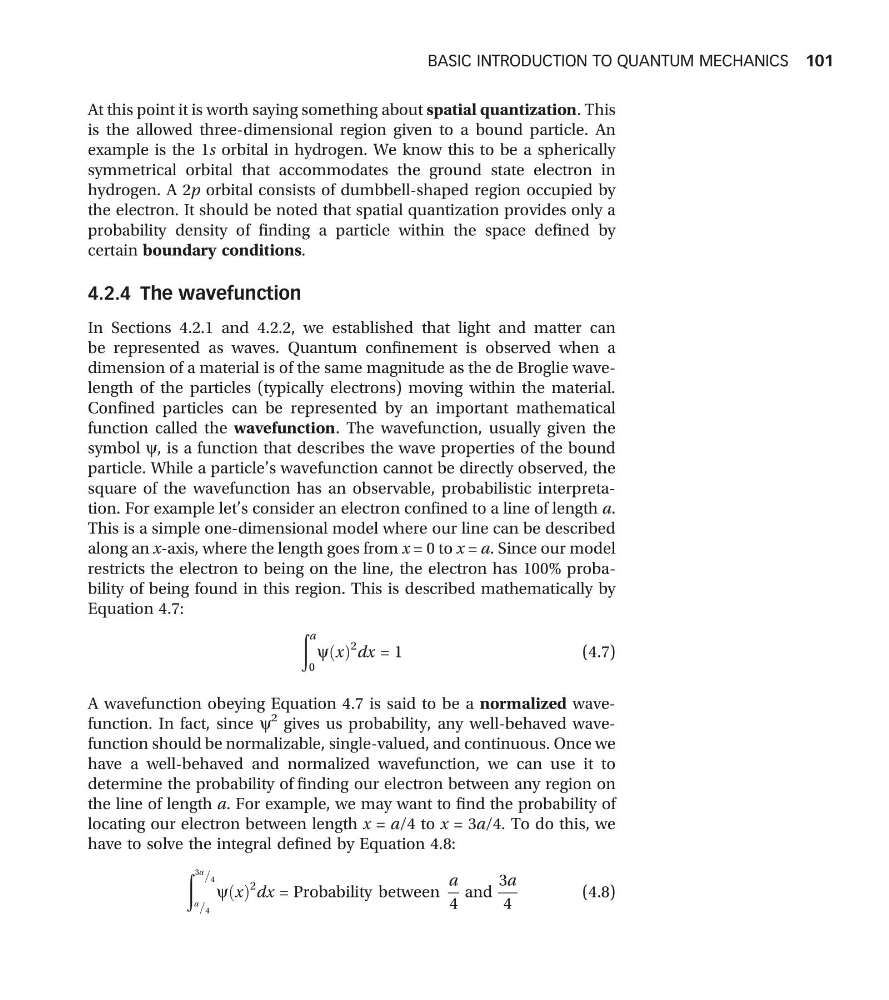
restricts the electron to being on the line, the electron has 100% probability of being found in this region. This is described mathematically by
Equation 4.7:
ð a
0
y x
ð Þ
2 dx = 1
(4.7)
A wavefunction obeying Equation 4.7 is said to be a normalized wavefunction. In fact, since y
2 gives us probability, any well-behaved wavefunction should be normalizable, single-valued, and continuous. Once we
have a well-behaved and normalized wavefunction, we can use it to
determine the probability of finding our electron between any region on
the line of length a. For example, we may want to find the probability of
locating our electron between length x = a/4 to x = 3a/4. To do this, we
have to solve the integral defined by Equation 4.8:
ð3a
4
=
a
4
=
y x
ð Þ
2 dx = Probability between
a
4
and
3a
4
(4.8)
BASIC INTRODUCTION TO QUANTUM MECHANICS 101
is the allowed three-dimensional region given to a bound particle. An
example is the 1s orbital in hydrogen. We know this to be a spherically
symmetrical orbital that accommodates the ground state electron in
hydrogen. A 2p orbital consists of dumbbell-shaped region occupied by
the electron. It should be noted that spatial quantization provides only a
probability density of finding a particle within the space defined by
certain boundary conditions.
4.2.4 The wavefunction
In Sections 4.2.1 and 4.2.2, we established that light and matter can
be represented as waves. Quantum confinement is observed when a
dimension of a material is of the same magnitude as the de Broglie wavelength of the particles (typically electrons) moving within the material.
Confined particles can be represented by an important mathematical
function called the wavefunction. The wavefunction, usually given the
symbol y, is a function that describes the wave properties of the bound
particle. While a particle’s wavefunction cannot be directly observed, the
square of the wavefunction has an observable, probabilistic interpretation. For example let’s consider an electron confined to a line of length a.
This is a simple one-dimensional model where our line can be described
along an x-axis, where the length goes from x = 0 to x = a. Since our model
restricts the electron to being on the line, the electron has 100% probability of being found in this region. This is described mathematically by
Equation 4.7:
ð a
0
y x
ð Þ
2 dx = 1
(4.7)
A wavefunction obeying Equation 4.7 is said to be a normalized wavefunction. In fact, since y
2 gives us probability, any well-behaved wavefunction should be normalizable, single-valued, and continuous. Once we
have a well-behaved and normalized wavefunction, we can use it to
determine the probability of finding our electron between any region on
the line of length a. For example, we may want to find the probability of
locating our electron between length x = a/4 to x = 3a/4. To do this, we
have to solve the integral defined by Equation 4.8:
ð3a
4
=
a
4
=
y x
ð Þ
2 dx = Probability between
a
4
and
3a
4
(4.8)
BASIC INTRODUCTION TO QUANTUM MECHANICS 101