

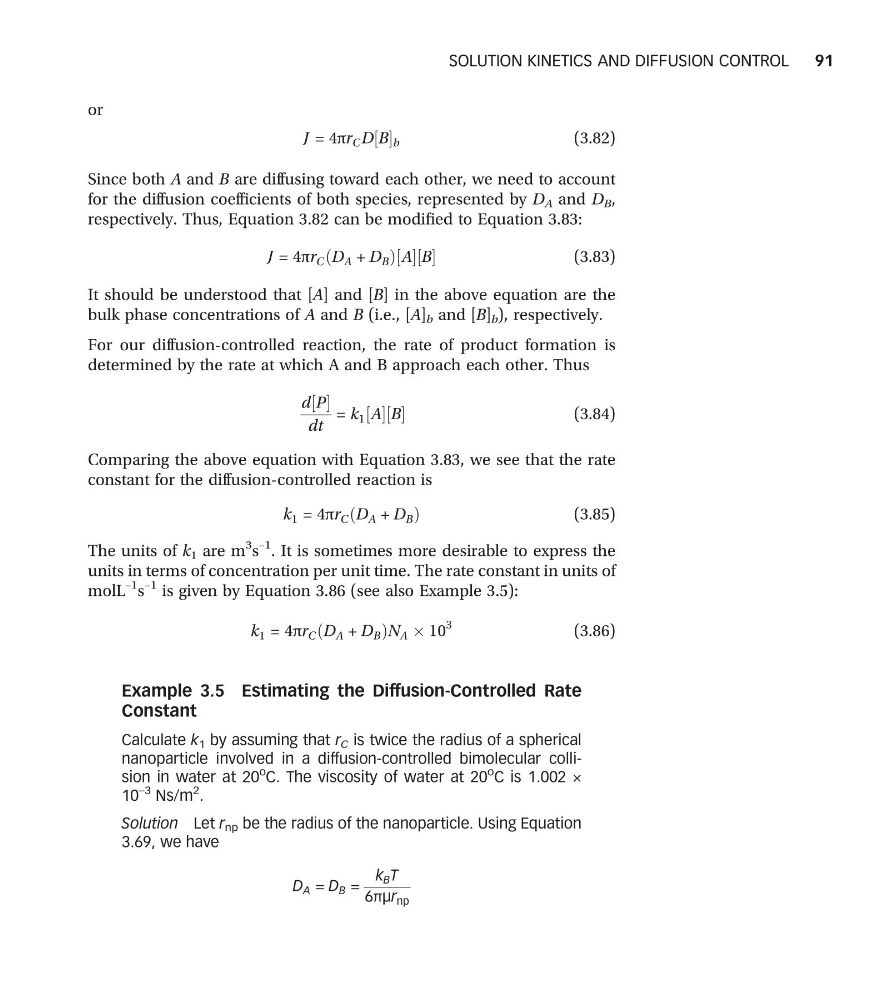
or
J = 4πr C D B
½ b
(3.82)
Since both A and B are diffusing toward each other, we need to account
for the diffusion coefficients of both species, represented by D A and D B ,
respectively. Thus, Equation 3.82 can be modified to Equation 3.83:
J = 4πr C D A + D B
ð
ÞA ½ B
½
(3.83)
It should be understood that [A] and [B] in the above equation are the
bulk phase concentrations of A and B (i.e., [A] b and [B] b ), respectively.
For our diffusion-controlled reaction, the rate of product formation is
determined by the rate at which A and B approach each other. Thus
d P
½
dt
= k 1 A
½ B
½
(3.84)
Comparing the above equation with Equation 3.83, we see that the rate
constant for the diffusion-controlled reaction is
k 1 = 4πr C D A + D B
ð
Þ
(3.85)
The units of k 1 are m
3 s
–1
. It is sometimes more desirable to express the
units in terms of concentration per unit time. The rate constant in units of
molL
–1 s
–1 is given by Equation 3.86 (see also Example 3.5):
k 1 = 4πr C D A + D B
ð
Þ N A Â 10
3
(3.86)
Example 3.5 Estimating the Diffusion-Controlled Rate
Constant
Calculate k 1 by assuming that r C is twice the radius of a spherical
nanoparticle involved in a diffusion-controlled bimolecular collision in water at 20
o
C. The viscosity of water at 20
o C is 1.002 ×
10
–3 Ns/m
2
.
Solution Let r np be the radius of the nanoparticle. Using Equation
3.69, we have
D A = D B =
k B T
6πμr np
SOLUTION KINETICS AND DIFFUSION CONTROL
91
J = 4πr C D B
½ b
(3.82)
Since both A and B are diffusing toward each other, we need to account
for the diffusion coefficients of both species, represented by D A and D B ,
respectively. Thus, Equation 3.82 can be modified to Equation 3.83:
J = 4πr C D A + D B
ð
ÞA ½ B
½
(3.83)
It should be understood that [A] and [B] in the above equation are the
bulk phase concentrations of A and B (i.e., [A] b and [B] b ), respectively.
For our diffusion-controlled reaction, the rate of product formation is
determined by the rate at which A and B approach each other. Thus
d P
½
dt
= k 1 A
½ B
½
(3.84)
Comparing the above equation with Equation 3.83, we see that the rate
constant for the diffusion-controlled reaction is
k 1 = 4πr C D A + D B
ð
Þ
(3.85)
The units of k 1 are m
3 s
–1
. It is sometimes more desirable to express the
units in terms of concentration per unit time. The rate constant in units of
molL
–1 s
–1 is given by Equation 3.86 (see also Example 3.5):
k 1 = 4πr C D A + D B
ð
Þ N A Â 10
3
(3.86)
Example 3.5 Estimating the Diffusion-Controlled Rate
Constant
Calculate k 1 by assuming that r C is twice the radius of a spherical
nanoparticle involved in a diffusion-controlled bimolecular collision in water at 20
o
C. The viscosity of water at 20
o C is 1.002 ×
10
–3 Ns/m
2
.
Solution Let r np be the radius of the nanoparticle. Using Equation
3.69, we have
D A = D B =
k B T
6πμr np
SOLUTION KINETICS AND DIFFUSION CONTROL
91