

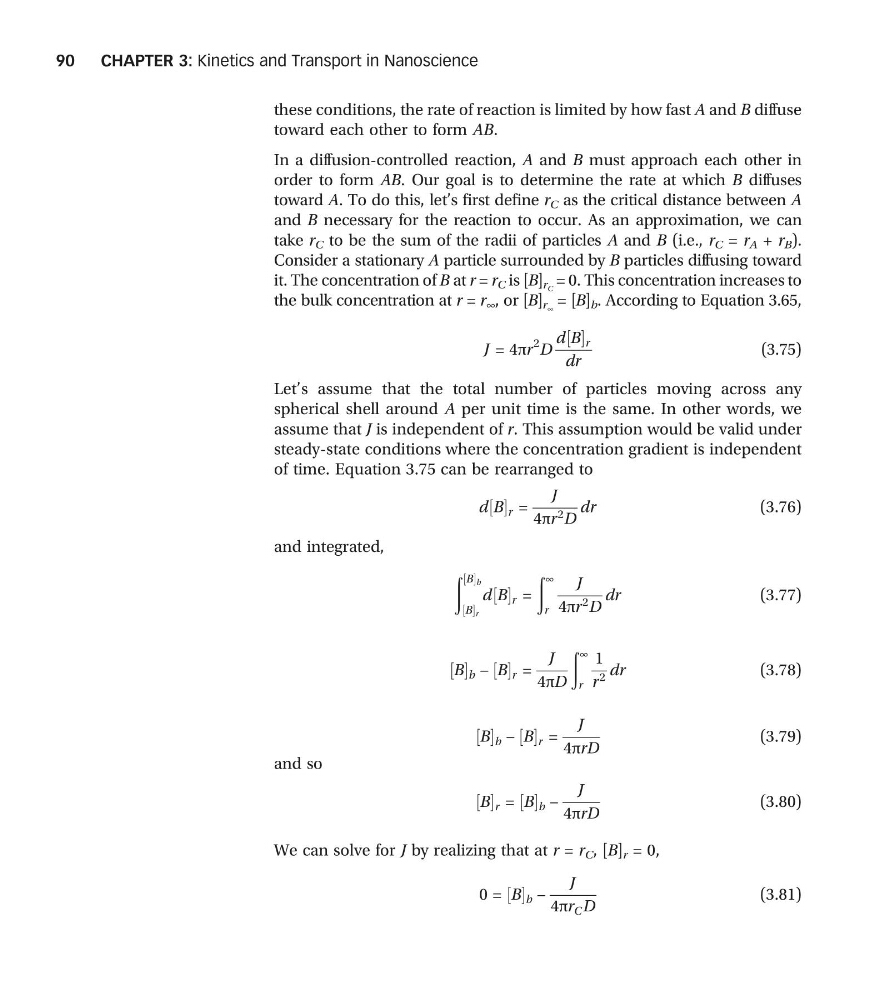
these conditions, the rate of reaction is limited by how fast A and B diffuse
toward each other to form AB.
In a diffusion-controlled reaction, A and B must approach each other in
order to form AB. Our goal is to determine the rate at which B diffuses
toward A. To do this, let’s first define r C as the critical distance between A
and B necessary for the reaction to occur. As an approximation, we can
take r C to be the sum of the radii of particles A and B (i.e., r C = r A + r B ).
Consider a stationary A particle surrounded by B particles diffusing toward
it. The concentration of B at r = r C is [B] r C = 0. This concentration increases to
the bulk concentration at r = r ∞ , or [B] r ∞ = [B] b . According to Equation 3.65,
J = 4πr
2 D
d B
½ r
dr
(3.75)
Let’s assume that the total number of particles moving across any
spherical shell around A per unit time is the same. In other words, we
assume that J is independent of r. This assumption would be valid under
steady-state conditions where the concentration gradient is independent
of time. Equation 3.75 can be rearranged to
d B
½ r =
J
4πr
2 D
dr
(3.76)
and integrated,
ð B
½ b
B
½ r
d B
½ r =
ð ∞
r
J
4πr 2 D
dr
(3.77)
B
½ b − B
½ r =
J
4πD
ð ∞
r
1
r
2 dr
(3.78)
B
½ b − B
½ r =
J
4πrD
(3.79)
and so
B
½ r = B
½ b −
J
4πrD
(3.80)
We can solve for J by realizing that at r = r C , [B] r = 0,
0 = B
½ b −
J
4πr C D
(3.81)
CHAPTER 3: Kinetics and Transport in Nanoscience
90
toward each other to form AB.
In a diffusion-controlled reaction, A and B must approach each other in
order to form AB. Our goal is to determine the rate at which B diffuses
toward A. To do this, let’s first define r C as the critical distance between A
and B necessary for the reaction to occur. As an approximation, we can
take r C to be the sum of the radii of particles A and B (i.e., r C = r A + r B ).
Consider a stationary A particle surrounded by B particles diffusing toward
it. The concentration of B at r = r C is [B] r C = 0. This concentration increases to
the bulk concentration at r = r ∞ , or [B] r ∞ = [B] b . According to Equation 3.65,
J = 4πr
2 D
d B
½ r
dr
(3.75)
Let’s assume that the total number of particles moving across any
spherical shell around A per unit time is the same. In other words, we
assume that J is independent of r. This assumption would be valid under
steady-state conditions where the concentration gradient is independent
of time. Equation 3.75 can be rearranged to
d B
½ r =
J
4πr
2 D
dr
(3.76)
and integrated,
ð B
½ b
B
½ r
d B
½ r =
ð ∞
r
J
4πr 2 D
dr
(3.77)
B
½ b − B
½ r =
J
4πD
ð ∞
r
1
r
2 dr
(3.78)
B
½ b − B
½ r =
J
4πrD
(3.79)
and so
B
½ r = B
½ b −
J
4πrD
(3.80)
We can solve for J by realizing that at r = r C , [B] r = 0,
0 = B
½ b −
J
4πr C D
(3.81)
CHAPTER 3: Kinetics and Transport in Nanoscience
90