

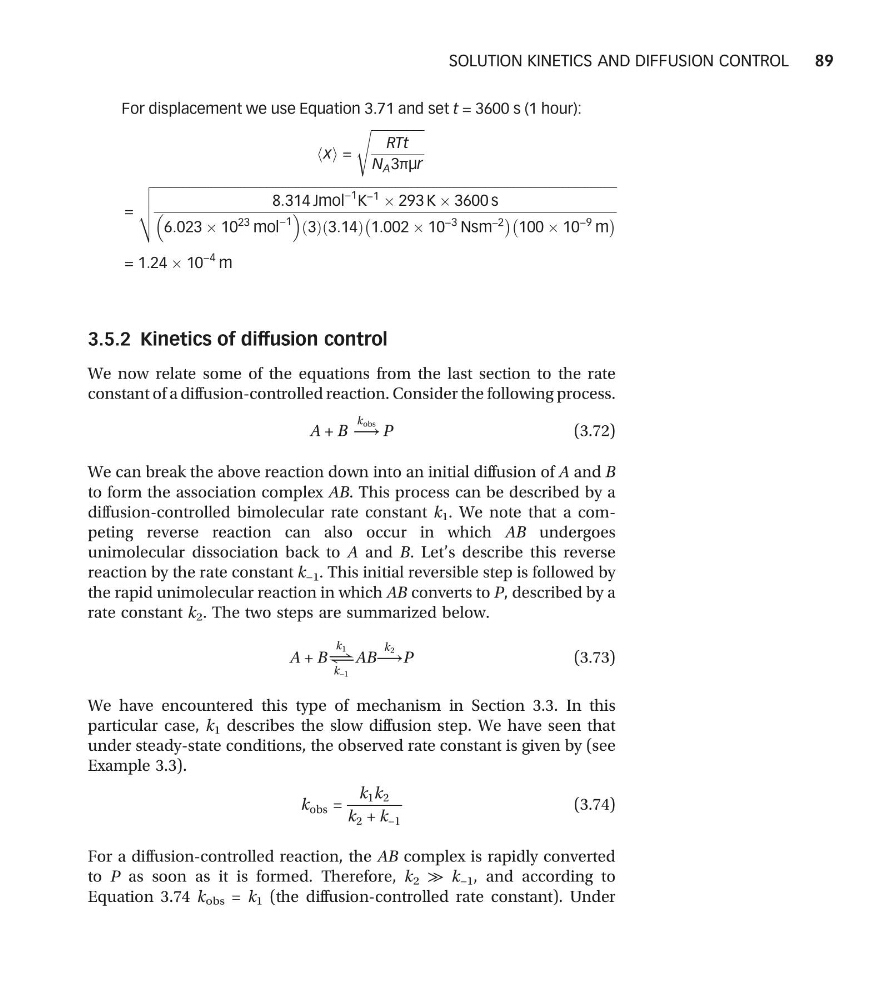
For displacement we use Equation 3.71 and set t = 3600 s (1 hour):
x
h i =
ffiffiffiffiffiffiffiffiffiffiffiffiffiffiffiffiffi
RTt
N A 3πμr
s
=
ffiffiffiffiffiffiffiffiffiffiffiffiffiffiffiffiffiffiffiffiffiffiffiffiffiffiffiffiffiffiffiffiffiffiffiffiffiffiffiffiffiffiffiffiffiffiffiffiffiffiffiffiffiffiffiffiffiffiffiffiffiffiffiffiffiffiffiffiffiffiffiffiffiffiffiffiffiffiffiffiffiffiffiffiffiffiffiffiffiffiffiffiffiffiffiffiffiffiffiffiffiffiffiffiffiffiffiffiffiffiffiffiffiffiffiffiffiffiffiffiffiffiffiffiffiffiffiffiffiffiffiffiffiffiffiffiffiffiffiffiffiffiffiffi
8:314 Jmol
−1 K
−1
 293 K  3600 s
6:023 Â 10
23 mol
−1
3
ð Þ 3:14
ð
Þ 1:002 Â 10
−3 Nsm
‒2
À
Á
100 Â 10
−9 m
À
Á
v
u
u
t
= 1:24 Â 10
−4 m
3.5.2 Kinetics of diffusion control
We now relate some of the equations from the last section to the rate
constant of a diffusion-controlled reaction. Consider the following process.
A + B ⟶
k obs P
(3.72)
We can break the above reaction down into an initial diffusion of A and B
to form the association complex AB. This process can be described by a
diffusion-controlled bimolecular rate constant k 1 . We note that a competing reverse reaction can also occur in which AB undergoes
unimolecular dissociation back to A and B. Let’s describe this reverse
reaction by the rate constant k −1 . This initial reversible step is followed by
the rapid unimolecular reaction in which AB converts to P, described by a
rate constant k 2 . The two steps are summarized below.
A + B⇌
k 1
k −1
AB⟶
k 2 P
(3.73)
We have encountered this type of mechanism in Section 3.3. In this
particular case, k 1 describes the slow diffusion step. We have seen that
under steady-state conditions, the observed rate constant is given by (see
Example 3.3).
k obs =
k 1 k 2
k 2 + k −1
(3.74)
For a diffusion-controlled reaction, the AB complex is rapidly converted
to P as soon as it is formed. Therefore, k 2 ≫ k −1 , and according to
Equation 3.74 k obs = k 1 (the diffusion-controlled rate constant). Under
SOLUTION KINETICS AND DIFFUSION CONTROL
89
x
h i =
ffiffiffiffiffiffiffiffiffiffiffiffiffiffiffiffiffi
RTt
N A 3πμr
s
=
ffiffiffiffiffiffiffiffiffiffiffiffiffiffiffiffiffiffiffiffiffiffiffiffiffiffiffiffiffiffiffiffiffiffiffiffiffiffiffiffiffiffiffiffiffiffiffiffiffiffiffiffiffiffiffiffiffiffiffiffiffiffiffiffiffiffiffiffiffiffiffiffiffiffiffiffiffiffiffiffiffiffiffiffiffiffiffiffiffiffiffiffiffiffiffiffiffiffiffiffiffiffiffiffiffiffiffiffiffiffiffiffiffiffiffiffiffiffiffiffiffiffiffiffiffiffiffiffiffiffiffiffiffiffiffiffiffiffiffiffiffiffiffiffi
8:314 Jmol
−1 K
−1
 293 K  3600 s
6:023 Â 10
23 mol
−1
3
ð Þ 3:14
ð
Þ 1:002 Â 10
−3 Nsm
‒2
À
Á
100 Â 10
−9 m
À
Á
v
u
u
t
= 1:24 Â 10
−4 m
3.5.2 Kinetics of diffusion control
We now relate some of the equations from the last section to the rate
constant of a diffusion-controlled reaction. Consider the following process.
A + B ⟶
k obs P
(3.72)
We can break the above reaction down into an initial diffusion of A and B
to form the association complex AB. This process can be described by a
diffusion-controlled bimolecular rate constant k 1 . We note that a competing reverse reaction can also occur in which AB undergoes
unimolecular dissociation back to A and B. Let’s describe this reverse
reaction by the rate constant k −1 . This initial reversible step is followed by
the rapid unimolecular reaction in which AB converts to P, described by a
rate constant k 2 . The two steps are summarized below.
A + B⇌
k 1
k −1
AB⟶
k 2 P
(3.73)
We have encountered this type of mechanism in Section 3.3. In this
particular case, k 1 describes the slow diffusion step. We have seen that
under steady-state conditions, the observed rate constant is given by (see
Example 3.3).
k obs =
k 1 k 2
k 2 + k −1
(3.74)
For a diffusion-controlled reaction, the AB complex is rapidly converted
to P as soon as it is formed. Therefore, k 2 ≫ k −1 , and according to
Equation 3.74 k obs = k 1 (the diffusion-controlled rate constant). Under
SOLUTION KINETICS AND DIFFUSION CONTROL
89