

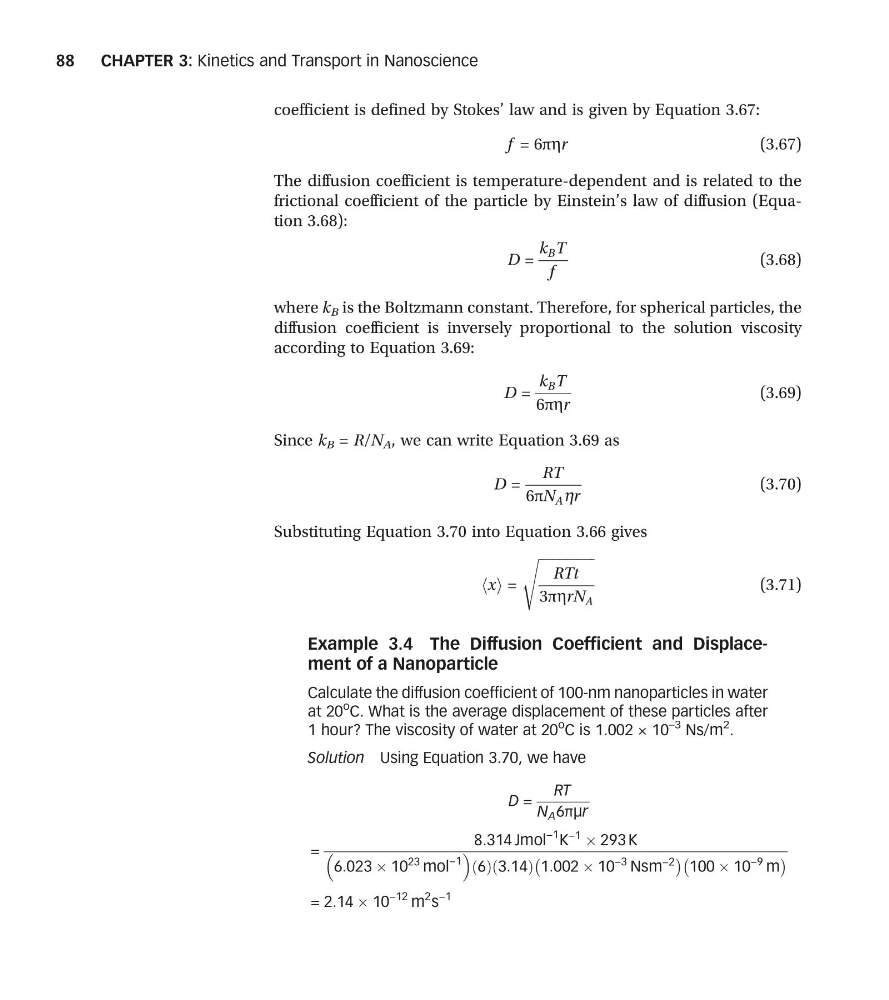
coefficient is defined by Stokes’ law and is given by Equation 3.67:
f = 6πhr
(3.67)
The diffusion coefficient is temperature-dependent and is related to the
frictional coefficient of the particle by Einstein’s law of diffusion (Equation 3.68):
D =
k B T
f
(3.68)
where k B is the Boltzmann constant. Therefore, for spherical particles, the
diffusion coefficient is inversely proportional to the solution viscosity
according to Equation 3.69:
D =
k B T
6πhr
(3.69)
Since k B = R/N A , we can write Equation 3.69 as
D =
RT
6πN A hr
(3.70)
Substituting Equation 3.70 into Equation 3.66 gives
x
h i =
ffiffiffiffiffiffiffiffiffiffiffiffiffiffiffiffi
RTt
3πhrN A
s
(3.71)
Example 3.4 The Diffusion Coefficient and Displacement of a Nanoparticle
Calculate the diffusion coefficient of 100-nm nanoparticles in water
at 20
o C. What is the average displacement of these particles after
1 hour? The viscosity of water at 20
o C is 1.002 × 10
–3 Ns/m
2
.
Solution Using Equation 3.70, we have
D =
RT
N A 6πμr
=
8:314 Jmol
−1 K
−1
 293 K
6:023 Â 10
23 mol
−1
6
ð Þ 3:14
ð
Þ 1:002 Â 10
−3 Nsm
−2
À
Á
100 Â 10
−9 m
À
Á
= 2:14 Â 10
−12 m
2 s
−1
CHAPTER 3: Kinetics and Transport in Nanoscience
88
f = 6πhr
(3.67)
The diffusion coefficient is temperature-dependent and is related to the
frictional coefficient of the particle by Einstein’s law of diffusion (Equation 3.68):
D =
k B T
f
(3.68)
where k B is the Boltzmann constant. Therefore, for spherical particles, the
diffusion coefficient is inversely proportional to the solution viscosity
according to Equation 3.69:
D =
k B T
6πhr
(3.69)
Since k B = R/N A , we can write Equation 3.69 as
D =
RT
6πN A hr
(3.70)
Substituting Equation 3.70 into Equation 3.66 gives
x
h i =
ffiffiffiffiffiffiffiffiffiffiffiffiffiffiffiffi
RTt
3πhrN A
s
(3.71)
Example 3.4 The Diffusion Coefficient and Displacement of a Nanoparticle
Calculate the diffusion coefficient of 100-nm nanoparticles in water
at 20
o C. What is the average displacement of these particles after
1 hour? The viscosity of water at 20
o C is 1.002 × 10
–3 Ns/m
2
.
Solution Using Equation 3.70, we have
D =
RT
N A 6πμr
=
8:314 Jmol
−1 K
−1
 293 K
6:023 Â 10
23 mol
−1
6
ð Þ 3:14
ð
Þ 1:002 Â 10
−3 Nsm
−2
À
Á
100 Â 10
−9 m
À
Á
= 2:14 Â 10
−12 m
2 s
−1
CHAPTER 3: Kinetics and Transport in Nanoscience
88