

diffusion of reactants. Thus, the rate is governed by the collision frequency between reacting species. Heterogeneous reactions are also often
diffusion-controlled, as reactant molecules must reach the interface to
participate in the reaction and are therefore common for reactions in
which solid nanomaterials (like particles) react with other species in
solution.
3.5.1 Some basic physics of diffusion of nanomaterials
in solution
This section introduces some of the basic equations describing the diffusion of nanoparticles in solution. Diffusion is an entropically driven
process; particles in solution will be more likely to move from regions of
high concentration to regions of low concentration since there are a greater
number of ways of moving a particle out of the high-concentration region
than into it. Consider the movement of particles along a two-dimensional
plate of area A. We will define flux (F) as the mass moving across this area
per unit time. Fick’s first law of diffusion tells us that the amount of material
diffusing across an area A is directly proportional to the concentration
gradient (dC/dt) and the area (Equation 3.64):
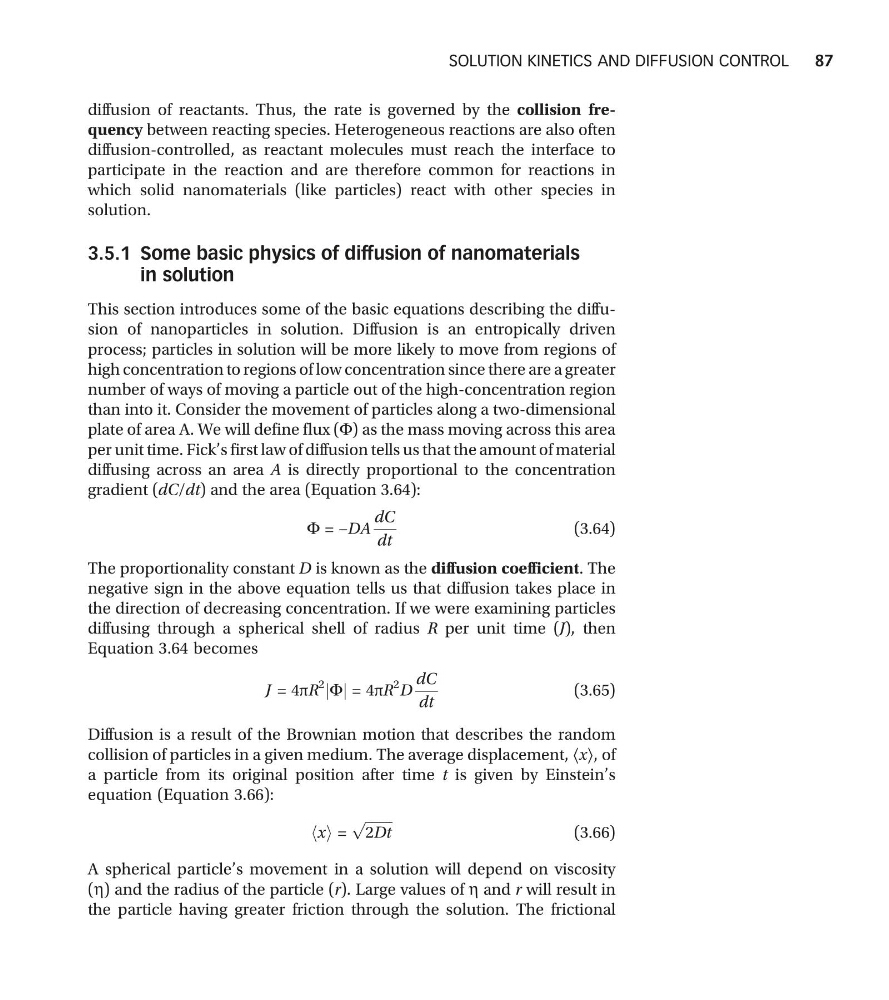
F = −DA
dC
dt
(3.64)
The proportionality constant D is known as the diffusion coefficient. The
negative sign in the above equation tells us that diffusion takes place in
the direction of decreasing concentration. If we were examining particles
diffusing through a spherical shell of radius R per unit time (J), then
Equation 3.64 becomes
J = 4πR
2 F
j j = 4πR
2 D
dC
dt
(3.65)
Diffusion is a result of the Brownian motion that describes the random
collision of particles in a given medium. The average displacement, 〈x〉, of
a particle from its original position after time t is given by Einstein’s
equation (Equation 3.66):
x
h i =
ffiffiffiffiffiffiffiffi
2Dt
p
(3.66)
A spherical particle’s movement in a solution will depend on viscosity
(h) and the radius of the particle (r). Large values of h and r will result in
the particle having greater friction through the solution. The frictional
SOLUTION KINETICS AND DIFFUSION CONTROL
87
diffusion-controlled, as reactant molecules must reach the interface to
participate in the reaction and are therefore common for reactions in
which solid nanomaterials (like particles) react with other species in
solution.
3.5.1 Some basic physics of diffusion of nanomaterials
in solution
This section introduces some of the basic equations describing the diffusion of nanoparticles in solution. Diffusion is an entropically driven
process; particles in solution will be more likely to move from regions of
high concentration to regions of low concentration since there are a greater
number of ways of moving a particle out of the high-concentration region
than into it. Consider the movement of particles along a two-dimensional
plate of area A. We will define flux (F) as the mass moving across this area
per unit time. Fick’s first law of diffusion tells us that the amount of material
diffusing across an area A is directly proportional to the concentration
gradient (dC/dt) and the area (Equation 3.64):
F = −DA
dC
dt
(3.64)
The proportionality constant D is known as the diffusion coefficient. The
negative sign in the above equation tells us that diffusion takes place in
the direction of decreasing concentration. If we were examining particles
diffusing through a spherical shell of radius R per unit time (J), then
Equation 3.64 becomes
J = 4πR
2 F
j j = 4πR
2 D
dC
dt
(3.65)
Diffusion is a result of the Brownian motion that describes the random
collision of particles in a given medium. The average displacement, 〈x〉, of
a particle from its original position after time t is given by Einstein’s
equation (Equation 3.66):
x
h i =
ffiffiffiffiffiffiffiffi
2Dt
p
(3.66)
A spherical particle’s movement in a solution will depend on viscosity
(h) and the radius of the particle (r). Large values of h and r will result in
the particle having greater friction through the solution. The frictional
SOLUTION KINETICS AND DIFFUSION CONTROL
87