

other L molecules to M. If n < 1 the binding is anticooperative—the
bound ligand prevents the binding of other ligands. If n = 1, the binding is
noncooperative—the bound ligand does not affect the binding of other
ligands. The theoretical maximum value of n is the total number of
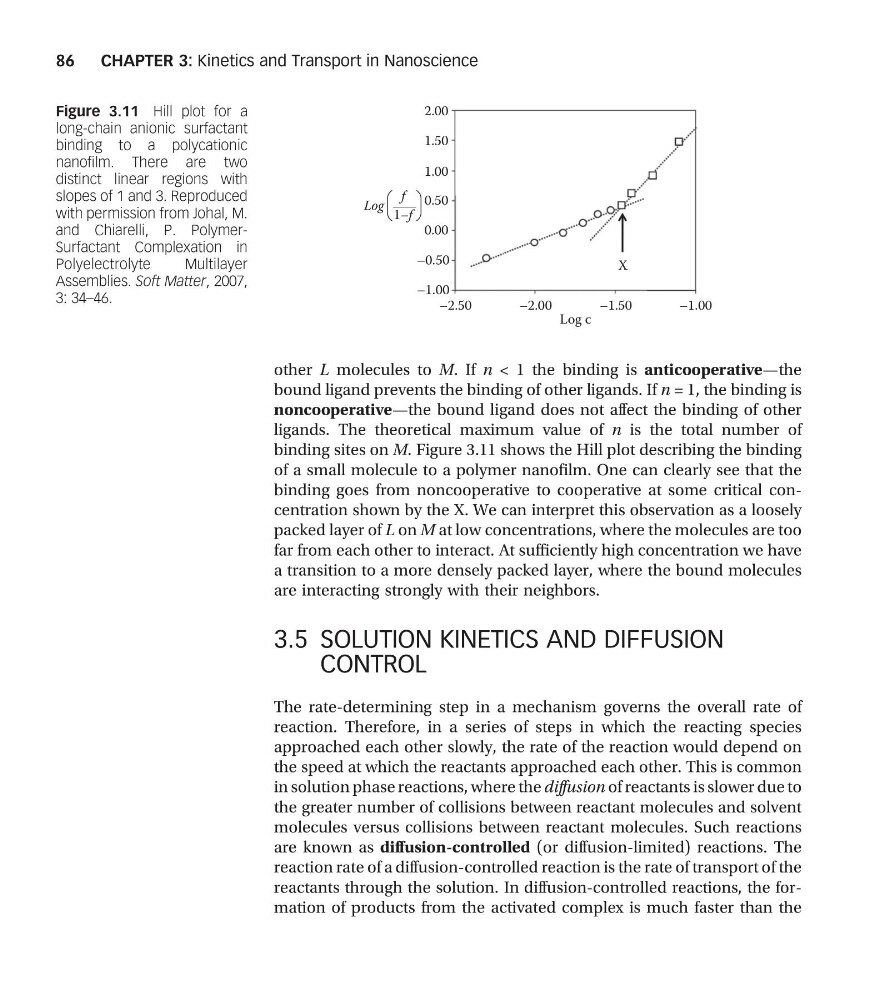
binding sites on M. Figure 3.11 shows the Hill plot describing the binding
of a small molecule to a polymer nanofilm. One can clearly see that the
binding goes from noncooperative to cooperative at some critical concentration shown by the X. We can interpret this observation as a loosely
packed layer of L on M at low concentrations, where the molecules are too
far from each other to interact. At sufficiently high concentration we have
a transition to a more densely packed layer, where the bound molecules
are interacting strongly with their neighbors.
3.5 SOLUTION KINETICS AND DIFFUSION
CONTROL
The rate-determining step in a mechanism governs the overall rate of
reaction. Therefore, in a series of steps in which the reacting species
approached each other slowly, the rate of the reaction would depend on
the speed at which the reactants approached each other. This is common
in solution phase reactions, where the diffusion of reactants is slower due to
the greater number of collisions between reactant molecules and solvent
molecules versus collisions between reactant molecules. Such reactions
are known as diffusion-controlled (or diffusion-limited) reactions. The
reaction rate of a diffusion-controlled reaction is the rate of transport of the
reactants through the solution. In diffusion-controlled reactions, the formation of products from the activated complex is much faster than the
2.00
1.50
1.00
0.50
0.00
–0.50
–1.00
–2.50
–2.00
–1.50
–1.00
X
Log c
Log
f
1–f
Figure 3.11 Hill plot for a
long-chain anionic surfactant
binding to a polycationic
nanofilm. There are two
distinct linear regions with
slopes of 1 and 3. Reproduced
with permission from Johal, M.
and Chiarelli, P. PolymerSurfactant Complexation in
Polyelectrolyte
Multilayer
Assemblies. Soft Matter, 2007,
3: 34–46.
CHAPTER 3: Kinetics and Transport in Nanoscience
86
bound ligand prevents the binding of other ligands. If n = 1, the binding is
noncooperative—the bound ligand does not affect the binding of other
ligands. The theoretical maximum value of n is the total number of
binding sites on M. Figure 3.11 shows the Hill plot describing the binding
of a small molecule to a polymer nanofilm. One can clearly see that the
binding goes from noncooperative to cooperative at some critical concentration shown by the X. We can interpret this observation as a loosely
packed layer of L on M at low concentrations, where the molecules are too
far from each other to interact. At sufficiently high concentration we have
a transition to a more densely packed layer, where the bound molecules
are interacting strongly with their neighbors.
3.5 SOLUTION KINETICS AND DIFFUSION
CONTROL
The rate-determining step in a mechanism governs the overall rate of
reaction. Therefore, in a series of steps in which the reacting species
approached each other slowly, the rate of the reaction would depend on
the speed at which the reactants approached each other. This is common
in solution phase reactions, where the diffusion of reactants is slower due to
the greater number of collisions between reactant molecules and solvent
molecules versus collisions between reactant molecules. Such reactions
are known as diffusion-controlled (or diffusion-limited) reactions. The
reaction rate of a diffusion-controlled reaction is the rate of transport of the
reactants through the solution. In diffusion-controlled reactions, the formation of products from the activated complex is much faster than the
2.00
1.50
1.00
0.50
0.00
–0.50
–1.00
–2.50
–2.00
–1.50
–1.00
X
Log c
Log
f
1–f
Figure 3.11 Hill plot for a
long-chain anionic surfactant
binding to a polycationic
nanofilm. There are two
distinct linear regions with
slopes of 1 and 3. Reproduced
with permission from Johal, M.
and Chiarelli, P. PolymerSurfactant Complexation in
Polyelectrolyte
Multilayer
Assemblies. Soft Matter, 2007,
3: 34–46.
CHAPTER 3: Kinetics and Transport in Nanoscience
86