

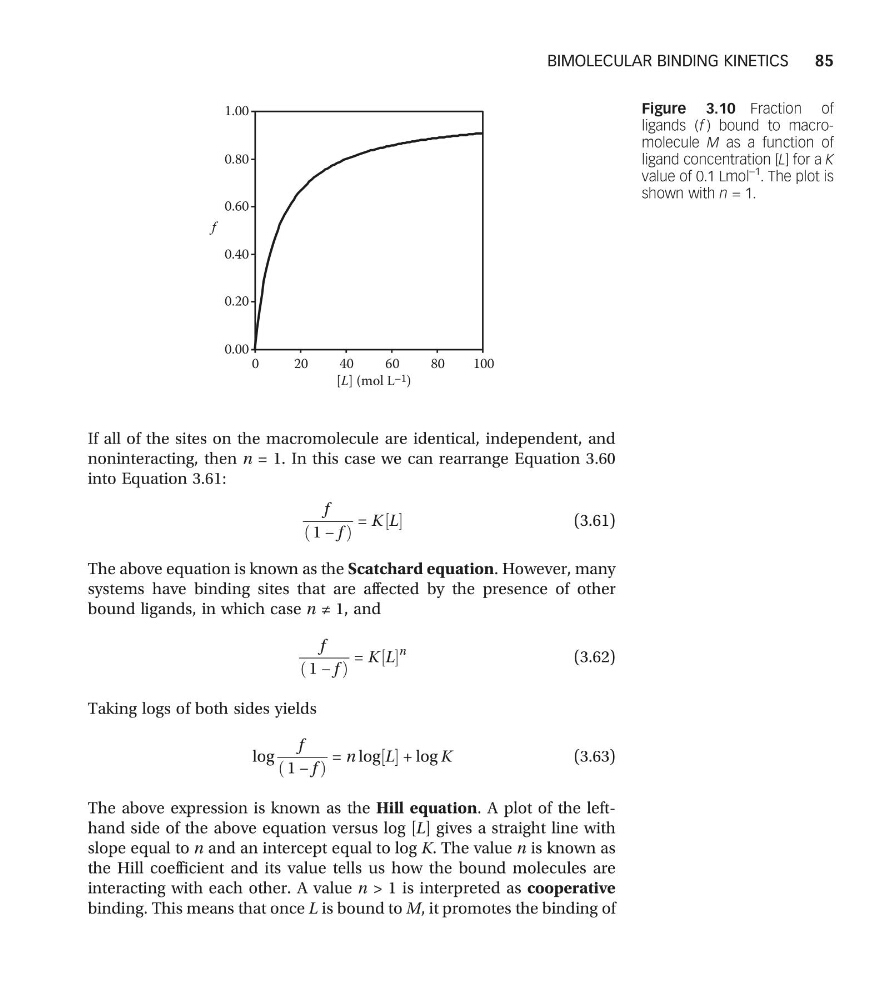
If all of the sites on the macromolecule are identical, independent, and
noninteracting, then n = 1. In this case we can rearrange Equation 3.60
into Equation 3.61:
f
1 − f
ð
Þ
= K L
½
(3.61)
The above equation is known as the Scatchard equation. However, many
systems have binding sites that are affected by the presence of other
bound ligands, in which case n ≠ 1, and
f
1 − f
ð
Þ
= K L
½
n
(3.62)
Taking logs of both sides yields
log
f
1 − f
ð
Þ
= n log L
½ + log K
(3.63)
The above expression is known as the Hill equation. A plot of the lefthand side of the above equation versus log [L] gives a straight line with
slope equal to n and an intercept equal to log K. The value n is known as
the Hill coefficient and its value tells us how the bound molecules are
interacting with each other. A value n > 1 is interpreted as cooperative
binding. This means that once L is bound to M, it promotes the binding of
f
0.40
0.20
0.00
0.80
0.60
1.00
0
20
40
60
80
100
[L] (mol L –1 )
Figure 3.10 Fraction of
ligands ( f ) bound to macromolecule M as a function of
ligand concentration [L] for a K
value of 0.1 Lmol
–1
. The plot is
shown with n = 1.
BIMOLECULAR BINDING KINETICS
85
noninteracting, then n = 1. In this case we can rearrange Equation 3.60
into Equation 3.61:
f
1 − f
ð
Þ
= K L
½
(3.61)
The above equation is known as the Scatchard equation. However, many
systems have binding sites that are affected by the presence of other
bound ligands, in which case n ≠ 1, and
f
1 − f
ð
Þ
= K L
½
n
(3.62)
Taking logs of both sides yields
log
f
1 − f
ð
Þ
= n log L
½ + log K
(3.63)
The above expression is known as the Hill equation. A plot of the lefthand side of the above equation versus log [L] gives a straight line with
slope equal to n and an intercept equal to log K. The value n is known as
the Hill coefficient and its value tells us how the bound molecules are
interacting with each other. A value n > 1 is interpreted as cooperative
binding. This means that once L is bound to M, it promotes the binding of
f
0.40
0.20
0.00
0.80
0.60
1.00
0
20
40
60
80
100
[L] (mol L –1 )
Figure 3.10 Fraction of
ligands ( f ) bound to macromolecule M as a function of
ligand concentration [L] for a K
value of 0.1 Lmol
–1
. The plot is
shown with n = 1.
BIMOLECULAR BINDING KINETICS
85