

protein. In this problem, the latter is immobilized as a thin nanofilm on a
surface and represents B in the analysis.
3.4.2 The Scatchard and Hill equations:
Cooperativity of binding
In nanoscience, we often encounter reactions in which some number n of
small molecules (or ligands, L) reversibly bind to distinct sites of a large
nanoassembly (or macromolecule, M) to form a complex (ML n ). An
important example is the binding of oxygen molecules to hemoglobin.
Equation 3.53 describes the process:
nL + M ⇌ ML n
(3.53)
The equilibrium constant for this process is
K =
ML n
½
L
½
n M
½
(3.54)
Since at any point in time the total concentration of M is [M] + [ML n ]
(mass balance), we can describe the fraction of bound molecules by
Equation 3.55:
f =
ML n
½
M
½ + ML n
½
(3.55)
The above equation can be rearranged as
f =
1
M
½
ML n
½
+ 1
=
1
1
K L
½
n + 1
=
1
1
K L
½
n +
K L
½
n
K L
½
n
=
1
1 + K L
½
n
K L
½
n
=
K L
½
n
1 + K L
½
n (3.56)
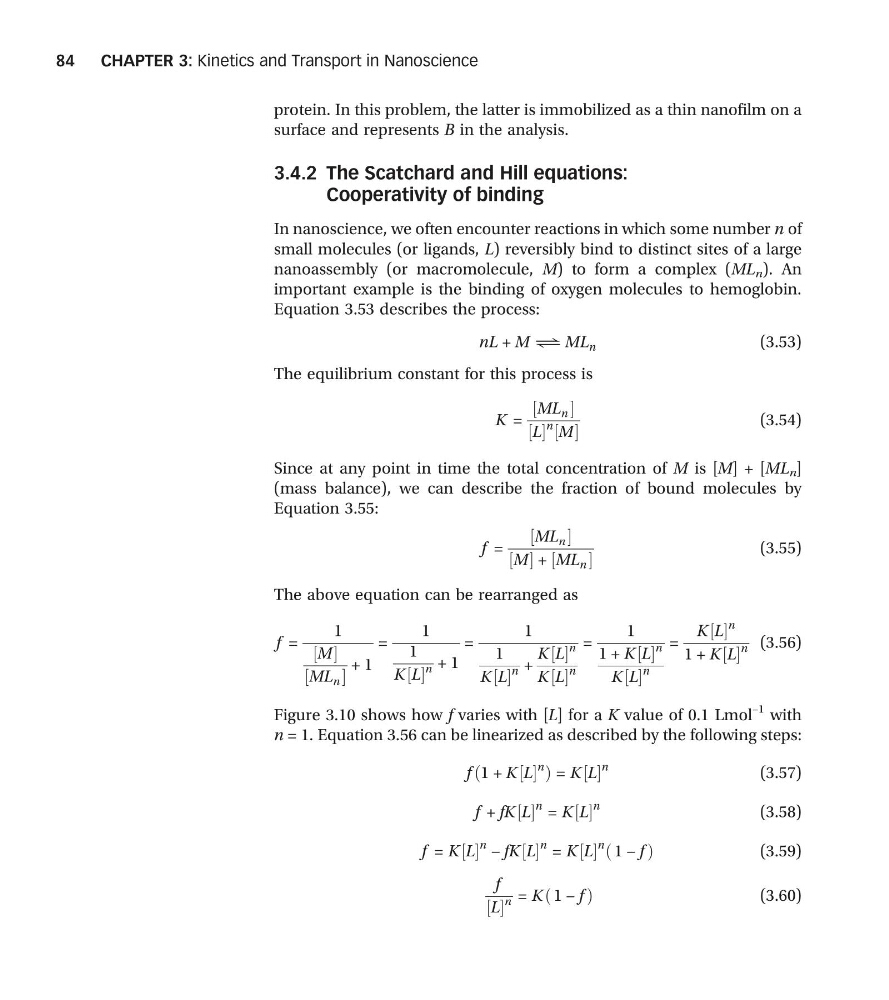
Figure 3.10 shows how f varies with [L] for a K value of 0.1 Lmol
–1 with
n = 1. Equation 3.56 can be linearized as described by the following steps:
f 1 + K L
½
n
ð
Þ= K L
½
n
(3.57)
f + fK L
½
n = K L
½
n
(3.58)
f = K L
½
n
− fK L
½
n = K L
½
n 1 − f
ð
Þ
(3.59)
f
L
½
n = K 1 − f
ð
Þ
(3.60)
CHAPTER 3: Kinetics and Transport in Nanoscience
84
surface and represents B in the analysis.
3.4.2 The Scatchard and Hill equations:
Cooperativity of binding
In nanoscience, we often encounter reactions in which some number n of
small molecules (or ligands, L) reversibly bind to distinct sites of a large
nanoassembly (or macromolecule, M) to form a complex (ML n ). An
important example is the binding of oxygen molecules to hemoglobin.
Equation 3.53 describes the process:
nL + M ⇌ ML n
(3.53)
The equilibrium constant for this process is
K =
ML n
½
L
½
n M
½
(3.54)
Since at any point in time the total concentration of M is [M] + [ML n ]
(mass balance), we can describe the fraction of bound molecules by
Equation 3.55:
f =
ML n
½
M
½ + ML n
½
(3.55)
The above equation can be rearranged as
f =
1
M
½
ML n
½
+ 1
=
1
1
K L
½
n + 1
=
1
1
K L
½
n +
K L
½
n
K L
½
n
=
1
1 + K L
½
n
K L
½
n
=
K L
½
n
1 + K L
½
n (3.56)
Figure 3.10 shows how f varies with [L] for a K value of 0.1 Lmol
–1 with
n = 1. Equation 3.56 can be linearized as described by the following steps:
f 1 + K L
½
n
ð
Þ= K L
½
n
(3.57)
f + fK L
½
n = K L
½
n
(3.58)
f = K L
½
n
− fK L
½
n = K L
½
n 1 − f
ð
Þ
(3.59)
f
L
½
n = K 1 − f
ð
Þ
(3.60)
CHAPTER 3: Kinetics and Transport in Nanoscience
84