

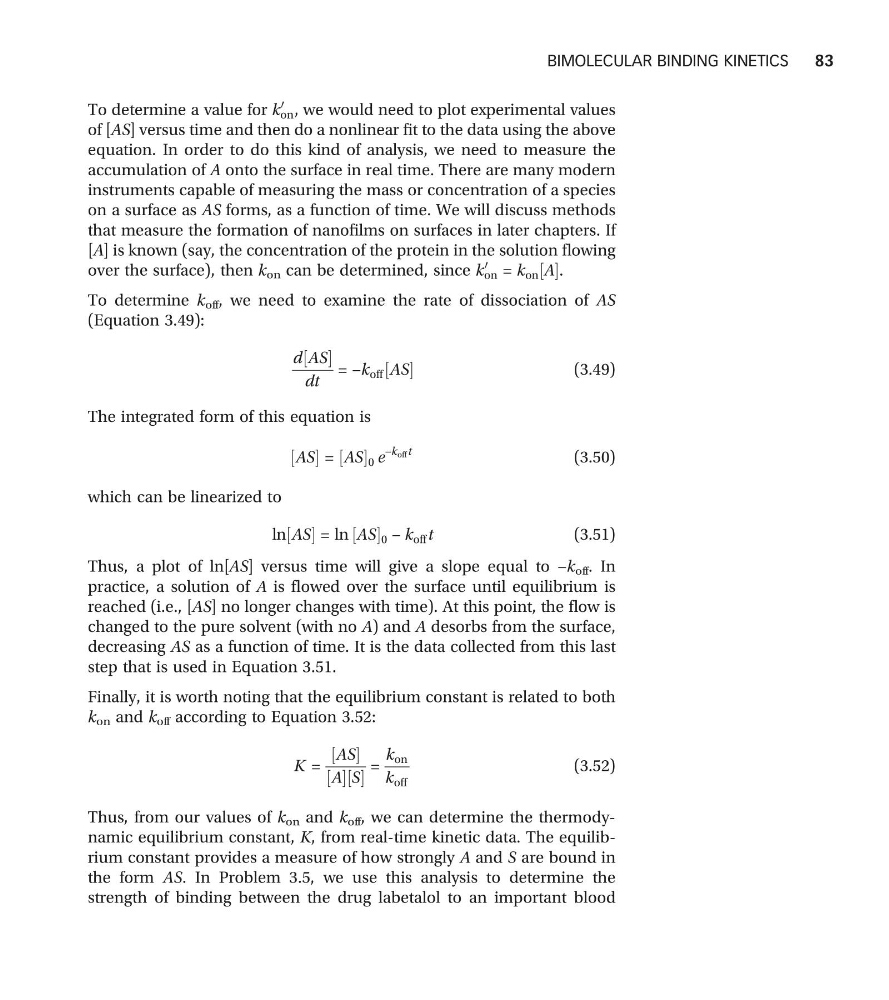
To determine a value for k
0
on , we would need to plot experimental values
of [AS] versus time and then do a nonlinear fit to the data using the above
equation. In order to do this kind of analysis, we need to measure the
accumulation of A onto the surface in real time. There are many modern
instruments capable of measuring the mass or concentration of a species
on a surface as AS forms, as a function of time. We will discuss methods
that measure the formation of nanofilms on surfaces in later chapters. If
[A] is known (say, the concentration of the protein in the solution flowing
over the surface), then k on can be determined, since k
0
on = k on ½A.
To determine k off , we need to examine the rate of dissociation of AS
(Equation 3.49):
d AS
½
dt
= −k off AS
½
(3.49)
The integrated form of this equation is
AS
½ = AS
½ 0 e
−k off t
(3.50)
which can be linearized to
ln AS
½ = ln AS
½ 0 − k off t
(3.51)
Thus, a plot of ln[AS] versus time will give a slope equal to −k off . In
practice, a solution of A is flowed over the surface until equilibrium is
reached (i.e., [AS] no longer changes with time). At this point, the flow is
changed to the pure solvent (with no A) and A desorbs from the surface,
decreasing AS as a function of time. It is the data collected from this last
step that is used in Equation 3.51.
Finally, it is worth noting that the equilibrium constant is related to both
k on and k off according to Equation 3.52:
K =
AS
½
A
½ S
½
=
k on
k off
(3.52)
Thus, from our values of k on and k off , we can determine the thermodynamic equilibrium constant, K, from real-time kinetic data. The equilibrium constant provides a measure of how strongly A and S are bound in
the form AS. In Problem 3.5, we use this analysis to determine the
strength of binding between the drug labetalol to an important blood
BIMOLECULAR BINDING KINETICS
83
0
on , we would need to plot experimental values
of [AS] versus time and then do a nonlinear fit to the data using the above
equation. In order to do this kind of analysis, we need to measure the
accumulation of A onto the surface in real time. There are many modern
instruments capable of measuring the mass or concentration of a species
on a surface as AS forms, as a function of time. We will discuss methods
that measure the formation of nanofilms on surfaces in later chapters. If
[A] is known (say, the concentration of the protein in the solution flowing
over the surface), then k on can be determined, since k
0
on = k on ½A.
To determine k off , we need to examine the rate of dissociation of AS
(Equation 3.49):
d AS
½
dt
= −k off AS
½
(3.49)
The integrated form of this equation is
AS
½ = AS
½ 0 e
−k off t
(3.50)
which can be linearized to
ln AS
½ = ln AS
½ 0 − k off t
(3.51)
Thus, a plot of ln[AS] versus time will give a slope equal to −k off . In
practice, a solution of A is flowed over the surface until equilibrium is
reached (i.e., [AS] no longer changes with time). At this point, the flow is
changed to the pure solvent (with no A) and A desorbs from the surface,
decreasing AS as a function of time. It is the data collected from this last
step that is used in Equation 3.51.
Finally, it is worth noting that the equilibrium constant is related to both
k on and k off according to Equation 3.52:
K =
AS
½
A
½ S
½
=
k on
k off
(3.52)
Thus, from our values of k on and k off , we can determine the thermodynamic equilibrium constant, K, from real-time kinetic data. The equilibrium constant provides a measure of how strongly A and S are bound in
the form AS. In Problem 3.5, we use this analysis to determine the
strength of binding between the drug labetalol to an important blood
BIMOLECULAR BINDING KINETICS
83