

order rate constant. The adsorption process is reversible, so we need to
consider the rate of dissociation of AS back to free A and exposed surface
S. The overall rate of AS formation is the forward rate minus the reverse
rate; that is
d AS
½
dt
= k
0
on S
½ − k off AS
½
(3.42)
The concentration of the available binding sites on the surface, [S], will
decrease exponentially over time (a first-order process) as AB is formed.
Thus
S
½ = S
½ 0 e
−k
0
on t
(3.43)
At any time, the amount of AB is given by the following mass balance
equation:
AS
½ = S
½ 0 − S
½
(3.44)
or
S
½ = S
½ 0 − AS
½
(3.45)
therefore
S
½ 0 − AS
½ = S
½ 0 e
−k
0
on t
(3.46)
or
− AS
½ = S
½ 0 e
−k
0
on t
− S
½ 0
(3.47)
therefore
AS
½ = S
½ 0 1 − e
−k
0
on t
(3.48)
A in
A out
Continuous flow cell
A (aq)
AB
B (substrate)
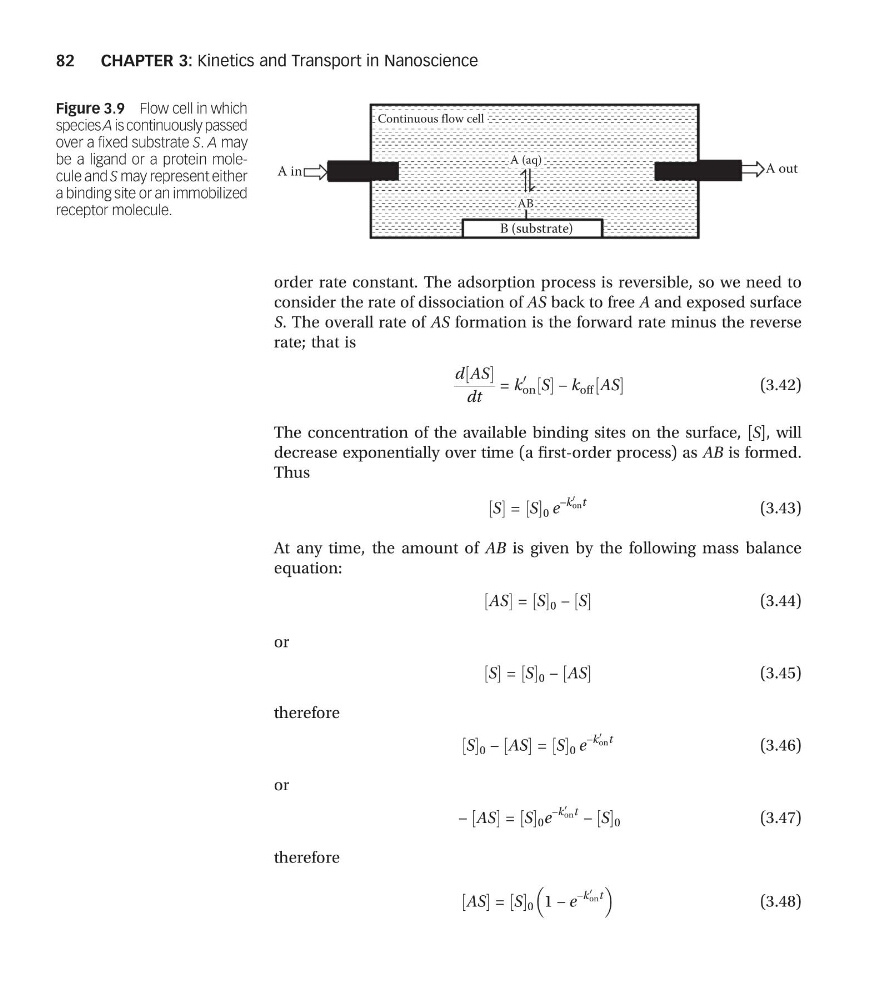
Figure 3.9 Flow cell in which
species A is continuously passed
over a fixed substrate S. A may
be a ligand or a protein molecule and S may represent either
a binding site or an immobilized
receptor molecule.
CHAPTER 3: Kinetics and Transport in Nanoscience
82
consider the rate of dissociation of AS back to free A and exposed surface
S. The overall rate of AS formation is the forward rate minus the reverse
rate; that is
d AS
½
dt
= k
0
on S
½ − k off AS
½
(3.42)
The concentration of the available binding sites on the surface, [S], will
decrease exponentially over time (a first-order process) as AB is formed.
Thus
S
½ = S
½ 0 e
−k
0
on t
(3.43)
At any time, the amount of AB is given by the following mass balance
equation:
AS
½ = S
½ 0 − S
½
(3.44)
or
S
½ = S
½ 0 − AS
½
(3.45)
therefore
S
½ 0 − AS
½ = S
½ 0 e
−k
0
on t
(3.46)
or
− AS
½ = S
½ 0 e
−k
0
on t
− S
½ 0
(3.47)
therefore
AS
½ = S
½ 0 1 − e
−k
0
on t
(3.48)
A in
A out
Continuous flow cell
A (aq)
AB
B (substrate)
Figure 3.9 Flow cell in which
species A is continuously passed
over a fixed substrate S. A may
be a ligand or a protein molecule and S may represent either
a binding site or an immobilized
receptor molecule.
CHAPTER 3: Kinetics and Transport in Nanoscience
82