

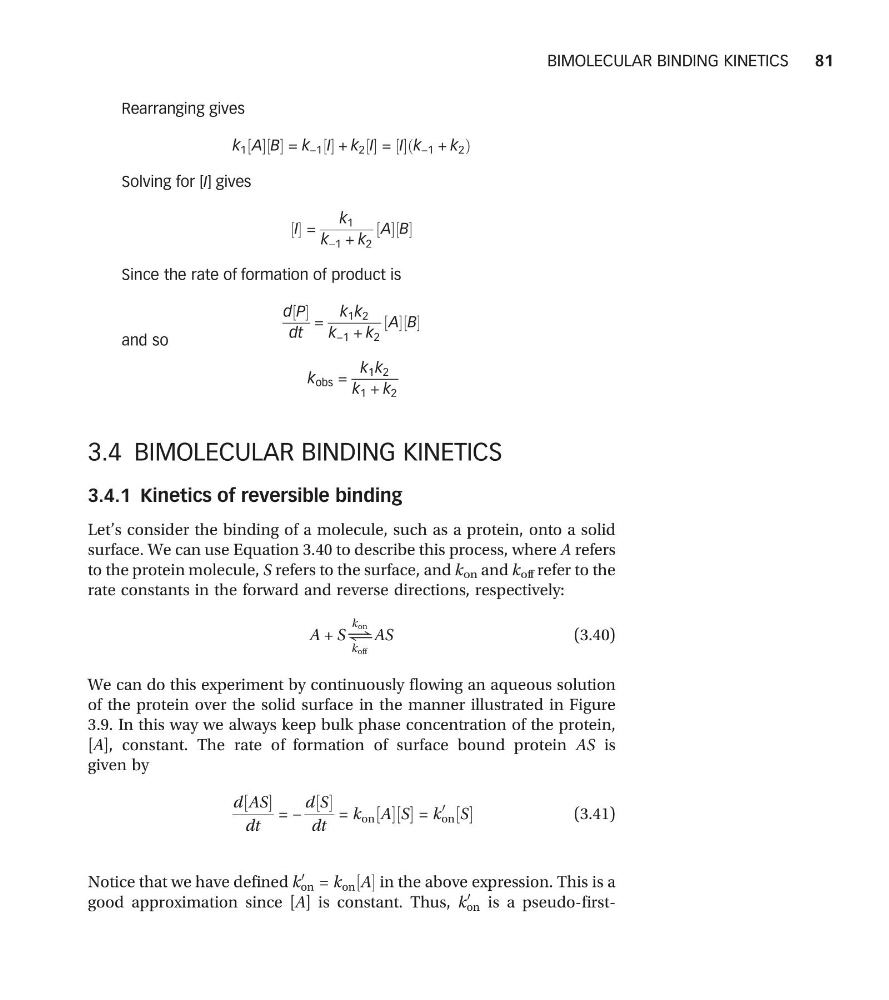
Rearranging gives
k 1 A
½ B
½ = k −1 I
½ + k 2 I
½ = I
½ k −1 + k 2
ð
Þ
Solving for [I] gives
I
½ =
k 1
k −1 + k 2
A
½ B
½
Since the rate of formation of product is
d P
½
dt
=
k 1 k 2
k −1 + k 2
A
½ B
½
and so
k obs =
k 1 k 2
k 1 + k 2
3.4 BIMOLECULAR BINDING KINETICS
3.4.1 Kinetics of reversible binding
Let’s consider the binding of a molecule, such as a protein, onto a solid
surface. We can use Equation 3.40 to describe this process, where A refers
to the protein molecule, S refers to the surface, and k on and k off refer to the
rate constants in the forward and reverse directions, respectively:
A + S⇌
k on
k off
AS
(3.40)
We can do this experiment by continuously flowing an aqueous solution
of the protein over the solid surface in the manner illustrated in Figure
3.9. In this way we always keep bulk phase concentration of the protein,
[A], constant. The rate of formation of surface bound protein AS is
given by
d AS
½
dt
= −
d S
½
dt
= k on A
½ S
½ = k
0
on S
½
(3.41)
Notice that we have defined k
0
on = k on ½A in the above expression. This is a
good approximation since [A] is constant. Thus, k
0
on is a pseudo-firstBIMOLECULAR BINDING KINETICS
81
k 1 A
½ B
½ = k −1 I
½ + k 2 I
½ = I
½ k −1 + k 2
ð
Þ
Solving for [I] gives
I
½ =
k 1
k −1 + k 2
A
½ B
½
Since the rate of formation of product is
d P
½
dt
=
k 1 k 2
k −1 + k 2
A
½ B
½
and so
k obs =
k 1 k 2
k 1 + k 2
3.4 BIMOLECULAR BINDING KINETICS
3.4.1 Kinetics of reversible binding
Let’s consider the binding of a molecule, such as a protein, onto a solid
surface. We can use Equation 3.40 to describe this process, where A refers
to the protein molecule, S refers to the surface, and k on and k off refer to the
rate constants in the forward and reverse directions, respectively:
A + S⇌
k on
k off
AS
(3.40)
We can do this experiment by continuously flowing an aqueous solution
of the protein over the solid surface in the manner illustrated in Figure
3.9. In this way we always keep bulk phase concentration of the protein,
[A], constant. The rate of formation of surface bound protein AS is
given by
d AS
½
dt
= −
d S
½
dt
= k on A
½ S
½ = k
0
on S
½
(3.41)
Notice that we have defined k
0
on = k on ½A in the above expression. This is a
good approximation since [A] is constant. Thus, k
0
on is a pseudo-firstBIMOLECULAR BINDING KINETICS
81