

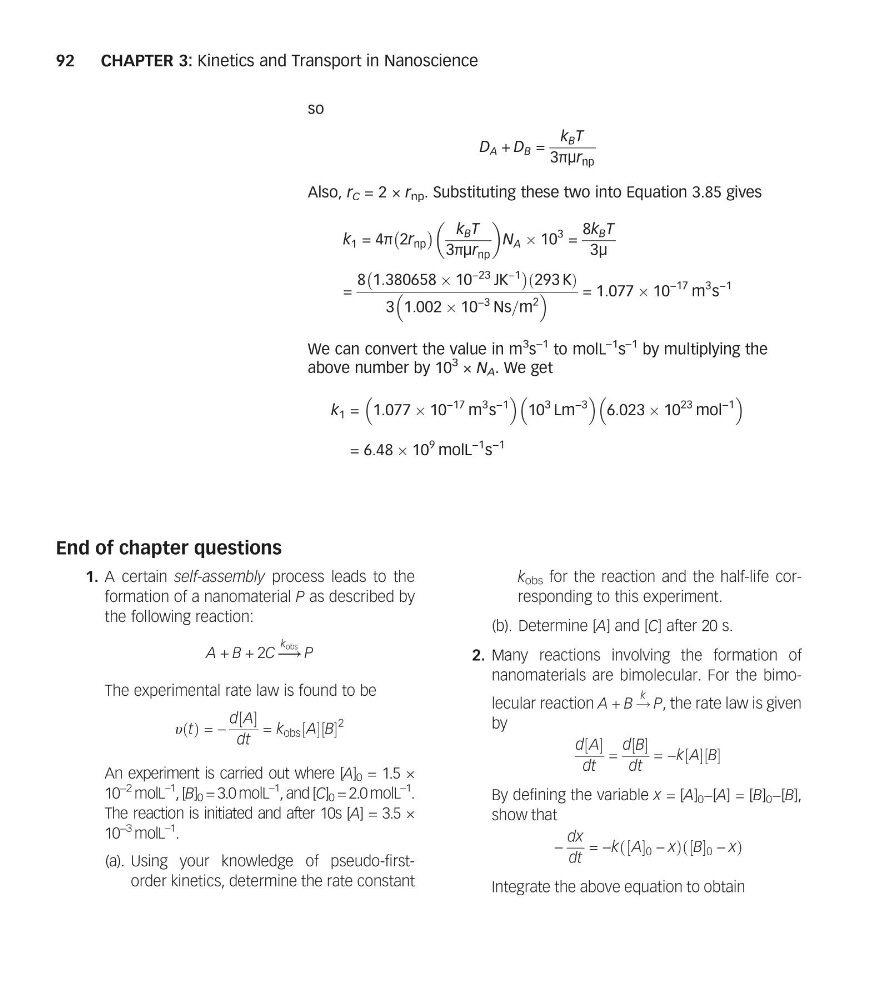
so
D A + D B =
k B T
3πμr np
Also, r C = 2 × r np . Substituting these two into Equation 3.85 gives
k 1 = 4π 2r np
À
Á k B T
3πμr np
N A Â 10
3 =
8k B T
3μ
=
8 1:380658 Â 10
−23 JK
−1
À
Á
293 K
ð
Þ
3 1:002 Â 10
−3 Ns=m
2
= 1:077 Â 10
−17 m
3 s
−1
We can convert the value in m
3
s
–1 to molL
–1
s
–1 by multiplying the
above number by 10
3 × N A . We get
k 1 = 1:077 Â 10
−17 m
3 s
−1
10
3 Lm
−3
6:023 Â 10
23 mol
−1
= 6:48 Â 10
9 molL
−1 s
−1
End of chapter questions
1. A certain self-assembly process leads to the
formation of a nanomaterial P as described by
the following reaction:
A + B + 2C ⟶
k obs P
The experimental rate law is found to be
υ t
ð Þ = −
d A
½
dt
= k obs A
½ B
½
2
An experiment is carried out where [A] 0 = 1.5 ×
10
−2 molL
–1
, [B] 0 = 3.0 molL
–1
, and [C] 0 = 2.0 molL
–1
.
The reaction is initiated and after 10s [A] = 3.5 ×
10
−3 molL
–1
.
(a). Using your knowledge of pseudo-firstorder kinetics, determine the rate constant
k obs for the reaction and the half-life corresponding to this experiment.
(b). Determine [A] and [C] after 20 s.
2. Many reactions involving the formation of
nanomaterials are bimolecular. For the bimolecular reaction A + B !
k P, the rate law is given
by
d A
½
dt
=
d B
½
dt
= −k A
½ B
½
By defining the variable x = [A] 0 −[A] = [B] 0 −[B],
show that
−
dx
dt
= −k A
½ 0 − x
ð
Þ B
½ 0 − x
ð
Þ
Integrate the above equation to obtain
CHAPTER 3: Kinetics and Transport in Nanoscience
92
D A + D B =
k B T
3πμr np
Also, r C = 2 × r np . Substituting these two into Equation 3.85 gives
k 1 = 4π 2r np
À
Á k B T
3πμr np
N A Â 10
3 =
8k B T
3μ
=
8 1:380658 Â 10
−23 JK
−1
À
Á
293 K
ð
Þ
3 1:002 Â 10
−3 Ns=m
2
= 1:077 Â 10
−17 m
3 s
−1
We can convert the value in m
3
s
–1 to molL
–1
s
–1 by multiplying the
above number by 10
3 × N A . We get
k 1 = 1:077 Â 10
−17 m
3 s
−1
10
3 Lm
−3
6:023 Â 10
23 mol
−1
= 6:48 Â 10
9 molL
−1 s
−1
End of chapter questions
1. A certain self-assembly process leads to the
formation of a nanomaterial P as described by
the following reaction:
A + B + 2C ⟶
k obs P
The experimental rate law is found to be
υ t
ð Þ = −
d A
½
dt
= k obs A
½ B
½
2
An experiment is carried out where [A] 0 = 1.5 ×
10
−2 molL
–1
, [B] 0 = 3.0 molL
–1
, and [C] 0 = 2.0 molL
–1
.
The reaction is initiated and after 10s [A] = 3.5 ×
10
−3 molL
–1
.
(a). Using your knowledge of pseudo-firstorder kinetics, determine the rate constant
k obs for the reaction and the half-life corresponding to this experiment.
(b). Determine [A] and [C] after 20 s.
2. Many reactions involving the formation of
nanomaterials are bimolecular. For the bimolecular reaction A + B !
k P, the rate law is given
by
d A
½
dt
=
d B
½
dt
= −k A
½ B
½
By defining the variable x = [A] 0 −[A] = [B] 0 −[B],
show that
−
dx
dt
= −k A
½ 0 − x
ð
Þ B
½ 0 − x
ð
Þ
Integrate the above equation to obtain
CHAPTER 3: Kinetics and Transport in Nanoscience
92