

1 LOW CARBON ENERGY IN THE MIDDLE EAST …
9
compared to gas-fired plants underlines the role of geopolitical considerations—in this case building a relationship with Russia; this represents
foreign policy hedging in the face of an unclear commitment from its
traditional aid benefactor, the US.
The relatively minimal role of low carbon sources in MENA’s power
sector is likely to change substantially in the coming decades. A recent
study projected that in the Middle East excluding Turkey, low carbon
energy’s share in the power mix could rise from 3.6 to 29.4% between
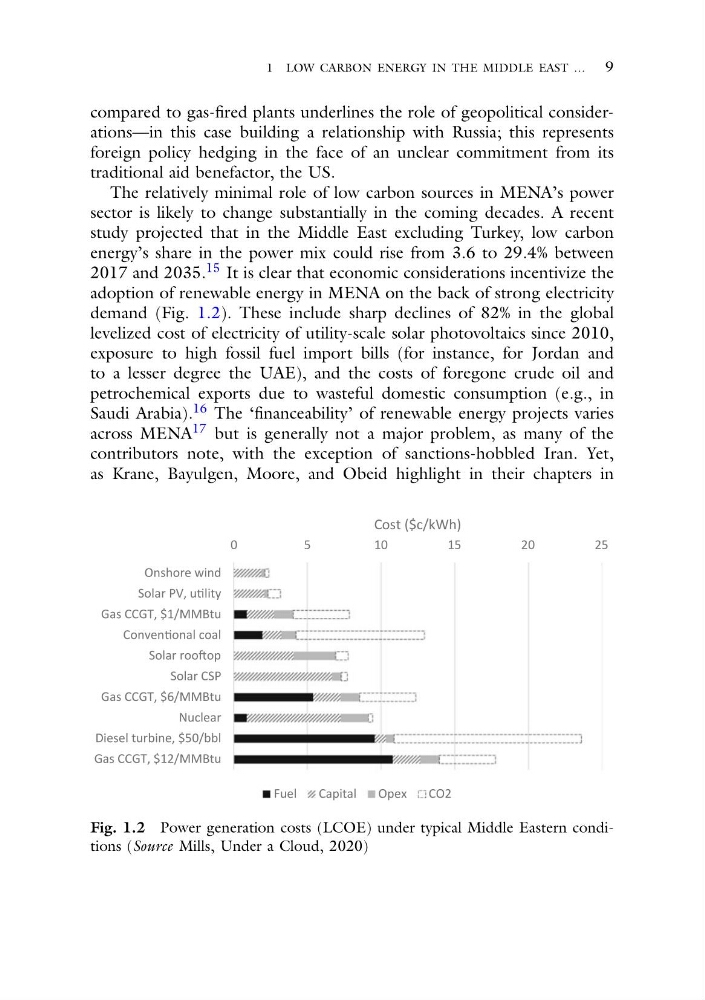
2017 and 2035. 15 It is clear that economic considerations incentivize the
adoption of renewable energy in MENA on the back of strong electricity
demand (Fig. 1.2). These include sharp declines of 82% in the global
levelized cost of electricity of utility-scale solar photovoltaics since 2010,
exposure to high fossil fuel import bills (for instance, for Jordan and
to a lesser degree the UAE), and the costs of foregone crude oil and
petrochemical exports due to wasteful domestic consumption (e.g., in
Saudi Arabia). 16 The ‘financeability’ of renewable energy projects varies
across MENA 17 but is generally not a major problem, as many of the
contributors note, with the exception of sanctions-hobbled Iran. Yet,
as Krane, Bayulgen, Moore, and Obeid highlight in their chapters in
0
5
10
15
20
25
Onshore wind
Solar PV, uƟlity
Gas CCGT, $1/MMBtu
ConvenƟonal coal
Solar rooŌop
Solar CSP
Gas CCGT, $6/MMBtu
Nuclear
Diesel turbine, $50/bbl
Gas CCGT, $12/MMBtu
Cost ($c/kWh)
Fuel
Capital
Opex
CO2
Fig. 1.2 Power generation costs (LCOE) under typical Middle Eastern conditions (Source Mills, Under a Cloud, 2020)
9
compared to gas-fired plants underlines the role of geopolitical considerations—in this case building a relationship with Russia; this represents
foreign policy hedging in the face of an unclear commitment from its
traditional aid benefactor, the US.
The relatively minimal role of low carbon sources in MENA’s power
sector is likely to change substantially in the coming decades. A recent
study projected that in the Middle East excluding Turkey, low carbon
energy’s share in the power mix could rise from 3.6 to 29.4% between
2017 and 2035. 15 It is clear that economic considerations incentivize the
adoption of renewable energy in MENA on the back of strong electricity
demand (Fig. 1.2). These include sharp declines of 82% in the global
levelized cost of electricity of utility-scale solar photovoltaics since 2010,
exposure to high fossil fuel import bills (for instance, for Jordan and
to a lesser degree the UAE), and the costs of foregone crude oil and
petrochemical exports due to wasteful domestic consumption (e.g., in
Saudi Arabia). 16 The ‘financeability’ of renewable energy projects varies
across MENA 17 but is generally not a major problem, as many of the
contributors note, with the exception of sanctions-hobbled Iran. Yet,
as Krane, Bayulgen, Moore, and Obeid highlight in their chapters in
0
5
10
15
20
25
Onshore wind
Solar PV, uƟlity
Gas CCGT, $1/MMBtu
ConvenƟonal coal
Solar rooŌop
Solar CSP
Gas CCGT, $6/MMBtu
Nuclear
Diesel turbine, $50/bbl
Gas CCGT, $12/MMBtu
Cost ($c/kWh)
Fuel
Capital
Opex
CO2
Fig. 1.2 Power generation costs (LCOE) under typical Middle Eastern conditions (Source Mills, Under a Cloud, 2020)