

546 ◾ Fundamental Food Microbiology
suspected to contain a toxin (antigen) in wells of microtitration plates. If the specific toxin is present in the sample, a diffuse pattern will appear in the bottom; in its absence, a ring or button will
appear.
Enzyme-Linked Immunosorbent Assay (ELISA)
ELISA is one of the most common assays used for detection of pathogens such as Salmonella, Lis.
monocytogenes, Esc. coli O157:H7, and Cam. Jejuni, or their toxins. Binding of antigens (pathogens
or toxins) to primary antibody or other ligand molecules, such as receptor proteins, aptamers, etc.,
is quantitatively measured in a 96-well polystyrene plate (microtiter plate) by using a secondary
antibody conjugated to an enzyme. Commonly used enzymes are horseradish peroxidase and
alkaline phosphatase (ALP). Upon addition of substrates, such as o-phenyldiamine and tetramethyl benzidine (both are substrates for peroxidase and p-nitrophenyl-phosphate, a substrate for
ALP), respectively, a positive color reaction is quantified by measuring the color intensity with a
spectrophotometer. The amount of the enzyme present is estimated by the colorimetric determination of catalysis of the substrate and is proportional to the amount of antigen present. Three forms
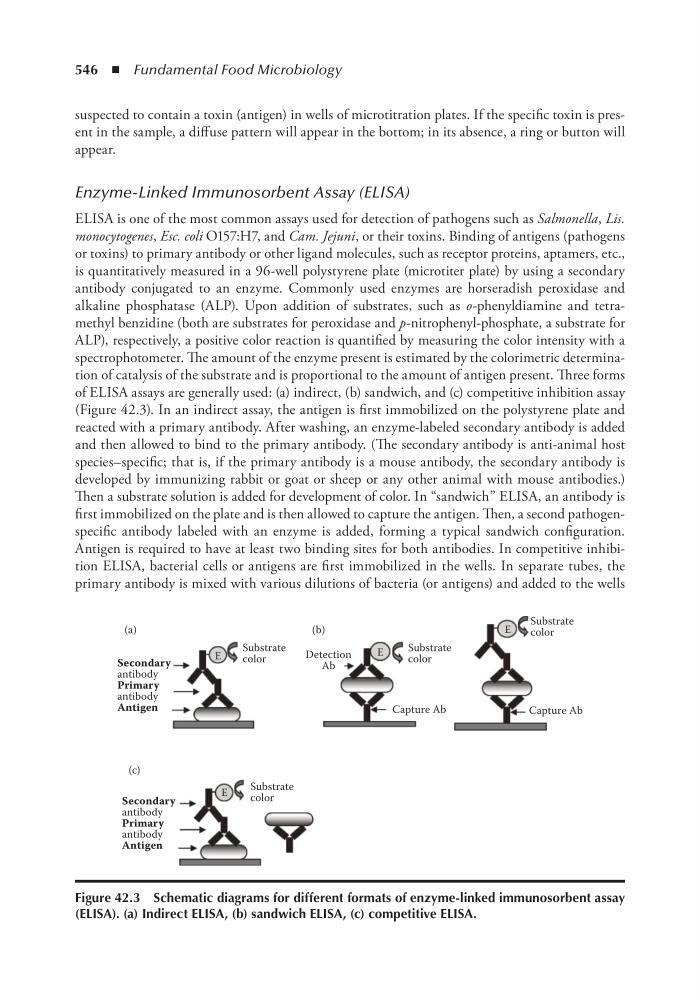
of ELISA assays are generally used: (a) indirect, (b) sandwich, and (c) competitive inhibition assay
(Figure 42.3). In an indirect assay, the antigen is first immobilized on the polystyrene plate and
reacted with a primary antibody. After washing, an enzyme-labeled secondary antibody is added
and then allowed to bind to the primary antibody. (The secondary antibody is anti-animal host
species–specific; that is, if the primary antibody is a mouse antibody, the secondary antibody is
developed by immunizing rabbit or goat or sheep or any other animal with mouse antibodies.)
Then a substrate solution is added for development of color. In “sandwich” ELISA, an antibody is
first immobilized on the plate and is then allowed to capture the antigen. Then, a second pathogenspecific antibody labeled with an enzyme is added, forming a typical sandwich configuration.
Antigen is required to have at least two binding sites for both antibodies. In competitive inhibition ELISA, bacterial cells or antigens are first immobilized in the wells. In separate tubes, the
primary antibody is mixed with various dilutions of bacteria (or antigens) and added to the wells
(a)
(c)
(b)
E
E
E
Substrate
color
Substrate
color
Substrate
color
Substrate
color
Detection
Ab
E
Capture Ab
Capture Ab
Secondary
antibody
Primary
antibody
Antigen
Secondary
antibody
Primary
antibody
Antigen
Figure 42.3 Schematic diagrams for different formats of enzyme-linked immunosorbent assay
(eLiSA). (a) indirect eLiSA, (b) sandwich eLiSA, (c) competitive eLiSA.
suspected to contain a toxin (antigen) in wells of microtitration plates. If the specific toxin is present in the sample, a diffuse pattern will appear in the bottom; in its absence, a ring or button will
appear.
Enzyme-Linked Immunosorbent Assay (ELISA)
ELISA is one of the most common assays used for detection of pathogens such as Salmonella, Lis.
monocytogenes, Esc. coli O157:H7, and Cam. Jejuni, or their toxins. Binding of antigens (pathogens
or toxins) to primary antibody or other ligand molecules, such as receptor proteins, aptamers, etc.,
is quantitatively measured in a 96-well polystyrene plate (microtiter plate) by using a secondary
antibody conjugated to an enzyme. Commonly used enzymes are horseradish peroxidase and
alkaline phosphatase (ALP). Upon addition of substrates, such as o-phenyldiamine and tetramethyl benzidine (both are substrates for peroxidase and p-nitrophenyl-phosphate, a substrate for
ALP), respectively, a positive color reaction is quantified by measuring the color intensity with a
spectrophotometer. The amount of the enzyme present is estimated by the colorimetric determination of catalysis of the substrate and is proportional to the amount of antigen present. Three forms
of ELISA assays are generally used: (a) indirect, (b) sandwich, and (c) competitive inhibition assay
(Figure 42.3). In an indirect assay, the antigen is first immobilized on the polystyrene plate and
reacted with a primary antibody. After washing, an enzyme-labeled secondary antibody is added
and then allowed to bind to the primary antibody. (The secondary antibody is anti-animal host
species–specific; that is, if the primary antibody is a mouse antibody, the secondary antibody is
developed by immunizing rabbit or goat or sheep or any other animal with mouse antibodies.)
Then a substrate solution is added for development of color. In “sandwich” ELISA, an antibody is
first immobilized on the plate and is then allowed to capture the antigen. Then, a second pathogenspecific antibody labeled with an enzyme is added, forming a typical sandwich configuration.
Antigen is required to have at least two binding sites for both antibodies. In competitive inhibition ELISA, bacterial cells or antigens are first immobilized in the wells. In separate tubes, the
primary antibody is mixed with various dilutions of bacteria (or antigens) and added to the wells
(a)
(c)
(b)
E
E
E
Substrate
color
Substrate
color
Substrate
color
Substrate
color
Detection
Ab
E
Capture Ab
Capture Ab
Secondary
antibody
Primary
antibody
Antigen
Secondary
antibody
Primary
antibody
Antigen
Figure 42.3 Schematic diagrams for different formats of enzyme-linked immunosorbent assay
(eLiSA). (a) indirect eLiSA, (b) sandwich eLiSA, (c) competitive eLiSA.