

Bacterial Pathogens, Mycotoxins, Viruses, Parasites, and Fish Toxins ◾ 395
This is particularly important for the mold strains from different genera that are used in food
production.
Growth and Mycotoxin Production
In general, molds grow best in humid and warm environments. They are aerobic and thus need air
for growth. They can grow, though slowly, at very low A W (0.65), low temperatures (refrigerated
temperatures), and low (pH 3.5). These conditions are often used to extend the shelf life of many
foods. Unless other methods (such as vacuum packaging) are used, they can grow in these foods
and, if toxigenic, can produce toxins in the foods. The optimum temperature and water activity
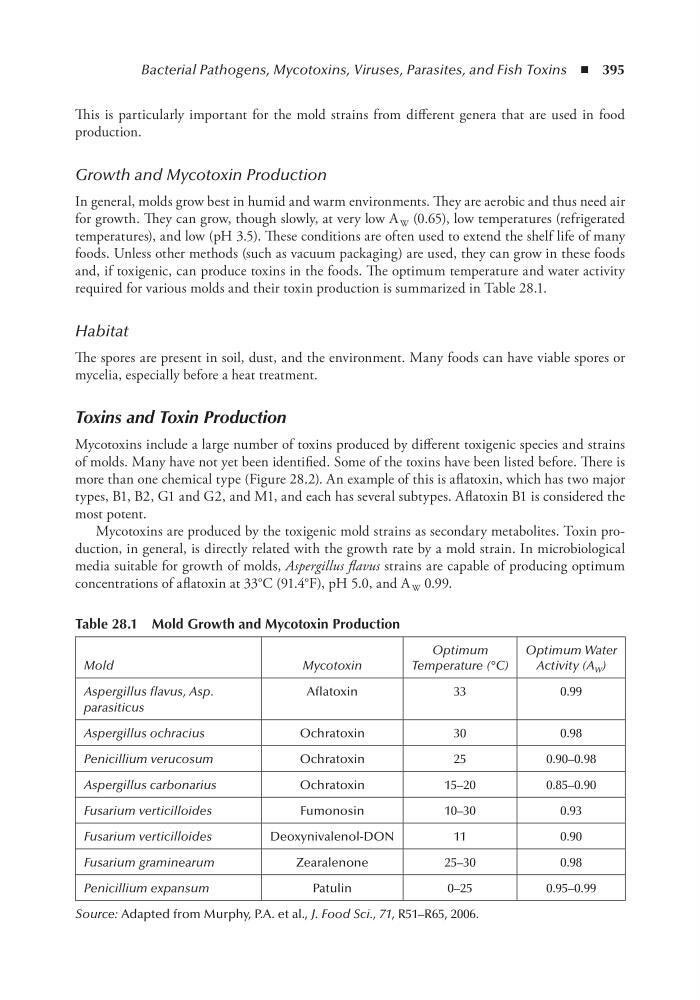
required for various molds and their toxin production is summarized in Table 28.1.
Habitat
The spores are present in soil, dust, and the environment. Many foods can have viable spores or
mycelia, especially before a heat treatment.
Toxins and Toxin Production
Mycotoxins include a large number of toxins produced by different toxigenic species and strains
of molds. Many have not yet been identified. Some of the toxins have been listed before. There is
more than one chemical type (Figure 28.2). An example of this is aflatoxin, which has two major
types, B1, B2, G1 and G2, and M1, and each has several subtypes. Aflatoxin B1 is considered the
most potent.
Mycotoxins are produced by the toxigenic mold strains as secondary metabolites. Toxin production, in general, is directly related with the growth rate by a mold strain. In microbiological
media suitable for growth of molds, Aspergillus flavus strains are capable of producing optimum
concentrations of aflatoxin at 33°C (91.4°F), pH 5.0, and A W 0.99.
table 28.1 Mold Growth and Mycotoxin Production
Mold
Mycotoxin
Optimum
Temperature (°C)
Optimum Water
Activity (A W )
Aspergillus flavus, Asp.
parasiticus
Aflatoxin
33
0.99
Aspergillus ochracius
Ochratoxin
30
0.98
Penicillium verucosum
Ochratoxin
25
0.90–0.98
Aspergillus carbonarius
Ochratoxin
15–20
0.85–0.90
Fusarium verticilloides
Fumonosin
10–30
0.93
Fusarium verticilloides
Deoxynivalenol-DON
11
0.90
Fusarium graminearum
Zearalenone
25–30
0.98
Penicillium expansum
Patulin
0–25
0.95–0.99
Source: Adapted from Murphy, P.A. et al., J. Food Sci., 71, R51–R65, 2006.
This is particularly important for the mold strains from different genera that are used in food
production.
Growth and Mycotoxin Production
In general, molds grow best in humid and warm environments. They are aerobic and thus need air
for growth. They can grow, though slowly, at very low A W (0.65), low temperatures (refrigerated
temperatures), and low (pH 3.5). These conditions are often used to extend the shelf life of many
foods. Unless other methods (such as vacuum packaging) are used, they can grow in these foods
and, if toxigenic, can produce toxins in the foods. The optimum temperature and water activity
required for various molds and their toxin production is summarized in Table 28.1.
Habitat
The spores are present in soil, dust, and the environment. Many foods can have viable spores or
mycelia, especially before a heat treatment.
Toxins and Toxin Production
Mycotoxins include a large number of toxins produced by different toxigenic species and strains
of molds. Many have not yet been identified. Some of the toxins have been listed before. There is
more than one chemical type (Figure 28.2). An example of this is aflatoxin, which has two major
types, B1, B2, G1 and G2, and M1, and each has several subtypes. Aflatoxin B1 is considered the
most potent.
Mycotoxins are produced by the toxigenic mold strains as secondary metabolites. Toxin production, in general, is directly related with the growth rate by a mold strain. In microbiological
media suitable for growth of molds, Aspergillus flavus strains are capable of producing optimum
concentrations of aflatoxin at 33°C (91.4°F), pH 5.0, and A W 0.99.
table 28.1 Mold Growth and Mycotoxin Production
Mold
Mycotoxin
Optimum
Temperature (°C)
Optimum Water
Activity (A W )
Aspergillus flavus, Asp.
parasiticus
Aflatoxin
33
0.99
Aspergillus ochracius
Ochratoxin
30
0.98
Penicillium verucosum
Ochratoxin
25
0.90–0.98
Aspergillus carbonarius
Ochratoxin
15–20
0.85–0.90
Fusarium verticilloides
Fumonosin
10–30
0.93
Fusarium verticilloides
Deoxynivalenol-DON
11
0.90
Fusarium graminearum
Zearalenone
25–30
0.98
Penicillium expansum
Patulin
0–25
0.95–0.99
Source: Adapted from Murphy, P.A. et al., J. Food Sci., 71, R51–R65, 2006.