

394 ◾ Fundamental Food Microbiology
in humans has not been recorded in recent years in many countries, at least in the developed
countries. This is because their presence in many foods are critically regulated and evaluated.
Incidences of mycotoxicosis have been recorded in some developing countries in recent years.
Some of the well-known mycotoxicosis incidences in humans in the past include ergotism from
the consumption of bread made from rye infected with Claviceps purpurea in Europe between the
14th and 16th centuries, yellow rice disease from the consumption of rice infested with toxigenic
strains of several Penicillium species in Japan during the 17th century, and alimentary toxic aleukia from the ingestion of grains infested with toxigenic strains of Fusarium species in Russia in the
early 20th century. In recent years, several incidences were reported in animals and birds, which
include the death of thousands of turkeys from liver necrosis in the 1960s in England following
feeding peanut meal in which Aspergillus flavus grew and produced the toxin aflatoxin.
Characteristics
Organisms
Toxigenic species and strains of molds from many genera are known to produce mycotoxins.
Some of the toxigenic strains from several species and genera and the toxins they produce include
Asp. flavus and Asp. parasiticus, which both produce aflatoxins; Asp. nidulans and Asp. virsicolor
produce sterigmatocystin; Fusarium verticilioides produces fumonisin; Fus. graminearum produces
deoxynivalenol-DON; Fusarium spp. produces Zearalenone; Penicillium viridicatum produces
ochratoxin; Pen. patulum produces patulin; Pen. roqueforti produces roquefortin; and Claviceps
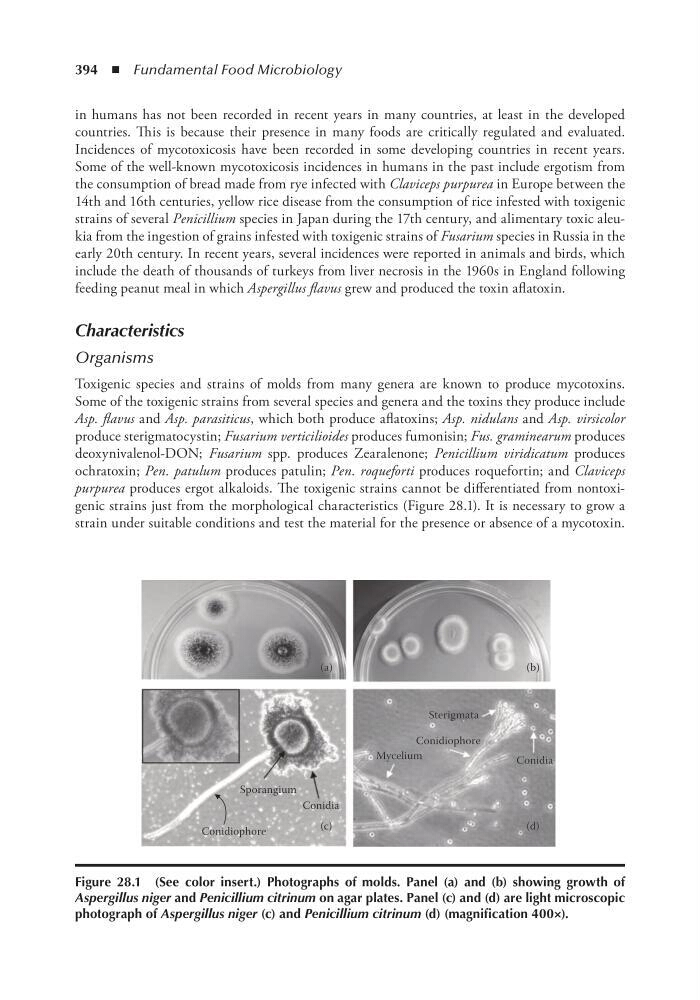
purpurea produces ergot alkaloids. The toxigenic strains cannot be differentiated from nontoxigenic strains just from the morphological characteristics (Figure 28.1). It is necessary to grow a
strain under suitable conditions and test the material for the presence or absence of a mycotoxin.
(a)
(b)
(c)
(d)
Sporangium
Conidiophore
Conidia
Conidia
Mycelium
Sterigmata
Conidiophore
Figure 28.1 (See color insert.) Photographs of molds. Panel (a) and (b) showing growth of
Aspergillus niger and Penicillium citrinum on agar plates. Panel (c) and (d) are light microscopic
photograph of Aspergillus niger (c) and Penicillium citrinum (d) (magnification 400×).
in humans has not been recorded in recent years in many countries, at least in the developed
countries. This is because their presence in many foods are critically regulated and evaluated.
Incidences of mycotoxicosis have been recorded in some developing countries in recent years.
Some of the well-known mycotoxicosis incidences in humans in the past include ergotism from
the consumption of bread made from rye infected with Claviceps purpurea in Europe between the
14th and 16th centuries, yellow rice disease from the consumption of rice infested with toxigenic
strains of several Penicillium species in Japan during the 17th century, and alimentary toxic aleukia from the ingestion of grains infested with toxigenic strains of Fusarium species in Russia in the
early 20th century. In recent years, several incidences were reported in animals and birds, which
include the death of thousands of turkeys from liver necrosis in the 1960s in England following
feeding peanut meal in which Aspergillus flavus grew and produced the toxin aflatoxin.
Characteristics
Organisms
Toxigenic species and strains of molds from many genera are known to produce mycotoxins.
Some of the toxigenic strains from several species and genera and the toxins they produce include
Asp. flavus and Asp. parasiticus, which both produce aflatoxins; Asp. nidulans and Asp. virsicolor
produce sterigmatocystin; Fusarium verticilioides produces fumonisin; Fus. graminearum produces
deoxynivalenol-DON; Fusarium spp. produces Zearalenone; Penicillium viridicatum produces
ochratoxin; Pen. patulum produces patulin; Pen. roqueforti produces roquefortin; and Claviceps
purpurea produces ergot alkaloids. The toxigenic strains cannot be differentiated from nontoxigenic strains just from the morphological characteristics (Figure 28.1). It is necessary to grow a
strain under suitable conditions and test the material for the presence or absence of a mycotoxin.
(a)
(b)
(c)
(d)
Sporangium
Conidiophore
Conidia
Conidia
Mycelium
Sterigmata
Conidiophore
Figure 28.1 (See color insert.) Photographs of molds. Panel (a) and (b) showing growth of
Aspergillus niger and Penicillium citrinum on agar plates. Panel (c) and (d) are light microscopic
photograph of Aspergillus niger (c) and Penicillium citrinum (d) (magnification 400×).