

Important Facts in Foodborne Diseases ◾ 307
be of food origin, report the incidence to the appropriate federal agencies, which then conduct an
epidemiological investigation. The investigation at the state and federal levels involves examination of the suspected food(s), environmental samples and materials obtained from the patient(s) for
pathogens, microbial and nonmicrobial toxins, and chemicals. Results of these tests provide direct
evidence of the association of an agent (e.g., pathogen, toxin, parasite, chemicals) with the disease.
In addition to testing suspected samples, both the sick and other people who consumed the same
food from the same source are interviewed to establish an indirect association to the most likely
food(s) with the disease. This information is collected, recorded, and reported by the CDC based
in Atlanta, Georgia (see the section on current trends).
Foodborne Disease Outbreak
In the United States, the federal regulatory agencies define a foodborne disease as an outbreak in
which two or more people become sick with a similar illness (symptoms) from the consumption
of the same food(s) from the same source, and the epidemiological investigations implicate, either
directly or indirectly, the same food(s) from the same source as the cause of the illness. However,
in the case of botulism, because of its high fatality rate, even when only one person has the illness,
it is considered an outbreak. For chemical poisoning, a single case is also considered an outbreak.
Incidence of Foodborne Disease Outbreak
The incidence of foodborne illnesses in most of the developed countries is lower than in many
developing countries. The major reasons for the low incidence are the implementation of necessary
regulations in the production and handling of foods, good sanitary and hygienic practices, and
the availability of necessary facilities to reduce abuse. In the United States from 2007 to 2010, an
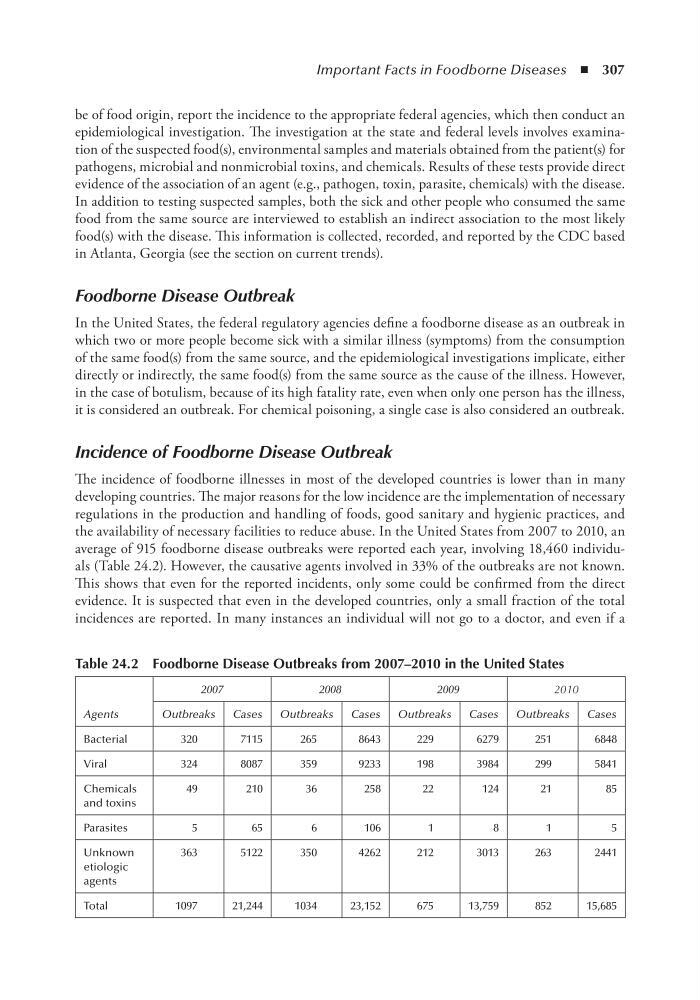
average of 915 foodborne disease outbreaks were reported each year, involving 18,460 individuals (Table 24.2). However, the causative agents involved in 33% of the outbreaks are not known.
This shows that even for the reported incidents, only some could be confirmed from the direct
evidence. It is suspected that even in the developed countries, only a small fraction of the total
incidences are reported. In many instances an individual will not go to a doctor, and even if a
table 24.2 Foodborne Disease outbreaks from 2007–2010 in the United States
Agents
2007
2008
2009
2010
Outbreaks
Cases
Outbreaks
Cases
Outbreaks
Cases
Outbreaks
Cases
Bacterial
320
7115
265
8643
229
6279
251
6848
Viral
324
8087
359
9233
198
3984
299
5841
Chemicals
and toxins
49
210
36
258
22
124
21
85
Parasites
5
65
6
106
1
8
1
5
Unknown
etiologic
agents
363
5122
350
4262
212
3013
263
2441
Total
1097
21,244
1034
23,152
675
13,759
852
15,685
be of food origin, report the incidence to the appropriate federal agencies, which then conduct an
epidemiological investigation. The investigation at the state and federal levels involves examination of the suspected food(s), environmental samples and materials obtained from the patient(s) for
pathogens, microbial and nonmicrobial toxins, and chemicals. Results of these tests provide direct
evidence of the association of an agent (e.g., pathogen, toxin, parasite, chemicals) with the disease.
In addition to testing suspected samples, both the sick and other people who consumed the same
food from the same source are interviewed to establish an indirect association to the most likely
food(s) with the disease. This information is collected, recorded, and reported by the CDC based
in Atlanta, Georgia (see the section on current trends).
Foodborne Disease Outbreak
In the United States, the federal regulatory agencies define a foodborne disease as an outbreak in
which two or more people become sick with a similar illness (symptoms) from the consumption
of the same food(s) from the same source, and the epidemiological investigations implicate, either
directly or indirectly, the same food(s) from the same source as the cause of the illness. However,
in the case of botulism, because of its high fatality rate, even when only one person has the illness,
it is considered an outbreak. For chemical poisoning, a single case is also considered an outbreak.
Incidence of Foodborne Disease Outbreak
The incidence of foodborne illnesses in most of the developed countries is lower than in many
developing countries. The major reasons for the low incidence are the implementation of necessary
regulations in the production and handling of foods, good sanitary and hygienic practices, and
the availability of necessary facilities to reduce abuse. In the United States from 2007 to 2010, an
average of 915 foodborne disease outbreaks were reported each year, involving 18,460 individuals (Table 24.2). However, the causative agents involved in 33% of the outbreaks are not known.
This shows that even for the reported incidents, only some could be confirmed from the direct
evidence. It is suspected that even in the developed countries, only a small fraction of the total
incidences are reported. In many instances an individual will not go to a doctor, and even if a
table 24.2 Foodborne Disease outbreaks from 2007–2010 in the United States
Agents
2007
2008
2009
2010
Outbreaks
Cases
Outbreaks
Cases
Outbreaks
Cases
Outbreaks
Cases
Bacterial
320
7115
265
8643
229
6279
251
6848
Viral
324
8087
359
9233
198
3984
299
5841
Chemicals
and toxins
49
210
36
258
22
124
21
85
Parasites
5
65
6
106
1
8
1
5
Unknown
etiologic
agents
363
5122
350
4262
212
3013
263
2441
Total
1097
21,244
1034
23,152
675
13,759
852
15,685