

308 ◾ Fundamental Food Microbiology
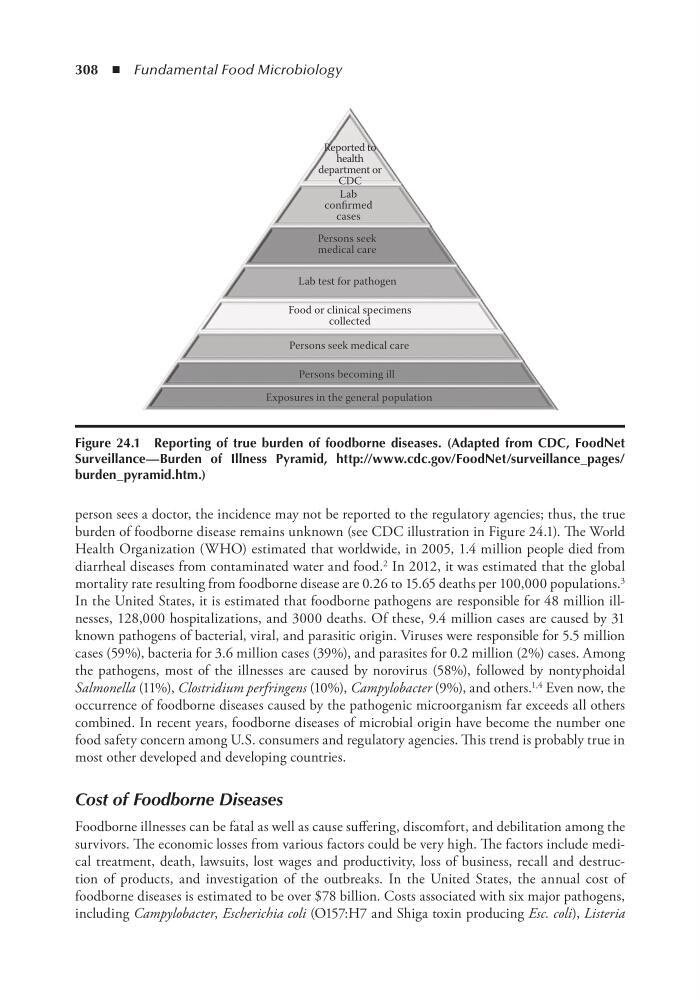
person sees a doctor, the incidence may not be reported to the regulatory agencies; thus, the true
burden of foodborne disease remains unknown (see CDC illustration in Figure 24.1). The World
Health Organization (WHO) estimated that worldwide, in 2005, 1.4 million people died from
diarrheal diseases from contaminated water and food. 2 In 2012, it was estimated that the global
mortality rate resulting from foodborne disease are 0.26 to 15.65 deaths per 100,000 populations. 3
In the United States, it is estimated that foodborne pathogens are responsible for 48 million illnesses, 128,000 hospitalizations, and 3000 deaths. Of these, 9.4 million cases are caused by 31
known pathogens of bacterial, viral, and parasitic origin. Viruses were responsible for 5.5 million
cases (59%), bacteria for 3.6 million cases (39%), and parasites for 0.2 million (2%) cases. Among
the pathogens, most of the illnesses are caused by norovirus (58%), followed by nontyphoidal
Salmonella (11%), Clostridium perfringens (10%), Campylobacter (9%), and others. 1,4 Even now, the
occurrence of foodborne diseases caused by the pathogenic microorganism far exceeds all others
combined. In recent years, foodborne diseases of microbial origin have become the number one
food safety concern among U.S. consumers and regulatory agencies. This trend is probably true in
most other developed and developing countries.
Cost of Foodborne Diseases
Foodborne illnesses can be fatal as well as cause suffering, discomfort, and debilitation among the
survivors. The economic losses from various factors could be very high. The factors include medical treatment, death, lawsuits, lost wages and productivity, loss of business, recall and destruction of products, and investigation of the outbreaks. In the United States, the annual cost of
foodborne diseases is estimated to be over $78 billion. Costs associated with six major pathogens,
including Campylobacter, Escherichia coli (O157:H7 and Shiga toxin producing Esc. coli), Listeria
Reported to
health
department or
CDC
Lab
confirmed
cases
Persons seek
medical care
Lab test for pathogen
Food or clinical specimens
collected
Persons seek medical care
Persons becoming ill
Exposures in the general population
Figure 24.1 Reporting of true burden of foodborne diseases. (Adapted from CDC, Foodnet
Surveillance—Burden of illness Pyramid, http://www.cdc.gov/Foodnet/surveillance_pages/
burden_pyramid.htm.)
person sees a doctor, the incidence may not be reported to the regulatory agencies; thus, the true
burden of foodborne disease remains unknown (see CDC illustration in Figure 24.1). The World
Health Organization (WHO) estimated that worldwide, in 2005, 1.4 million people died from
diarrheal diseases from contaminated water and food. 2 In 2012, it was estimated that the global
mortality rate resulting from foodborne disease are 0.26 to 15.65 deaths per 100,000 populations. 3
In the United States, it is estimated that foodborne pathogens are responsible for 48 million illnesses, 128,000 hospitalizations, and 3000 deaths. Of these, 9.4 million cases are caused by 31
known pathogens of bacterial, viral, and parasitic origin. Viruses were responsible for 5.5 million
cases (59%), bacteria for 3.6 million cases (39%), and parasites for 0.2 million (2%) cases. Among
the pathogens, most of the illnesses are caused by norovirus (58%), followed by nontyphoidal
Salmonella (11%), Clostridium perfringens (10%), Campylobacter (9%), and others. 1,4 Even now, the
occurrence of foodborne diseases caused by the pathogenic microorganism far exceeds all others
combined. In recent years, foodborne diseases of microbial origin have become the number one
food safety concern among U.S. consumers and regulatory agencies. This trend is probably true in
most other developed and developing countries.
Cost of Foodborne Diseases
Foodborne illnesses can be fatal as well as cause suffering, discomfort, and debilitation among the
survivors. The economic losses from various factors could be very high. The factors include medical treatment, death, lawsuits, lost wages and productivity, loss of business, recall and destruction of products, and investigation of the outbreaks. In the United States, the annual cost of
foodborne diseases is estimated to be over $78 billion. Costs associated with six major pathogens,
including Campylobacter, Escherichia coli (O157:H7 and Shiga toxin producing Esc. coli), Listeria
Reported to
health
department or
CDC
Lab
confirmed
cases
Persons seek
medical care
Lab test for pathogen
Food or clinical specimens
collected
Persons seek medical care
Persons becoming ill
Exposures in the general population
Figure 24.1 Reporting of true burden of foodborne diseases. (Adapted from CDC, Foodnet
Surveillance—Burden of illness Pyramid, http://www.cdc.gov/Foodnet/surveillance_pages/
burden_pyramid.htm.)