

Biochemistry of Some Beneficial Traits ◾ 135
when a pentose is present in the environment. Although Ped. pentosaceus, Ped. acidilactici, and
Lac. lactis can metabolize some pentoses, the pathways are not clearly known. 2,6
The metabolizable pentoses by the Leuconostoc and Lactobacillus (Group II and Group III)
are first converted to xylulose-5-phosphate in several different ways. Xylulose-5-phosphate is then
metabolized to produce lactate and acetate or ethanol by the mechanisms described in the nonoxidizing portion of metabolism of hexoses by heterofermentative lactic acid bacteria (Figure 12.4).
No CO 2 is produced from the metabolism of pentoses through this pathway.
Hexose Fermentation by Bifidobacterium
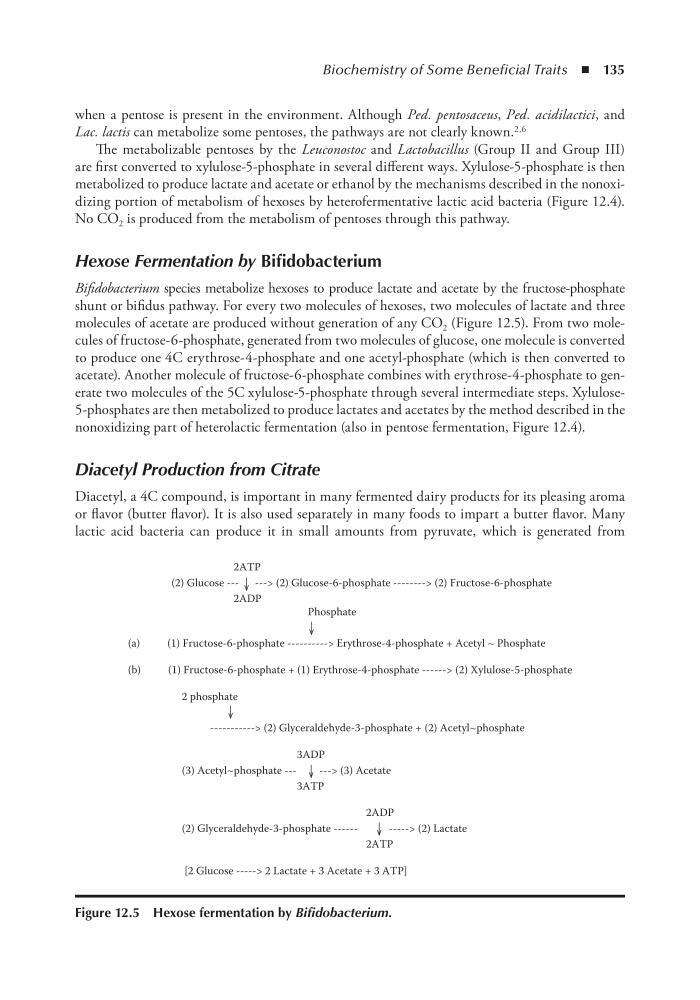
Bifidobacterium species metabolize hexoses to produce lactate and acetate by the fructose-phosphate
shunt or bifidus pathway. For every two molecules of hexoses, two molecules of lactate and three
molecules of acetate are produced without generation of any CO 2 (Figure 12.5). From two molecules of fructose-6-phosphate, generated from two molecules of glucose, one molecule is converted
to produce one 4C erythrose-4-phosphate and one acetyl-phosphate (which is then converted to
acetate). Another molecule of fructose-6-phosphate combines with erythrose-4-phosphate to generate two molecules of the 5C xylulose-5-phosphate through several intermediate steps. Xylulose5-phosphates are then metabolized to produce lactates and acetates by the method described in the
nonoxidizing part of heterolactic fermentation (also in pentose fermentation, Figure 12.4).
Diacetyl Production from Citrate
Diacetyl, a 4C compound, is important in many fermented dairy products for its pleasing aroma
or flavor (butter flavor). It is also used separately in many foods to impart a butter flavor. Many
lactic acid bacteria can produce it in small amounts from pyruvate, which is generated from
2ATP
(2) Glucose --- ---> (2) Glucose-6-phosphate --------> (2) Fructose-6-phosphate
2ADP
Phosphate
(a)
(1) Fructose-6-phosphate ----------> Erythrose-4-phosphate + Acetyl ~ Phosphate
(b)
(1) Fructose-6-phosphate + (1) Erythrose-4-phosphate ------> (2) Xylulose-5-phosphate
2 phosphate
-----------> (2) Glyceraldehyde-3-phosphate + (2) Acetyl~phosphate
3ADP
(3) Acetyl~phosphate -----> (3) Acetate
3ATP
2ADP
(2) Glyceraldehyde-3-phosphate ----------> (2) Lactate
2ATP
[2 Glucose -----> 2 Lactate + 3 Acetate + 3 ATP]
Figure 12.5 Hexose fermentation by Bifidobacterium.
when a pentose is present in the environment. Although Ped. pentosaceus, Ped. acidilactici, and
Lac. lactis can metabolize some pentoses, the pathways are not clearly known. 2,6
The metabolizable pentoses by the Leuconostoc and Lactobacillus (Group II and Group III)
are first converted to xylulose-5-phosphate in several different ways. Xylulose-5-phosphate is then
metabolized to produce lactate and acetate or ethanol by the mechanisms described in the nonoxidizing portion of metabolism of hexoses by heterofermentative lactic acid bacteria (Figure 12.4).
No CO 2 is produced from the metabolism of pentoses through this pathway.
Hexose Fermentation by Bifidobacterium
Bifidobacterium species metabolize hexoses to produce lactate and acetate by the fructose-phosphate
shunt or bifidus pathway. For every two molecules of hexoses, two molecules of lactate and three
molecules of acetate are produced without generation of any CO 2 (Figure 12.5). From two molecules of fructose-6-phosphate, generated from two molecules of glucose, one molecule is converted
to produce one 4C erythrose-4-phosphate and one acetyl-phosphate (which is then converted to
acetate). Another molecule of fructose-6-phosphate combines with erythrose-4-phosphate to generate two molecules of the 5C xylulose-5-phosphate through several intermediate steps. Xylulose5-phosphates are then metabolized to produce lactates and acetates by the method described in the
nonoxidizing part of heterolactic fermentation (also in pentose fermentation, Figure 12.4).
Diacetyl Production from Citrate
Diacetyl, a 4C compound, is important in many fermented dairy products for its pleasing aroma
or flavor (butter flavor). It is also used separately in many foods to impart a butter flavor. Many
lactic acid bacteria can produce it in small amounts from pyruvate, which is generated from
2ATP
(2) Glucose --- ---> (2) Glucose-6-phosphate --------> (2) Fructose-6-phosphate
2ADP
Phosphate
(a)
(1) Fructose-6-phosphate ----------> Erythrose-4-phosphate + Acetyl ~ Phosphate
(b)
(1) Fructose-6-phosphate + (1) Erythrose-4-phosphate ------> (2) Xylulose-5-phosphate
2 phosphate
-----------> (2) Glyceraldehyde-3-phosphate + (2) Acetyl~phosphate
3ADP
(3) Acetyl~phosphate -----> (3) Acetate
3ATP
2ADP
(2) Glyceraldehyde-3-phosphate ----------> (2) Lactate
2ATP
[2 Glucose -----> 2 Lactate + 3 Acetate + 3 ATP]
Figure 12.5 Hexose fermentation by Bifidobacterium.